
In the 1991 movie Hum, 'Jumma Chumma' was a song where Amitabh Bachchan's character harasses Jumma aka Jumalina Gonsalves, played by Kimi Katkar, into giving him a kiss, even as she is sprayed with beer by an army of dock workers. This multistarrer, directed by the late Mukul S Anand, came at the tail-end of Bachchan's first brush with stardom, where the actor plays a reluctant goonda who collects hafta. The song follows a scene where Bachchan upturns Katkar on his shoulder to get the coins she owes him as hafta—coins which she had hidden in her bosom.
It's not the most charming of circumstances but the song, where Jumalina is supposed to give Bachchan's character, Tiger, a kiss on Friday (she ends up kissing him all over his face), is completely weaponised in the trailer of a new film from Ajay Devgn, Chauhaan, slated to hit the screens next year. Here the 'Jumma Chumma' song is a call to action of another kind, a deadly dog whistle in these divisive times, as a young man, clearly enraged, calls for mobilisation, and Devgn's character decides to teach him and those ranged with him, a lesson.
Devgn's voiceover says: "Eent ka jawab pather se suna tha (We had heard that a brick is to be answered with a stone)." But what if the person in front of us is throwing stones?
Cut to visuals of young men throwing stones at paramilitary forces, supposedly in Pulwama, 2018. And then Devgn goes on, conversationally, saying tear gas is not effective, because masks are easily available online; pellet guns cause limited damage; and water cannons are a mere temporary solution. After 75 years, 15 lakh soldiers and 35,000 crore of "investment", he says, we still don't have an answer for the stone pelting in Kashmir.
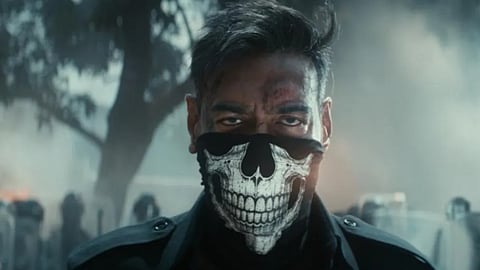
Enter Devgn in an eerie half mask, carrying a boom box playing the 'Jumma Chumma' song from Hum, and the voiceover continues: "Pathanon se kehna, Chauhaan aa raha he." There is little regard for truth or sensitivity. Kashmiris are not Pathans, and as someone pointed out on X, they fought them tooth and nail in October 1947 during the invasion by the Kabalis (Pathans) orchestrated by the Pakistani Army.
The trailer doesn't merely criminalise a state and its people, it also takes a leaf out of Aditya Dhar's Dhurandhar playbook. Weaponise retro songs, using them as the background to images oozing with blood and gore, thus normalising violence, the way video games such as the GTA series, do. So in Dhurandhar 1, his music composer Shashwat Sachdev takes 'Rambha Ho', used in Armaan, 1981, in a celebration of the streets of Goa, as the backdrop to a scene where the lead character Hamza (Ranveer Singh) is demolishing the men sent to kill Sher e Baloch's sons.
In Dhurandhar: The Revenge, he uses 'Tamma Tamma' from Thanedaar (1989), to play in the background as Sanjay Dutt's convoy is blown up. 'Tamma Tamma', a lighthearted track composed by Bappi Lahiri, was previously best known, and mocked, for displaying Dutt's appalling footwork, especially because he was with his co-star Madhuri Dixit, one of the best dancers in the industry then and now.
This normalising of violence and painting of all Kashmiris with one brush as stone throwers and free loaders comes at a time when the people most affected by the trouble, the Kashmiri Pandits, are trying to heal and honour their homeland with love and forgiveness rather than hatred and bitterness. Batt Koch, a full-length feature produced by Vinayak Razdan, and Tasrufdar, a short film directed by Kapil Mattoo, have argued for remembrance and preservation of language, rituals, and a way of life.
They have shed so many tears that there are none left. Now all they want is peace. In Tasrufdaar, a ghost (based on djinns from Kashmiri folklore) berates a Kashmiri Muslim man for the departure of Kashmiri Pandits from the Valley, and says his father betrayed him. Says Mattoo, who had to leave Kashmir when he was 14 and lost his father to terrorism in Kashmir: "These are questions my father would have liked to ask his neighbours."
It is not moving on and forgetting one's homeland, but retaining it in one's heart and mind. But Hindi films have no patience for any nuance.
Ironically, in the 2024 film, Singham Again, Devgn's character, a police officer, extolled the virtues of Naya Bharat ka Naya Kashmir where a crowd of youngsters extended their hand in friendship rather than raise them into fists carrying stones. An even greater irony is the retweeting of the trailer, "in appreciation", by Bachchan, the 'Jumma Chumma' star.
