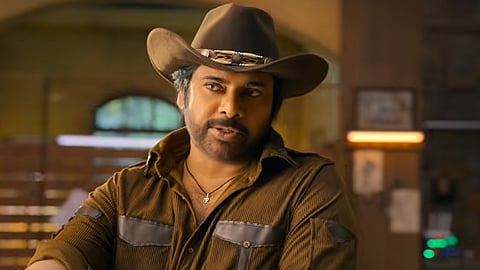

Director Harish Shankar delivered a massive blockbuster with Pawan Kalyan in Gabbar Singh back in 2012. At that time, Pawan Kalyan was in need of a strong comeback, and Harish Shankar’s writing — packed with punch dialogues, engaging entertainment, and memorable sequences like the Anthakshari episode — played a key role in the film’s success. Even though it was a remake of Dabangg, Harish made enough changes to give it a fresh and entertaining appeal.
After a 14-year gap, the duo have reunited for Ustaad Bhagat Singh, which hit the screens on Ugadi. However, with Pawan Kalyan now actively involved in politics and public service, he could dedicate only limited time to the project, and this seems to have had a visible impact on the film’s overall execution.
Initially, Harish Shankar had plans to remake Vijay’s Theri, but later he shifted direction, stating that he wanted to develop a different story, with shades of an extension to Khushi. With multiple changes in the script, delays, and even a last-minute switch in the music department — from Devi Sri Prasad to S Thaman for the background score — the film appears to have been completed in a rushed manner.
That hurried approach is quite evident on screen. The film suffers from lack of continuity and uneven narration. More than telling a cohesive story, it often feels like a series of scenes designed to elevate Pawan Kalyan’s image, especially considering his current political stature. There are also visible inconsistencies, with portions that seem to have been shot at different times over the last couple of years.
Story, written and director: Harish Shankar
Cast: Pawan Kalyan, Sreeleela, Raashi Khanna, Rao Ramesh, Parthibhan, KS Ravi Kumar, Gauthami, Satyam Rajesh, Praveen, Prabhas Sreenu and others
Bhagat Singh (Pawan Kalyan), a former officer, is leading a quiet life in the Nallamala forest. A wealthy businessman arrives at a forest guest house for his younger daughter’s pre-wedding celebrations. His elder daughter Shloka (Raashii Khanna) is dealing with emotional distress after a breakup. Bhagat is assigned to ensure the family’s safety during their stay.
At the same time, the Chief Minister’s son visits the forest for a private party, invited by Chengayya (Rao Ramesh). In a sudden twist, Bhagat kidnaps the Chief Minister’s son and hides him in the forest. Instead of turning to the police, the Chief Minister (Parthiban) seeks help from a militant group operating in the region.
What drives Bhagat Singh to take such a drastic step? What is his past? How is he connected to the militant group? And what role does Leela (Sreeleela) play in his life? These questions form the crux of the story.
Harish Shankar’s biggest strength has always been his writing, but here he seems to be working under limitations. The narrative appears disjointed, largely because the film was shot in phases based on the lead actor’s availability. Instead of a smooth flow, the story feels patchy.
The first half is particularly weak, filled with dull sequences and outdated comedy. A significant portion is spent on establishing Bhagat’s backstory, but it fails to create the desired impact. Comedy tracks involving Satyam Rajesh, Praveen, and Prabhas Sreenu fall flat and only slow down the narrative further.
Another major drawback is the excessive focus on Pawan Kalyan’s public image. Several scenes appear to be inserted purely to reflect his ideology and political persona rather than serving the story. These moments feel forced and disrupt the narrative flow. While such elements might appeal to a section of fans, they dilute the film’s overall impact.
That said, there are a few moments that work. The action sequence involving the kidnapping of the Chief Minister’s son is well-executed and engaging. In the second half, the romantic track between Pawan Kalyan and Sreeleela is handled relatively better. The use of nostalgic elements, including references to Tholi Prema and Khushi, may strike a chord with fans, even though they feel repetitive at times.
Pawan Kalyan brings his trademark charisma and screen presence to the role. His comic timing works in parts, and his dance in one of the songs is likely to please fans. He is also effective in action sequences. Sreeleela gets a better role and shares decent chemistry with Pawan Kalyan, though her character arc is limited. Raashii Khanna, unfortunately, is underutilized and doesn’t get much scope to perform. Parthiban, as the antagonist, lacks depth, and the loud dubbing doesn’t help his performance. KS Ravikumar is convincing as Bhagat’s mentor. Rao Ramesh stands out with a different role and provides some relief in an otherwise uneven narrative. The rest of the supporting cast, including Satyam Rajesh, Praveen, and Prabhas Sreenu, fail to make an impact.
The music by Devi Sri Prasad is one of the film’s biggest disappointments. Apart from one song, the soundtrack fails to leave a mark, which is surprising given his successful past collaborations with Pawan Kalyan. S Thaman’s background score, however, adds some energy to key moments and helps elevate a few scenes. There are also noticeable issues with dubbing and lip-sync in certain portions, which further affect the viewing experience.
With a weak storyline, inconsistent narration, and an overemphasis on the lead actor’s image, the film struggles to engage beyond a point. While a few moments in the second half and Pawan Kalyan’s presence may entertain his fans, the overall film feels like a missed opportunity.
