
S Saraswathi movie review:
Versatile actor Varalaxmi Sarathkumar is known for her powerful performances in Telugu and Tamil cinema. Over the years, she has earned a reputation for choosing strong and performance-driven roles. Now, she steps into a new role behind the camera with her directorial debut S Saraswathi, which hit theatres this Friday. Apart from directing the film, Varalaxmi also produced it along with her sister Pooja.
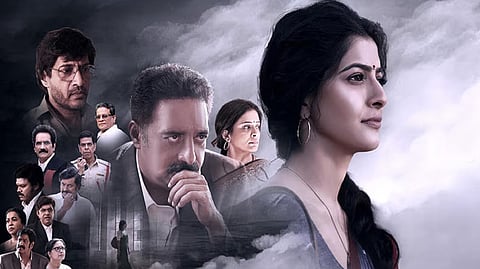
With an impressive ensemble cast that includes seasoned performers such as Prakash Raj, Rao Ramesh, Nassar, Priyamani, Jiiva, Murali Sharma, Kishore and Radikaa Sarathkumar in key roles, the makers promised an intense narrative.
The story revolves around a sensitive subject — child abuse — while also touching upon women’s strength and resilience. The film is essentially a psychological courtroom drama, though a large portion of the narrative tends to feel predictable.
Director: Varalaxmi Sarathkumar
Cast: Varalaxmi, Jiiva, Radikaa Sarathkumar, Prakash Raj, Rao Ramesh, Nasser, Priyamani, Kishore, Murali Sharma, Tulasi and others
The story revolves around Lakshmi (Varalaxmi), an orphan who works as a nurse in a private hospital. She leads a simple life and shares a close bond with her daughter Saraswathi. One day, on August 15, Lakshmi drops her daughter at school before heading to work. However, when she returns in the evening to pick her up, Saraswathi is nowhere to be found.
Lakshmi begins searching for her daughter desperately and questions the school authorities. Shockingly, the management tells her that there is no student named Saraswathi in Class 7. Confused and disturbed, Lakshmi seeks help from the police. A police officer played by Murali Sharma arrives at the school to investigate, but they fail to find any witnesses or evidence confirming the girl’s existence.
Later, Lakshmi files a complaint at the police station claiming that three individuals raped her daughter. The police immediately react and begin the investigation with forensic experts. However, the case takes a strange turn when Lakshmi reveals that she already buried her daughter. The police ask her to show the burial spot, but when they dig the location she indicates, there is no body to be found.
With no proof, witnesses, or physical evidence, the police are unable to proceed with the case. Frustrated and desperate for justice, Lakshmi approaches senior advocate Ramanujam (Prakash Raj), who is known for taking up genuine cases. But even he struggles to find evidence supporting Lakshmi’s claims.
Just when everything seems to have reached a dead end, the story takes a shocking twist with Lakshmi's journey taking a dark turn. This sudden twist transforms the story into a gripping mystery.
As a director, Varalaxmi Sarathkumar chooses a subject that has been explored several times in Telugu cinema. Stories revolving around sexual assault and harassment of children are, unfortunately, not new. However, Varalaxmi attempts to present it with a different perspective by adding elements of crime investigation and psychological drama.
Unfortunately, the director reveals too many clues early in the narrative, making it easier for viewers to predict the story, and that is the main drawback. Many of the developments unfold exactly as the audience might expect. There is little surprise in the storytelling, and the narrative often follows a familiar pattern.
The entry of Prakash Raj’s character Ramanujam adds some interest to the proceedings. His investigation and courtroom involvement bring a bit of momentum to the film. However, the courtroom scenes themselves could have been written more powerfully.
While the film tries to venture into psychological drama territory, the narrative loses pace due to prolonged courtroom arguments and repetitive scenes that resemble earlier portions of the film. It is also disappointing that the psychological drama introduced in the latter half also feels slightly unconvincing.
While the motive and reasoning behind her actions are compelling, the flashback explaining what happened with Lakshmi could too have been presented more convincingly. If the emotional depth in those sequences had been stronger, the film would have had a greater impact.
Despite its flaws, the film does have some noteworthy moments. The pre-climax courtroom sequences and the climax are engaging and leave a decent impression.
As a director, Varalaxmi deserves appreciation for attempting a socially relevant subject in her first film. She shows that she has the potential to handle serious themes and stage certain scenes effectively. Making her directorial debut while also acting in the lead role is not easy, yet she manages to balance both responsibilities reasonably well.
On the performance front, it is Prakash Raj who stands out the most. His portrayal of advocate Ramanujam adds weight to the film. Though the role itself is not entirely new for him, his commanding screen presence, maturity, and expressive acting make the character memorable. He truly carries a significant portion of the film.
Varalaxmi, as Lakshmi, delivers a sincere performance. She handles the emotional variations required for the character fairly well, especially during the investigation and courtroom scenes. Rao Ramesh appears briefly as a judge, and his presence lends credibility to the narrative. Other talented actors such as Priyamani, Kishore, Nasser, Radikaa Sarathkumar, and Murali Sharma perform their roles convincingly. Jiiva appears in an extended cameo and does a neat job.
Overall, S Saraswathi deals with a serious and relevant subject, but th predictability is a downer. With stronger writing and tighter narration, the film could have turned out even better.
Still, S Saraswathi stands as a decent attempt that highlights Varalaxmi Sarathkumar’s ambition to tell socially meaningful stories.
