
Nari Nari Naduma Murari movie review: A hilarious entertainer and a refreshing festive watch
A hilarious entertainer Nari Nari Naduma Murari(3 / 5)
Nari Nari Naduma Murari movie review:
With Sankranthi traditionally being the season of family-friendly entertainers, Telugu cinema this year has leaned heavily on humour and light-hearted drama. Amid releases headlined by stars like Prabhas, Chiranjeevi and Ravi Teja, Sharwanand’s Nari Nari Naduma Murari arrives quietly but ends up making the loudest impact where it matters the most — consistent laughs. At a time when Sharwanand’s career has been searching for a decisive turnaround, this film, directed by Ram Abbaraju, comes across as a timely and much-needed break.
Known for delivering the sleeper hit Samajavaragamana, Ram Abbaraju reunites with writer Bhanu Bhogavarapu and dialogue writer Nandu for this outing, and the trio once again proves that a simple idea, when backed by sharp writing and confident execution, can work wonders. Stories involving one man caught between two women are hardly new to Telugu cinema, but Nari Nari Naduma Murari tweaks the familiar template with an amusing twist and narrates it with unforced humour.
Director: Ram Abbaraju
Cast: Sharwanand, Sakshi Vaidya, Samyuktha, VK Naresh, Sampath, Vennela Kishore, Siri Hanumanth, Sudharshan, Satya, Srikanth Iyerngar, Sunil, Getup Seenu and others

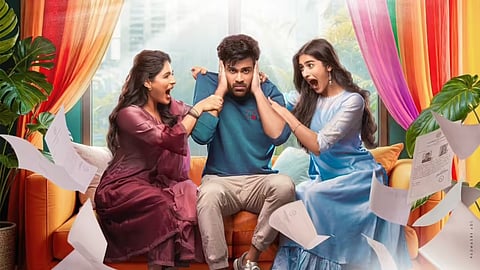
Gautham (Sharwanand) is a young architect who believes he has his life neatly sorted out. He is in love with Nithya (Sakshi Vaidya), the daughter of a well-known advocate (Sampath Raj), and the couple is ready to take the next step. Gautham’s father (VK Naresh), meanwhile, shocks everyone by marrying Pallavi (Siri Hanumanth), a much younger woman, at the age of 60 — a decision Gautham wholeheartedly supports. However, this unconventional marriage doesn’t sit well with Nithya’s father, who insists that the young couple go for a registered marriage before anything else.
What should have been a straightforward process takes an unexpected turn when the registrar points out a rather inconvenient detail: Gautham is already married. Enter Dia (Samyuktha), a woman from Gautham’s past, whose presence suddenly throws his present into chaos. How this forgotten chapter resurfaces, how Gautham tries to navigate the mess, and whether honesty can untangle the knots form the crux of the narrative.
What works immensely in the film’s favour is the way Ram Abbaraju handles potentially sensitive situations with a light touch. Instead of turning the premise into a melodramatic love triangle, he treats it as a comedy of errors, mining humour from awkward conversations, social perceptions of marriage, and generational hypocrisy. The idea of a youthful, impulsive registered marriage coming back to haunt a man years later is played entirely for laughs, without trivialising the emotional stakes.
The film opens on a riotous note with Gautham orchestrating his father’s second marriage, setting the tone for what follows. From that point on, the humour rarely dips. Every character is given space to contribute to the comedy, making the narrative feel busy yet balanced. The father-son dynamic, in particular, becomes a recurring source of humour, especially when Gautham’s support for his father’s unconventional choices ends up becoming the biggest obstacle in his own love life.
One of the film’s most enjoyable stretches revolves around the registrar scenes, where Gautham and his friends attempt to wriggle their way out of trouble using half-baked ideas and desperate lies. These moments are elevated by crisp dialogue writing that lands punchlines effortlessly. The humour feels organic, rooted in situations rather than exaggerated antics, which is a rarity in festive entertainers.
The second half maintains the momentum as Dia enters Gautham’s professional space, further complicating matters. While the film briefly flirts with seriousness by touching upon themes of trust, maturity and emotional responsibility, it never loses sight of its primary goal — entertainment. Even potentially awkward scenarios are resolved with warmth and wit, reinforcing the film’s belief that laughter can coexist with sincerity.
Sharwanand is the film’s biggest asset. After a string of underwhelming outings, he appears completely at ease here, rediscovering his comic rhythm with impressive confidence. His timing, expressions and delivery bring back memories of his earlier successes like Run Raja Run and Express Raja. He shoulders the film with ease, making Gautham both relatable and endearing.
Sakshi Vaidya gets a well-defined role and handles it with charm, bringing both vulnerability and spunk to Nithya. Samyuktha, despite limited screen time, makes a strong impression with her composed performance. VK Naresh is a revelation, stealing several scenes with his impeccable comic timing and lived-in portrayal. Siri Hanumanth surprises with her confident presence, while actors like Sudharshan, Vennela Kishore and Satya keep the humour flowing without overdoing it.
Visually, the film is pleasing, with neat cinematography that captures both urban spaces and scenic locations effectively. Vishal Chandrasekhar’s music, however, turns out to be the film’s weakest link, with songs that fail to leave a lasting impression. That said, the sharp dialogues more than compensate for the lack of musical highs.
In the end, Nari Nari Naduma Murari stands tall as a clean, laugh-out-loud entertainer that understands the pulse of festive audiences. Without resorting to forced drama or over-the-top gimmicks, it delivers genuine humour driven by writing and performance. For Sharwanand, it marks a confident return to form, and for audiences, it offers exactly what a Sankranthi release promises — unpretentious, wholehearted entertainment.