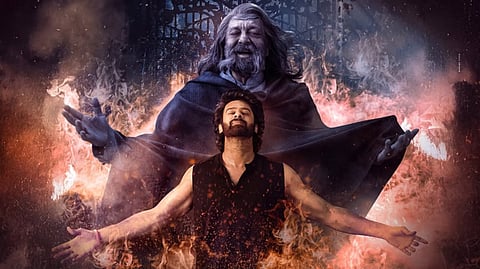

The Raja Saab Movie Review:
After a long wait filled with delays, controversies, and sky-high expectations, The Raja Saab has finally hit the screens. Starring Prabhas in the lead role, the film is directed by Maruthi and produced by TG Vishwa Prasad. Marketed as a horror-comedy with fantasy elements, the film instead turns out to be a slow, exhausting experience that lacks horror, comedy, emotional depth, and engaging narration.
Apart from Prabhas, the film features Niddhi Agerwal, Malavika Mohanan, and Riddhi Kumar as the female leads. Bollywood actors Sanjay Dutt and Boman Irani play key roles, while veteran actress Zarina Wahab makes a comeback to Telugu cinema after a long gap. Despite the impressive cast and massive budget, The Raja Saab fails to justify its scale or ambition.
Director: Maruthi
Cast: Prabhas, Niddhi Agerwal, Malavika Mohan, Riddhi Kumar, Sanjay Dutt
The film opens with a brief sequence involving comedian Satya, who enters a mysterious, supposedly haunted house carrying an urn and gets trapped inside. This scene is meant to set the tone for the film but neither creates suspense nor offers any comic relief. The narrative then shifts to Raja (Prabhas), who lives with his grandmother Gangamma (Zarina Wahab) and his uncle’s daughter Anitha (Riddhi Kumar). Anitha loves Raja, while Gangamma suffers from Alzheimer’s disease and remembers only her husband Kanakaraju (Sanjay Dutt), who she believes is still alive. She urges Raja to search for him, setting the story in motion.
Raja learns that his grandfather may be in Hyderabad, near Charminar, and travels there. During this phase, he encounters a nun (Niddhi Agerwal) and instantly falls in love with her — a hurried romantic track that leads directly to a song, offering little emotional grounding.
Raja’s uncle (VTV Ganesh), a police constable, demands a bribe of ₹5 lakh for his superior, for helping in the search. Raja manages only ₹2 lakh after donating the rest to a child’s surgery. Around the same time, Bhairavi (Malavika Mohanan) enters the story, delivering a large sum of money to Raja on her grandfather’s (Samuthirakhani) instructions. Through him, Raja learns that his grandfather is hiding in the Narasapur forest.
The story then shifts to a haunted house deep in the forest, where Raja, Bhairavi, his friend, and his uncle enter — only to find Satya already trapped there. What happened to Kanakaraju? Why did he abandon Gangamma? What secrets does the haunted house hold? These questions form the crux of the second half.
Director Maruthi, who earlier tasted success with small and mid-budget films like Prema Katha Chitram, Bhale Bhale Magadivoy, and Mahanubhavudu, gets a golden opportunity to direct a pan-India star like Prabhas. Unfortunately, he squanders it with weak writing, poor narration, and lack of clarity.
On paper, the core idea — involving royal betrayal, hypnotism, revenge, and generational trauma — sounds interesting, almost like a modern-day Chandamama tale. A cruel man manipulates a queen using tantric powers, steals her wealth, and leaves her to live a miserable life. Years later, her grandson discovers the truth and seeks revenge. While the premise has potential, the execution is deeply flawed.
The film lacks strong character arcs, emotional weight, or engaging conflicts. Scenes drag endlessly, especially in the first half, filled with unnecessary romance and glamour shots. The interval point finally offers a mildly interesting twist, but by then, the audience’s patience is already tested.
The second half, set mostly inside the haunted house, is predictable and dull. Neither horror nor comedy works. Forced songs interrupt the flow, and they are clearly inserted for commercial appeal rather than narrative necessity.
Prabhas looks stylish and relaxed, but his character is poorly written. There is no emotional depth or heroic elevation that one expects from a star of his stature. Some scenes clearly appear to use a body double, which breaks immersion. More concerning is his voice — several dialogues are unclear, poorly modulated, and at times almost inaudible, raising questions about dubbing or technical choices.
Among the female leads, Malavika Mohanan gets the most screen time and even an action sequence. However, her character lacks substance. Niddhi Agerwal and Riddhi Kumar are underutilised, serving primarily as glamour attractions rather than meaningful contributors to the story.
Sanjay Dutt’s role is a major disappointment, offering nothing memorable. Zarina Wahab, meanwhile, delivers a sincere performance as the grandmother and stands out. Boman Irani’s hypnotist role is brief and forgettable. Comedians like Satya, Saptagiri, Prabhas Sreenu, and VTV Ganesh fail to generate laughs, mainly due to weak writing.
Thaman’s music is one of the film’s biggest drawbacks. The background score is often loud and intrusive, and the remix song feels unnecessary and poorly executed. None of the songs leave a lasting impression.
The cinematography is decent, and some VFX shots are visually appealing. However, excessive reliance on graphics over storytelling works against the film. Given reports that the film cost nearly ₹400 crore and took almost three years to complete, the final output feels unjustified.
The Raja Saab is a classic example of a film with high expectations but poor execution. Director Maruthi struggles to handle a star like Prabhas and fails to balance horror, comedy, fantasy, and emotion. The result is a dull, overlong film that lacks soul and engagement.
Despite a promising premise and star power, weak writing, shallow characters, and sluggish narration drag the film down. Except for a mildly interesting climax segment, there is little to appreciate. Overall, The Raja Saab turns out to be a major disappointment — especially for Prabhas fans — and tests the audience’s patience rather than entertaining them.
