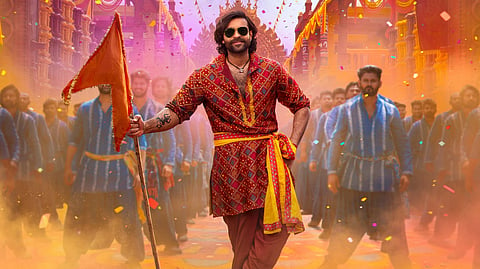

Actor Varun Tej, who had experimented with his earlier films, is back to entertainment with Korean Kanakaraju. He is now banking heavily on this film, which is directed by Merlapaka Gandhi. Rajeev Reddy, along with UV Creations, produced this film, while Ritika Nayak plays the female lead. Comedian Satya is also seen in a key role. The film released on Friday, and the question is whether this will bring luck to Varun Tej.
Horror comedies are not new to Telugu cinema, as many films have been made in this genre earlier. But Korean Kanakaraju comes up with a new Korean backdrop, which is something different. While Gandhi has come up with a good idea, he seems to run out of ideas soon enough and ends up incorporating a lot of AI visuals, which spoils the final portions of the film. Director: Merlapaka Gandhi
Cast: Varun Tej, Ritika Nayak, Satya, Muralidhar Goud, Sunil, Avasarala Srinivas, VTV Ganesh, Revanth and others
Kanakaraju (Varun Tej) lives with his parents in Penukonda, and his close friend is Kistappa (Satya), who runs a photo studio. Chaitra (Ritika Nayak) works at KIA Motors and is fascinated by Korean culture and wants to go to Korea. A small jar containing the ashes of a Korean person accidentally reaches Penukonda. It finally reaches a bar in the small town, where the owner keeps it on display like an old artefact.
Kanakaraju and Kistappa regularly drink at the same bar. One day, Kanakaraju pours alcohol into the jar and drinks it along with the ashes. The Korean soul then possesses Kanakaraju’s body, and his behaviour starts changing. From then on, Kanakaraju starts speaking Korean. When translated, the Korean soul says that it wants to see its wife and child in Korea and promises to leave Kanakaraju’s body afterwards. It also agrees to give Rs 3 crore to Kanakaraju if he can travel to Korea and show him his family. What happens next and how Kanakaraju, Kistappa and Chaitra deal with the soul, along with the actual background of the Korean person, can be seen on the big screen.
When you make a horror comedy, you don't necessarily need to look for logic. Director Merlapaka Gandhi starts the film interestingly, showing how the Korean person’s ashes travel to India and eventually reach Penukonda. At the same time, he establishes Kanakaraju and his character, along with his friend Kistappa. Chaitra, who works at the KIA factory, speaks Korean, and Kanakaraju falls in love with her at first sight, as seen in many films. The director narrates the story with several entertaining scenes, and Satya steals the show with his one-liners and punch lines.
Once the Korean soul possesses Kanakaraju, the story takes a new direction. Till this point, the director narrates the story quite conveniently and introduces a few characters, including Sunil as a local politician in Penukonda who doesn't like Kanakaraju. Another character is played by Muralidhar Goud, who performs Tantrik pujas to drive out spirits.
After the Korean soul possesses Kanakaraju, the director narrates the proceedings interestingly with some entertaining scenes until the interval. Take, for instance, the dog scene involving Varun Tej, Satya and Ritika, which is hilarious. The graveyard scene is another episode that works well and generates laughs.
But the problem is that the story is completely predictable and follows a very formulaic template. Except for the Korean backdrop, which is definitely new in Telugu cinema, the entire film follows the regular template. Once the team lands in Korea, there are some hilarious scenes, but the director completely loses his grip on the story. The film survives largely because of Satya, who takes everything on his shoulders. He plays a parallel hero alongside Varun Tej in the film. In the second half, the combination of Satya and Muralidhar Goud somehow manages to save the film; otherwise, it completely falls flat.
The climax is shot in a very poor way, as the director uses AI, and the entire episode turns out to be a big waste. The Avasarala Srinivas episode is not very strong either. Most of the second half takes place in Korea, and the director seems to be in a hurry, with many scenes feeling illogical and some even boring. But in between, Satya’s one-liners keep the audience interested.
It seems Merlapaka Gandhi has been watching a lot of reels these days, as a recently viral scene involving late NTR, where he talks about being ‘amateurish’, is referenced in the film, with Satya also using the same word. The director succeeds only halfway, with the hilarious first half, but completely loses control over the story in the second half.
When it comes to performances, Varun Tej, who plays two characters — A young Rayalaseema man and the one possessed by the Korean spirit —does both roles well. But the film belongs to Satya, who gets a parallel role alongside Varun Tej from beginning to end. He takes the burden of the film onto his shoulders with his punches, comic expressions, one-liners and overall performance. Even in the second half, when the story becomes dull and boring, Satya keeps things lively with his comic acts. Definitely, this film could be one of the better films in Satya’s career, and the audience will enjoy watching him. He is also at ease with the Rayalaseema slang.
Ritika Nayak as Chaitra is beautiful, and justifies her role. Muralidhar Goud is adequate as the Tantrik, and his combination with Satya in the second half works well. Revanth, who played Bulli Raju in Sankranthiki Vasthunnam, plays a small role in this one, but fails to make an impact, while the other actors don't get much scope to showcase their performances.
Technically, the film is good, with decent cinematography and production values. Thaman’s music is not up to the mark, and it doesn't have much impact on the film. Some of the dialogues are entertaining, especially those written for Satya, but the writing is very weak, particularly in the second half.
Korean Kanakaraju entertains you if you put aside the logic of the story. Varun Tej’s performance is definitely a plus point, but it is Satya who steals the show with his lively comic performance. The second half, especially the last 20 minutes and the climax, is poorly written, but there are enough entertaining moments here and there to keep you engaged.
