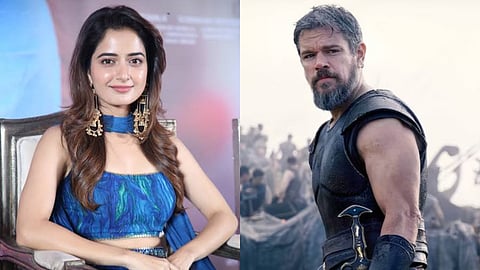

Christopher Nolan's epic adaptation of Homer's Odyssey has been breaking box office records since its release last week. The latest actor from India to praise the film is Ashika Ranganath. Taking to her Instagram Stories space, Ashika shared that the world of The Odyssey feels quite familiar to her.
"Days later and The Odyssey is still on my mind. While watching it, I was completely immersed in its world. Yet, there was something about it that felt oddly familiar I just couldn't place it.. It wasn't until I came across this interpretation and started reading more about it that it all clicked," Ashika shared on her Instagram.
The actor added, "I've read books about the Mahabharata, especially Krishna's final days and the beginning of Kali Yuga, so looking at The Odyssey through that lens genuinely fascinated me. It compared The Odyssey to Krishna realizing Kali Yuga had already begun—not through one defining moment, but through subtle shifts in human nature and the values that once held society together."
Ashika clarified her statement, saying that she is not accusing Nolan of plagiarism with it. "Not saying one story is adapted from the other.. I'm simply fascinated by how two different mythologies can be interpreted through a similar lens, exploring the same timeless idea," she explained.
Speaking of which, in Greek mythology, the end of Odysseus's journey marks the transition from the Age of Heroes into the Age of Iron, which is a time period characterised by conflicts and moral decay that does not have direct intervention from Gods.
Likewise, the end of the Kurukshetra War marks the transition from the Dwapara Yuga to Kali Yuga (Age of Darkness), which is characterised by the loss of dharma (righteousness), truthfulness, and virtue.
Even Nolan's previous film, Oppenheimer, also has similarities to the Mahabharata.
