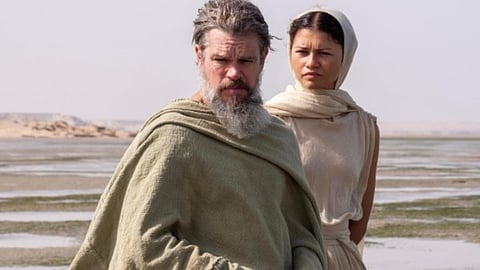


The most fascinating aspect of Christopher Nolan's The Odyssey lies in how it explores the profound irony of a king who vanquishes his enemy through a deceit that violates his principles, only to later seek redemption with another disguise. Odysseus (Matt Damon) wins the Trojan War not through brute force but rather a grand deception with the Trojan Horse. While this may make Odysseus a tactical mastermind, the trickery and its aftermath enrage the Gods, especially Poseidon, forcing him to deal with a decade of wandering, drifting farther and farther away from his destination.
When Odysseus returns to Ithaca, he finds greedy suitors trying to steal his wife and kingdom, meaning he cannot simply walk in as a conquering king but must earn his way home as a beggar. If he reveals his identity to the suitors too early, it would endanger his wife Penelope (Anne Hathaway) and son Telemachus (Tom Holland). Thus, he maintains the charade long enough, enduring mental and physical humiliation in his palace with a passivity that belies his status as a king. As Odysseus himself tells Telemachus, “To have the best view, one must look from below.” If the perilous journey from Troy to Ithaca, where he encounters treacherous waters, witches and wyrms, is Odysseus's punishment, being a beggar is his ultimate penance. Punishment is what the Gods do to him; penance is what he must do to himself for the ultimate salvation. Lowering himself to the absolute bottom of society is his only way to find out who is still loyal to him, execute his strategy against the suitors, and truly become the rightful King of Ithaca once again. It is the ultimate test of emotional control for a proud king, who at one point even dares to defy the Gods.
To ground this irony, Nolan uses multiple elements, including Odysseus fighting a wild boar and a deer. Before going for the kill, he warns his prey each time, thus giving them a fair chance to fight for survival. By touching his bowstring to alert the animal, Odysseus ensures a dignified struggle between hunter and prey—a starc contrast to his cowardly ambush at Troy. Even as a boar severely wounds his leg, Odysseus refuses to abandon his code of honor, although he discards it during the attack on Troy. When he is forced to sit in his own palace under the guise of a beggar, it acts as a compelling narrative counterbalance to his crimes.
The contrast between a fair hunt and the sheer brutality of war may be rooted in classic literature, but Nolan's The Odyssey elevates it with psychologically layered and dense writing. It encapsulates the true tragedy of Troy and its people, who get no warning or chance to defend themselves before the ambush. Nolan's film is smart when it comes to how it keeps the visual depiction of the slaughter to the final few moments. Earlier in the film, Nolan masterfully builds dread through brief shots of Odysseus watching his army plunder the city, hinting at his deep sense of moral decay. The carnage late in the film subverts a standard hero's triumph arc into a staggering exploration of the human psyche. It turns Odysseus from a master strategist into a compromised figure carrying the weight of his own 'victory'. Ultimately, the brilliance of Nolan's film lies in recalibrating the Greek hero into a tragic figure, whose triumph over the suitors feels like a grim passage rather than a celebratory moment.