
Lenin Pandiyan Movie Review:
The price of shame is the cost of freedom. The price people pay is not only having to forgo their basic rights to survive, but also to also live as a human with self-esteem. While the shame that a society and its inhabitants place on an individual has been explored time and again, the individual is treated as an example of society in these stories. So what if an individual was subjected to shame in real life, what will they think? How will they react? What happens to them? In DD Balachandran’s Lenin Pandiyan, we see the exploration of the impact of shame on different parts of a microcosm. But instead of being craterous, it becomes a pothole.
Director: DD Balachandran
Cast: Gangai Amaran, Dhaarshan Ganesan, Roja, Shrrita Rao
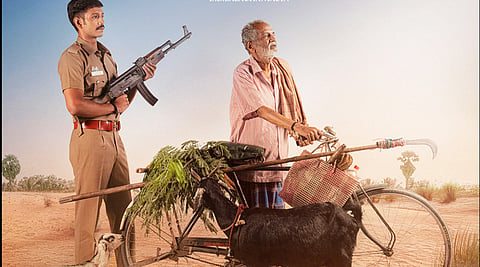
Lenin Pandiyan’s strongest factor becomes its spine: the unwavering way with which the themes of social justice and equality are portrayed. In the film, Dorairasu (Gangai Amaran) wants justice for his goat, after the animal is struck to death by a lorry. On paper, this might seem to be a negligible conflict to be a motivating factor. The loss of an animal, which isn’t considered cute to be a common pet for the larger populace, and is often reared for its meat, is tricky for the viewers to sympathise. But with Dorairasu, Balachandran sets the tone for the viewers to see the world through his eyes, as the character demands it. In the midst of the story, we are also offered an interlude, where we see the story and motivations of a judge, Bhimarao (George Maryan). While in the larger view of the film’s story, the judge’s story could have been diminished to a few scenes, instead, we are offered a convincing tale of how a man’s diminutive stature can seem giant-like, when empowered by education and law.
But such strong themes and a sprawling story over 2.5 hours is propped up on half complete writing. Doraiarasu’s fight to get justice for his dead goat, brings Constable Maruvarman Sundarapandiyan (Dharshan Ganeshan) into his life. Maruvarman, or as he is called ‘Karunai’ (Charity) by the rest of the police department, gets his job due to an ex-gratia appointment after his father’s death. Right from his moniker to his half-thought actions, he is shamed time and again, which makes him an insecure man out to prove himself. While Doraiarasu is an example of a man who has to wade through the shaming dealt to him due to society’s labels, Pandi has to deal with the shame which makes him an indecisive people pleaser. While Pandi’s motivations are strong, the film takes too long for Pandi’s journey to reach its destination, which is then subdued by a quick ending. The victims of this subdued writing are also the film's female leads Roja and Shrrita Rao. As Sandhanam and Priya, Roja and Shrrita have well defined characteristics with a strong set of principles. But after building up their story in the film, their characters fizzle out with loose ends.
The same is extended for the rest of the supporting characters throughout the film. The shame in the film is doled out by an endless array of villains, representing various forms of systemic injustices. But every one of those villains are dealt with in a manner that lets down the ways with which every single thematic ideals and storylines.
While a lot of elements make up Lenin Pandiyan, Ilaiyaraaja effortlessly makes his presence known. His music brings out the emotions in the scenes but isn’t too suggestive. Even the reuse of ‘Poongatru Thirumbuma’ from Muthal Mariyathai, doesn’t feel shoed-in, just to support the references of the film in Lenin Pandiyan.
As a writer DD Balachandran is a good architect of worlds. From the names of the smallest of characters to the environment that makes up the story, Balachandran has thoughtfully written what makes the story. In its exploration of shame, which impacts a man’s day even in the smallest of moments, the film achieves its core focus of being ideally strong. But the weight of immaculate focus, drags this story to be half complete.
