
Enna Vilai Movie Review:
Luxury. In a society that is built on differences, hierarchies, and divisions, one’s necessity is another’s luxury, and one’s luxury is another’s necessity. Time and again, we have seen the system decide what is necessary for the majority, and even take it away just to ensure a few's luxury is not disturbed. Of course, it is a malicious system that runs on the whims of the luxurious, and tramples on the basics of the rest. But this is the system we have, and it will remain so until people decide to organise, agitate, and revolt. Now, this is easier said than done, and in Sajeev Pazhoor’s Enna Vilai, it is watered down so much that it deifies the very system it tries to defy throughout the film.
Director: Sajeev Pazhoor
Cast: Karunaas, Nimisha Sajayan, Vijayalakshmi Veeramani, Shashaa Shivakumar, Pandi
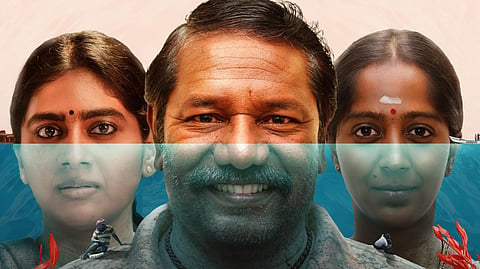
Thavasi Muthu (A competent Karunaas) is a doting dad, a loving husband, and a protective brother, settled in Rameshwaram. He does a lot of odd jobs, including diving into the water to retrieve coins thrown into the ocean by the sea of pilgrims who visit the temple town. His wife, Palamma (a wonderful Vijayalakshmi Veeramani), does odd jobs around the temple, and they make sure their children get the best education, even if it means punching above their weight to make ends meet. Thavasi is honest and hardworking, and he respects people like him, regardless of caste or class. But he is also naive in a very cinematic sense, and we know what happens when such a person falls into the scheming hands of certain law enforcers. During one of his many dives into the ocean, he retrieves a gold locket, and all hell breaks loose.
Sajeev, known for writing the National Award-winning Malayalam film Thondimuthalum Driksaakshiyum, treads familiar ground in Enna Vilai as well. There is gold. There is a theft. Police are almost immediately involved. The process becomes the punishment. And there is Nimisha Sajayan. While Thondimuthalum Drikshakshiyum never allowed the spotlight to go away from the core story of three people and a theft, Enna Vilai moves away from the protagonists to become an overarching social commentary that questions a bunch of things. This is where the film starts meandering, and we are forced to resort to the age-old ‘Good intentions, heart in the good place, but…’ kind of response. It is also one of those films where strong performances get buried under exasperating writing and one-note characters.
Enna Vilai tackles an important aspect of our judicial and bureaucratic system, but it takes too long to get there. We are made to go around in circles, and the film makes it even more difficult to follow the scheme of things. Again, it isn’t because the legalese is difficult to comprehend. In fact, it makes one wonder if the makers were clear about the case they were fighting in court. But all of this wouldn’t have mattered if there was emotional resonance. It is easy to make the TRP-hungry media a powerful enemy, but the makers resort to generic treatment of these scenes. This treatment extends to the showcase of social media outrage, the rallying of crowds, the system being questioned through organic culmination of emotions, and more. But when Enna Vilai gets it right, the film becomes quite an arresting exploration of how easy it is for oppressors to find various ways to oppress people. Take, for instance, the scene where Thavasi and his family are hounded by sections of the media. Even as he breaks down at the prospect of returning to prison, he has to safeguard his family from the prying eyes of the various cameras that have surrounded his home. When Palamma finally gives a haunting stare to the cameras that double as a much-needed dressing-down of the voyeuristic nature of the media and its audience, Enna Vilai rises above its own genericity. The film needed more moments like this, but many nuances get diluted in its ambition to say a lot.
It is also disappointing that a few scenes feel too rushed, and the emotional punches don’t land as expected. The same happens with the legal portions of the film, involving Kanchana (Nimisha Sajayan), who plays Thavasi’s lawyer. These portions don’t have that required zing, and we are left with just hearing lawyers and judges citing sections, saying ‘Objection’ and ‘Much obliged’ and going through the motions. Even here, there is a neat little moment where the power goes out in a court, and an assistant brings a battery-operated fan for the judge. Once the power is back on, when the same assistant tries to take the fan back, the judge asks him to keep it there. It might not amount to much, but it is such scenes that livens up the characters. Enna Vilai needed more.
Sam CS deserves credit for a soundtrack that reflects the film's setting. The background score is like water droplets hitting the surface, and it's a novel idea given how the film is set against the ocean. But again, it becomes too distracting after a while because the music feels like it's overpowering the visuals. Probably, a case of Enna Vilai needing less. Similarly, the film would have benefited from giving us more about Thavasi and his family, including his son's (Kamalesh Jagan) feelings and the dynamic between his sister (Shashaa Shivakumar) and her lover (Pandi). Without exploring the emotional heft of the family, it is tough to rally behind the cause, however compelling it is.
But as the film saunters into its final act, it poses the titular question. ‘Enna Vilai’... what is the value? It is an important discussion to have, and something that has to be addressed, especially today. We are seeing how even truth is not absolute. Anyone can be cancelled, victimised, broken down, and labelled. The news cycle is hardly a few minutes now, and the proliferation of AI in this post-truth society is only making things worse. Enna Vilai makes a compelling argument to substantiate the need for the system to treat everyone equally and with dignity. Even if the film doesn’t always keep us engaged and becomes unnecessarily verbose at times, we can’t sidestep the question Sajeev and team pose to the system. In fact, they go one step ahead and answer it, too, albeit too simplistically. Anyway, even if it is a luxury to imagine there are times when the system won’t win, it is okay… What is cinema if not a willing suspension of disbelief?
