
Sardar 2 Movie Review:
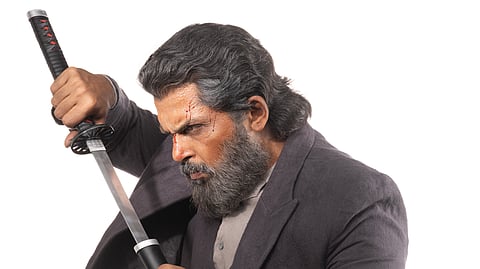
Tropes, like social media trends, emerge and re-emerge in cycles. And they always come back with a sweet tinge of nostalgia. At a time when we are treated to an unrequited barrage of “make yourself look like you’re from the 80s” AI-generated posts, Sardar 2 resurrects a lofty collection of old spy thriller tropes. And much like the 80s nostalgia trend, Sardar 2 has caught these tropes at a time when the cycle has once again emerged on our fonder side. What was once considered stale is now charming to behold, whether it is a spy and his team going rogue against their organisation, bizarrely shaped keys hidden in curious places, a private army of henchmen, and a villain hell-bent on elaborating his plans before pulling the trigger. Sardar 2 also infuses its own refreshing take on the genre. For example, it is not often that we see a young trainee spy’s skills questioned, morality irreversibly greyed, and innocence sullied. Karthi has a firmer grip on the Sardar character this time around, especially in the sequences set in the 80s. Unlike the slightly more experienced spy in the flashback portions of the original, we see a younger Sardar who has just gotten into RAW. He is more wide-eyed, hopeful, and easily trusting of people. Sardar 2 offers a number of such charming moments, ideas, themes, and scenes. And yet, it suffers from an interesting problem of excess. It is a gladiator match between several promising ideas where everyone struggles to come out on top.
Director: PS Mithran
Cast: Karthi, SJ Suryah, Malavika Mohanan, Ashika Ranganath, Rajisha Vijayan
Every interesting idea had its lacklustre counterpart. Throughout the film, we see Sardar being forced to deal with variations of The Trolley Problem, and the associated guilt and disillusionment of his moral core. Sardar’s son Viji (a younger Karthi) drifts aimlessly through the story, as a mere vessel to demonstrate various action hero tropes, almost as if the hero’s own henchman for a change. There is barely any emotional arc or psychological depth to Viji, and so he faces the only viable conclusion most underdeveloped characters face when the story suddenly realises it hasn’t done much with them. We see the brutality of bioweapons and the coldness of international relations in the 80s portions. But it somehow turns into a lesson on ‘antibiotic apocalypse’, with SJ Suryah’s Yogi screaming at us to ‘stop eating those juiced up chickens already’. Coming to the ‘villain’s monologue’, they had an effective analogy to convey the convoluted science behind Yogi’s ideology, but the extremely didactic lines were stretched and hammered in to a point where it becomes overwhelming and tedious. That particular scene once again proves that the length of expository dialogue is inversely proportional to the trust the film has in the audience to understand it. Yet, for the most part, how director PS Mithran conveys exposition in the sequel, is vastly more evolved than how it was handled in the original Sardar.
The dense, unceasing exposition is just a symptom of a larger issue anyway: thematic abundance. On one hand, it demonstrates the tremendous research that went into building the world. One of the biggest joys of the spy thriller genre is watching the protagonist covertly swipe everyday things like a lightbulb or water bottle and turn them into a weapon. And so it goes for when he casually throws in specific terminologies without feeling the need to explain it, like when Sardar says, “Get me a VLF, you know…Very Low Frequency?” But it would have been effective if he wasn’t saying such strategies to a senior official. Maybe Malavika Mohanan’s Sara, who is trained in neutralising a sophisticated bioweapon, could have come up with that. Understandably, this is to make Sardar look cooler, but maybe he could have shared some of the cool solving-the-mission moments with Sara as well? On the other hand, the thematic abundance, which are borderline indulgent, is detrimental to the seamlessness of the experience and becomes overwhelming to a fault.
Sardar (2022) was captivating for how it grounded the spy genre to a Tamil common man context. It also dealt with the pain of absolute devotion to a cause even when you have to hide that away from your loved ones. The emotional heart of the original film was still loyal to the father-son relationship. The sequel barely builds on what the original left and treads the same path again. There are several supporting characters serving fragments of several different story purposes; a couple of them could have been merged together, and some of them we wouldn’t have noticed the absence of. This fundamental story editing issue unfortunately seeps into the visual editing as well. The result is a film that mistakes impatience for faster pace and is averse to consistent rhythm, leaving us emotionally distant.
Sardar marks the rare moment in Tamil cinema when we have an original homegrown character with abundant storytelling potential. As a standalone experience, Sardar 2 is an entertaining watch and is never boring, but deep down, you can feel that Sardar, the spy, has far cooler stories buried inside his files. If only PS Mithran could dig deeper into the vaults.
