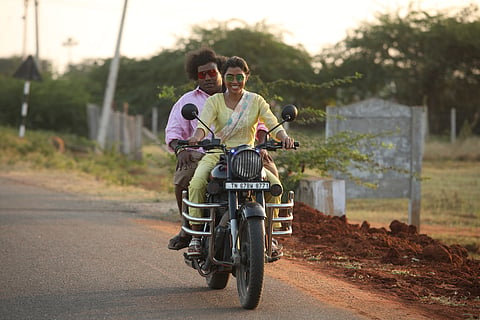

Kenatha Kanom is a classic case of weaponised empathy. And the target of this weapon is apparently scientific temperament. A small village in Tamil Nadu is suffering from a severe drought, and after countless prayers to the village deity, the villagers seek the help of a water diviner and find the perfect spot right outside the village priest Manivasagam’s (Yogi Babu) house. However, instead of water, what they find are fossilised dinosaur bones. It is a wonderfully quirky premise, potent with discussions around bureaucratic failure, big picture versus immediate needs, common man versus the government, and more. What Kenatha Kanom does instead is resort to a sappy romanticisation of the “old ways”. Which wouldn’t have been a problem except that the arguments it relies on to make its case stem from misguided philosophies and an abject misunderstanding of science.
The film does show plenty of promise at the beginning. The villagers, their culture, and their inner lives are etched with painstaking detail, portrayed through a colourful cast of characters. An old freedom fighter who acts as the village’s wise elder, the scheming village leader who is not a caricaturish ruler, a mute old man with paralysed legs crawling through the dusty streets all day, and the cyclist who brings him news about what goes on in the village, to name a few. Everyone has their own definitive story arc and is unique in their own way. For every praise-worthy writing decision, the film also has issues of equal magnitude. While you notice how the story abstains from making stereotypical jokes out of a character with a feminine body language, you cannot ignore the unfunny height-shaming jokes at the expense of a man with dwarfism. A hard-hitting scene of the entire village being tortured by the police is immediately followed by repeated attempts at humour, with every single one of them failing.
Director: Suresh Sangaiah
Cast: Yogi Babu, Lovelyn Chandrasekhar, Raichal Rabecca, Ramakrishnan
While you praise the distinctness of the supporting characters, you also notice how they have the decision-making skills of a herd of sheep. You understand that they were probably going for the “innocent villager” trope, but it is borderline repulsive to show them as dullards with no brains of their own. The village also seems to be populated entirely by middle-aged couples and old, senile men. No trace of a child or a youngster in sight, until the plot needs school children to line up to see the dinosaur fossils, to show how that is the only way these old bones could be useful. Speaking of which…
Kenatha Kanom has an almost deep-seated hatred for palaeontologists, scientists, or historians of any kind. There is an acute focus on showing how the “scientists” exist to trample on the poor villagers. The most unintentionally funny scene is when the head of the palaeontology team lashes out at the villagers, demanding closure of the dig site, saying, “Ivangalukku survival of the fittest naa enna ne therla.” She then hires the villagers to help dig the site. Which is hard to imagine, considering that even the most trained professionals use a brush to remove the bones carefully, let alone allow random people inside the site. The film's biggest failure is not its painfully weak dialogues; it is its total misunderstanding of how science or academia works. An entire monologue is dedicated to how “digging up bones,” or the study of history, is useless and that it is only done to massage our collective ego of a glorious past. The film declares boldly that “science should only create what is useful for the people.” Some of the most era-defining inventions that pulled people out of poverty came from scientists not exactly working on specific problems. The American military wasn’t exactly looking for ways to democratise information when it invented the internet. But a boy from the smallest village in Tamil Nadu could now educate himself at the same level as an Ivy League American student, thanks to the internet. For a film that dismisses the study of dinosaur fossils as a waste of time, Kenatha Kanom definitely wishes we could live as we did in the time of the dinosaurs. It is worth noting that humans arrived millions of years after the extinction of the dinosaurs, but that is exactly the kind of information the film finds useless, so the use of the analogy might be justified here.
