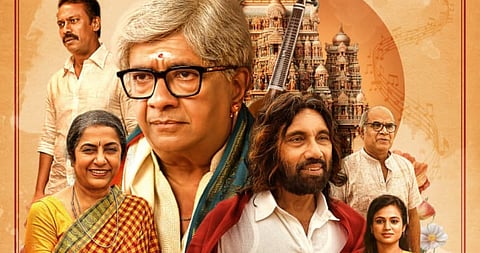

Sweeping lectures about the new generation not safeguarding age-old cultures or not being within the rigid worldview of one single person isn't new to Tamil cinema. The radically angry family members who should know better than to question authority (elder family members). The older generation with a Martyr complex who are revered in the end because they have always known better for everybody else. What happens if you chip off some of the fundamental markers of these tropes and sand it and varnish it so that it looks fresh, you get Suresh Krissna's Charukesi.
Director: Suresh Krissna
Cast: YG Mahendra, Thalaivasal Vijay, Raj Ayyappa, Sriramya Pandian, and Sathyaraj
The film revolves around an aged titular musician, played by YG Mahendra, who is regarded as 'god' by the people surrounding him. See, even if people do amazing things, make paramount sacrifices, and help lift each other up, it shouldn't make them superhuman. Humans are fundamentally flawed. The film forgets this basic rule, and builds up the talent, magnanimity, and philanthropic nature of Charukesi. The film ends up making him a 'god' and we are never able to root for Charukesi's human side. Also in making Charukesi an infalliable character, the film loses a lot of time on dialogues that are just uttered to reinforce what we already know about him. Every single character has to reinforce how Charukesi can never forget anything, how even beyond multiple betrayals he has always done the right thing, to a point where the redundancy becomes claustrophobic. This redundancy in dialogues also extends to reinforcing the direction of the narrative, which pulls back the narrative.
Charukesi is a man, whose life has been consumed by music. But the use of music has not been used to propel the narrative or even establish its importance in the film. Music seems to have been added to the film, simply because a film has to have music. When there aren't many opportunities to connect with the film within the dialogue or the story, music could have been that opportunity.
Nevertheless, music composer Deva delves fully into the Carnatic style and creates uniquely melodic tunes that carry the film. Deva is aided by an enigmatic Shankar Mahadevan, as the singing voice of Charukesi. The singer elevates the composer's tunes by adding his own layers that elevate the film's dramatic nature.
Charukesi is a lot of things. It chronicles the end stages of a man's life, it dissects the relationships between various members of a fractured family, it tries to construct a story debating some spiritual and philosophical arguements. But it ends up being a lecture. A lecture from a man, who might mean well, but has morals that is stuck in the past. When a woman is shown in a negative shade, the things that represent her are a chudidhar, or having non-vegetarian food. Even, when one tries to play the devil's advocate and argue that every house has its own rules, terming non-vegetarian food consumption as a wrong thing, is in itself wrong. Idealogical debates aside, Charukesi also goes through a mid-life crisis. In a choice between cutting down on certain scenes to make the film more seamless and retaining them, the film settles for the latter. This weighted and clunky sequence of scenes confuses the audience as to where the film is heading.
Charukesi is filled with performances with people who have believed in their characters. Sathyaraj, who plays a version of God, is able to convincingly deliver sermons on doing the right thing. Meanwhile, a very good Thalaivasal Vijay carries the emotional expression for the entire film, and acts his heart out. While Charukesi can remind you of age-old Tamil cinema tropes wrapped in some new-age making, the film misses the beat quite often.
