
Habeebi Movie Review:
What is life without the namma ooru mann vasanai? The weight of these words hit hard, more so in the aftermath of veteran filmmaker Bharathiraja’s demise who spearheaded several stories in the hinterlands of Southern India. Meera Kathiravan’s latest film Habeebi too falls in this genre and revolves around a Muslim family’s changing dynamics through the decades as they grapple with loss of livelihood. At its core, the film is a long love story—between couples, school kids, and even the craft of handloom weaving. Movies in the genre are aplenty, but its treatment is what makes it stand apart. While romantic movies set inside a Muslim household are sparse, Habeebi fails to channel the potential it possesses and succumbs to the same narrative cliches that it wants to move away from.
Cast: Kasthuri Raja, Esha, Malavika Manoj, Dhanasree Sudhakaran and others
Director: Meera Kathiravan
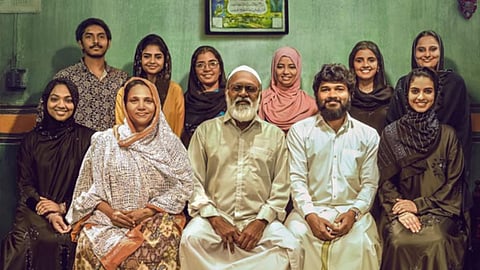
Mohammed Yusuf (Kasthuri Raja), a staunch patriarch, doesn’t want to let go of his craft amid rapid industrialisation. In his own words, the sound of weaving was his first lullaby when he was born. As his brother heads to West Asia for job opportunities, time does little to heal Yusuf as he constantly faces pressure to cut ties with his generational craft. Yusuf’s son Abu Tahir (Esha) is his soft spot. Abu Tahir and his neighbour Niloufer (Malavika Manoj) are love birds stuck in their own cages. It is worth noting that Niloufer travels through the film sans dialogues and has little to no agency in a world that scrutinises women outside their houses.
It is commendable that the filmmaker stays true to the Kadayanallur setting, and showcases practices observed in Muslim household. The film visually depicts the agony of being separated from a partner who chooses to move abroad seeking financial stability. But these depictions in scenes like a man pining in love or languishing in the funeral of a loved one are just too long. When the camera can switch across decades within a few scenes, why does it choose in linger in places where it overstays its welcome? In fact, the film’s central conflict is presented just few minutes before the intermission. Until then, it merrily gestates in its simplicity and the lovey-dovey nature of its characters.
It is clear that Meera wants to underline a person's connection to their roots and hometown, while establishing that the heart often wants what it wants. The emotional pull is evident, and the pain of that separation feels authentic. The director never villainises the one making that hard choice to leave. In fact, he acknowledges the realities that drive young people to seek opportunities elsewhere—to fill their stomachs and their wallets. It also has one of my favourite scenes where Abu Tahir’s chacha and chachi find comfort in each other’s’ voices through cassettes as they navigate the pain of mundanity. However, Habeebi places one too many signposts around the downsides of that decision that it unintentionally comes across less as a nuanced exploration and more as a discouragement masquerading as empathy.
Kasthuri Raja brings an earnest portrayal to Yusuf, a man who is struggling to come to terms with a world that he no longer recognises. The music of Sam CS music lifts the story when it falters and adds emotional weight to it. But the best character in the film is Dhanasree Sudhakaran’s Parveen who quotes lines from Ambedkar, Periyar and Martin Luther King. She wields her abaya but emphasises the need for women to speak up. In one key scene, she holds up a mirror to the protagonist on how silence doesn’t indicate obedience and manners, but is in fact sometimes, deeply disrespectful. Her scenes are short, but notable enough to make an impact. But Habeebi doesn’t capitalise on these pivotal moments. Instead of exploring politics, Habeebi's focus is on Yusuf and his family, and nothing else. However, many a time, we are left confused about Abu Tahir’s mental state and where his heart actually lies. Who is he really, beyond his responsibilities and family?
In the end, Habeebi talks about everyone’s journey to the Gulf, but despite all that travel, the film itself never quite arrives anywhere.
