
Arulvaan Movie Review:
It is perhaps a testament to the power of storytelling and cinema that no matter how important your message is, if you don’t respect the medium enough, the film doesn’t even work as a competent PSA (Public Service Announcement). Arulvaan follows a young tribal girl and her quest to find education, after she sees how her illiterate tribal community is exploited and oppressed by the ones in power. There is an all-encompassing unidimensionality to the film's making. It is as if the director was hoping you would be moved enough by the very real issue shown that you would give the shoddy making a pass. Which, ironically, translates to an (hopefully) unintentional form of exploitation despite the supposed noble intention.
Director: Ganesh Vinayakan
Cast: Arulnithi, Kritika, Arav, Ramya Pandian
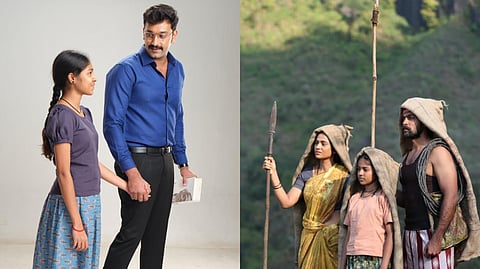
Director Ganesh Vinayakan makes an effort to have the actors speak the Kaadar tribal language. The effort makes you want to forgive the fact that every Kaadar monologue is followed by someone translating it into Tamil, even though Kaadar is a fairly perceptible mix of Tamil and Malayalam. While (a largely confused-looking) Arulnithi appears in an extended cameo as the Theni district Collector, the standout performer is undeniably Kritika, who plays the young tribal girl Kurinji. One of the few good directorial choices in the film is trusting Kritika with emotionally heavy scenes. However, the director loses all that goodwill when Ramya Pandian ends up playing an adult version of Kurinji in the climax, taking over what is essentially a cathartic moment for the character, making it feel unearned.
Arav, who plays Kurinji’s father, delivers a performance devoid of any understanding of his character's interiority. The wooden performance reaches unbearable heights when he is given a Kantara-esque ‘saami aaduthal’ (the lord's dance) sequence towards the middle. John Vijay plays yet another perverted cop. He could probably have added some flavour to the film with his signature wackiness, but for some reason, after all this time, he picks Arulvaan to play it straight and suffers under a sluggish script anyway. Even before a scene plays out, the music tells you how to feel. Even before you spot John Vijay sitting in the jeep, the ‘sleazy cop’ bgm starts playing. Yes, the music that played in your head when you read ‘sleazy cop’, that one. GV Prakash’s palpable impatience to be done with the film was the most relatable aspect about it.
The dialogues in Arulvaan represent the major philosophical issues with the making of the film. Everyone speaks in a sappy, old-fashioned manner, which isn’t a problem on its own. But when you are trying to make a film feel grounded and realistic, it helps to make the characters talk like real people, and not classical theatre artists who speak with measured pauses and poetic flourishes. It instantly takes you out of the film when, after an emotional moment where the tribal chief is humiliated, Arav's character says, “Saamikku vecha padayala naai nakkuna adhu saamiya asinga paduthuna maari aagathu” (If a dog takes a bite out of the offering to the gods, it is not an offense to the gods), or when Arulnithi's character says, “Unakku kalvi ah naan kudukkuren,” (I will provide education for you), instead of just going, “Unna naan padikka vekkiren,” (I will help you get educated), like how someone would say in a contemporary setting. These types of writing choices should have ideally been protected under ‘creative liberty,’ but not when it is awkwardly placed in a film that tries hard to present itself as a rooted story. Arulvaan’s desperation to shove its message down your throat reaches absurd heights when it finally lets go of its pretense of being a film and starts showing various real news clips of tribals fighting against the system during the credits. This isn’t unusual; we have seen films do this, but here, the news clips are far more impactful.
