
DC Movie Review:
Redemption. There is something cathartic about seeing someone find a way to stand up despite the odds being heavily stacked against them. Such a redemptive arc isn’t accorded to the ordinary. It requires immense grit, perseverance, and of course, atleast a sliver of luck going your way. Probably why the majority, who resign to their fates, see the underdog as an extension of their own unfulfilled dreams. They want to root for the person who society leaves to rot. Be it Rocky, Saani Kaayidham, Captain Miller, or DC, director Arun Matheswaran is clear about the stories he wants to tell. These are not stories of the people Tamil cinema always loves to tell. These people are, let’s call them, Arun Matheswaran’s Irregulars. They are the people whose lives are forever on the fringe. People whose lives are never important enough for the majority. However, these stories didn’t always translate into convincing cinema since the sum of the parts didn’t do much for the whole. But the fourth time is the charm for Arun, and almost everything fell into place in DC, and it all started when he signed this one person called Anirudh Ravichander.
Director: Arun Matheswaran
Cast: Lokesh Kanagaraj, Wamiqa Gabbi, Sanjana, Avinash
Anirudh’s soundtrack is the lifeline of DC. It is through his music that we acclimatise ourselves to the raw and gritty nature of Devadas (a competent Lokesh Kanagaraj) and the dreamy yet dreary life of Parvathi (a lovely Sanjana). But before the paths of Das and Parvathi come together, we first see why the former is on the run, and it plays out like an Arun Matheswaran showreel. We have seen his previous films have similar beats, but things feel different here. There is a gang that is branded naxals or terrorists by the cops, and the gang firmly believes that the people after them are no different. In fact, when a senior cop sends a dedicated task force to go after the gang, led by Arasu (A solid Thalaivasal Vijay), the uniformed upholder of law and justice says, “Be brutal.” In this film, systemic oppression and institutional violence aren’t an outlier, but the norm. When the gang hits back, the violence doesn’t really feel gratuitous, but that doesn’t mean it is glorified, either. There is a neat balance that Arun brings to these proceedings.
The film does begin with a thanks card to Sarat Chandra Chattopadhyay, the author of the famous novel, Devdas. DC’s Devadas is a man who craves unadulterated love from a woman. He thinks Parvathi can give that to him because she reminds him of his mother. In a way, they are meeting in a palatial bungalow of sorts, and the entire universe conspires to keep them away from each other. They meet as strangers, and when Devadas, who has spent his life running away from love, runs towards it, catastrophe ensues. In fact, this is a commonality in all of the equations Devadas shares with the people around him. He puts her in harm’s way because he dared to develop feelings for her. Would he dare to do that again? Would Chandra make him do that again?
Arun Matheswaran, known for his visual aesthetic, especially the long black-and-white shots, and the Tarantinoesque way of dividing his films into chapters, doesn’t resort to those machinations in DC. Here, he holds on to his visual aesthetic and chapter divisions, but he doesn’t spell them out loud. We do get huge words overcrowding the screen, but this time, these are locations. Similarly, the dialogues, which might seem too out of place in his films, feel well-placed in DC because its protagonists are people constantly on the run. A huge crime in one location, followed by a bigger crime in another, and then another, and then another again, and the list goes on. Leading the hunt is officer Bojaraj (An effective Krish Dayal), a no-nonsense cop who believes sentiment is their biggest enemy. Now, this sentiment is shared by Das’ friend, Kitty (A solid Avinash Raghudevan). Both the hunters and the prey interchange places often, and there are so many people who are killed in the most grotesque of ways that a single bullet to the head feels the easiest way out.
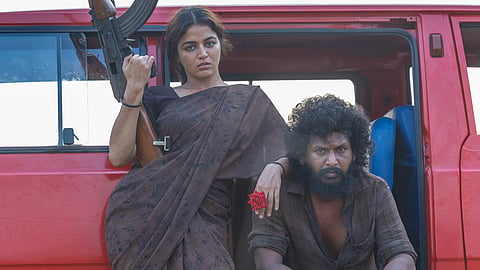
It is in this melee of bullets, brutality, and barbarism that Das meets Chandra for the first time. She is a sex worker, and the first time we meet her, she is watching Moondram Pirai. The Seenu who saves her from her godforsaken existence is named Das. This is one of the more gorgeously shot scenes in the film. Every frame, every angle, every camera movement is orchestrated with perfection. We know the happenings aren’t organic, but it is riveting. You can’t take your eyes off the screen even if blood is being sprayed all over the screen, limbs are being strewn, and bones are being crunched. The excessive gore is offset by the strong emotional core of the entire sequence. Das’ bloody rampage isn’t just for Chandra. It is for the ones he was forced to leave behind, and we are shown glimpses of the trail, and full points to GK Prasanna’s editing that seamlessly stitches together all of this bloody mess. Once Chandra enters the picture, DC becomes complete, and it ends up being more than just a Devadas redux. The allusions to Bonnie and Clyde, and even Thelma and Louise, feel like the natural scheme of things. What else can you do when you are telling the story of two fugitives? Yet, these portions feel organic because the gradual blossoming of trust between Devadas and Chandra isn’t built on love, but the lack of it. As they say, misery loves company.
Arun Matheswaran populates this hellish world with all kinds of people who are 50 shades of grey. A cop, who misses home and has a conscience, can’t really stop extra-judicial killings. Another cop, who believes in safeguarding the integrity of policing, doesn’t really mind being trigger-happy. And then, you have Devadas and Co, who have differing sets of moral values. Is there honour among thieves? But then, Arun expands the definition of thieves, includes a few police officers in this bracket, and asks, “Quis custodiet ipsos custodes? (Who watches the watchers?).”
What if the answer to this question is Devadas and Co? Now, who do you root for? In fact, Arun often asks this question through his films. When someone who is expected to do right does wrong, shouldn’t the vengeance be multifold? Probably why the violence against the oppressors is showcased in its unadulterated form. Of course, there are just enough cutaway shots to not show the extent of violence capable by the men and women in this film. The stunt choreography by PC Stunts wants you to feel visceral violence, and not brush it away as videogame action setpieces. The emotional upheaval in these scenes lends the violence a bit of a sense, and the payoffs are almost always worth it. In fact, it is the novelty in the stunt choreography that makes you not be overwhelmed by the relentless bloodshed, maiming, and killing. There can be a case made against the profanity-laden conversations in DC, but Arun gets it right by building it up on a strong emotional base.
Just like all of Arun’s films, DC also boasts of terrific visuals (Mukesh G) and intricate production design (Kannan S) that make even the most mangled of scenes look like a painting. Be it the interval block where lighting a matchstick illuminates Devadas and Chandra against a car’s mirror, or the climactic sequence where we see a novel approach to the spreading of smoke and debris after a bomb blast. But what DC gets absolutely right is that this technical wizardry elevates a strong story that revolves around romance, redemption, and revenge.
It is Arun’s most accessible, entertaining, and engaging film, and it gives Lokesh Kanagaraj the safest acting debut. Lokesh is given this brooding, alcohol-friendly role where his fists and weapons do most of the talking. But he is quite effective in the quieter moments, as well, especially the scene where he has to subdue a wild Chandra after a particularly violent episode. Arun does a wonderful job with the casting as every actor proves why they deserve more chances. The ever-consistent Avinash is the perfect foil to the mercurial nature of Das. There is something ethereal yet vulnerable about Sanjana’s performance as Parvathy, which is the soul of the film. It is her character arc that defines Devadas’ approach to Chandra, and the way the writing connects them both was such a beautiful knot. And of course, Wamiqa, as Chandra, brings an unfiltered innocence to a dangerous character. She is a femme fatale meets damsel in distress, and it is a fascinating balance.
In many ways, DC is all about redemption. The redemption of Devadas, his father (Kasthuri Raja), his gang, Chandra, and even the bunch of cops on the gang’s trail. But it is beautiful how cinema has a way of dotting all the i’s and crossing all the t’s. Tamil cinema has seen many rewrite their own history to rise up from oblivion. Such redemptive arcs aren’t accorded to the ordinary. It requires immense grit, perseverance, and of course, atleast a sliver of luck going your way. And that’s exactly what has happened in the lives of Arun Matheswaran and Lokesh Kanagaraj. They were no pushovers earlier, but social media has a way of humbling even the best of us. However, with DC, these two have found a way to rise up to the very top, and thanks to Anirudh, no redemption tune has sounded better.
