
Kara Movie Review:
Metier. Many people go years without knowing what they are actually good at, while others understand it in an instant. The people who fall into the latter category have a thin rope to walk on. Should they stick to what they know? Should they attempt to break free from their own boundaries? What should they be judged for? What if you are good at something that the world isn’t ready to have a conversation about? What is the yardstick to measure their success? It is beautiful how these questions can be asked of both the director, Vignesh Raja, and the protagonist of his sophomore film, Kara.
Director: Vignesh Raja
Cast: Dhanush, Suraj Venjaramoodu, Jayaram, Mamitha Baiju, Karunaas
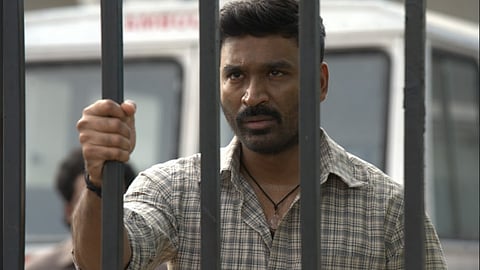
Vignesh Raja, who has written the film with Alfred Prakash, wastes no time in pulling us right into the world of Kara. We meet Karasaami (Dhanush), a professional thief, as he embarks on his ‘One Last Job.’ Right from the time of The Italian Job to Ocean’s Eleven, or even Naanayam and Lucky Bhaskar, we know what it means when the protagonist says, ‘One Last Time.’ Murphy’s Law comes into action, and everything that can go wrong goes wrong, and Kara finds himself between a rock and a hardened cop, Bharathan (Suraj Venjaramoodu). As the system closes in on him, Kara gets intertwined in a cat-and-mouse game with Bharathan, but the writers have other plans in between.
It is these plans that blow hot and cold in Kara. There’s a layer involving Kara’s fractured relationship with his father, Thangasami (KS Ravikumar). There’s a layer involving Kara’s romantic and fruitful relationship with his wife, Selli (Mamitha Baiju). There’s a layer involving Kara’s familiar but frayed relationship with his uncle (Karunaas). Now, each of these equations could be a film in itself, but Vignesh and Alfred choose to treat it sparingly and focus on building a treatise on how every system in our society is built on the oppression of the voiceless. Dhanush isn’t new to championing such causes, and in Kara, he is fighting not just the police system but also the banking sector.
While these portions are the most compelling in Kara, the film takes its own sweet time to get here. There are some writing flourishes here that play right up the alley of Vignesh and Alfred, who love employing a couple of Chekov’s Guns, and have done enough in Por Thozhil to make us believe that every single word uttered in the film has a reason for its existence. If you see Kara lifting a sack somewhere or there is a tractor rotting away on a barren field, you expect a payoff. And the magic of this writing lies in the when… and not the if.
However, this magic doesn’t always make you go a-ha in Kara. At some point, all these connections and the rug being pulled out from under us feel like an attempt to mask something more fundamentally flawed. And this becomes clear when the film reaches its final stretch. Suddenly, characters that were serious and reeking villainy resort to comic antics that pull us out of the film in an instant. Their arcs lead to such random resolutions that they risk eroding all the goodwill the film had earned up to that point. Some characters are also conveniently forgotten, only to be brought back to add an extra layer of sentimentality that is clearly artificial but passes muster due to rock-solid performances.
Leading from the front, as always, is Dhanush, who showcases a rather internalised performance that keeps you in anticipation of the assured unleash. Where there is restraint, there is retribution, and yet, both Vignesh and Dhanush ensure that his stardom never overshadows the character. There are glimpses, of course, but it never overstays its welcome. Vignesh also utilises Dhanush to the fullest, and the scenes where he opens up to his father and mother separately are the standouts in the film. The way he stages the scene where Kara breaks down in front of his mother stands in stark contrast to the setting of a similar scene with his father. He could walk away from one setting, but is cornered in another. Dhanush brings in a physicality to the character that very few actors can do convincingly. He is vulnerable by choice, and helpless by coincidence, and he never lets himself and the others around him forget that. Mamitha plays Selli in the film, and she gets to ugly-cry twice, says ‘there-there’ to Kara a couple of times, reminds him that she exists in his world, and poof! She vanishes.
While both Suraj, as the hardened cop with an agenda, and Jayaram, as the crooked bank manager with an agenda, get author-backed roles, it is a pity that they end up as pale shadows of their earlier selves in the first half of the film. The shift from menace and malice to helplessness and humour doesn’t bode well for a film that takes its seriousness seriously.
Karunaas has a lot of fun in Kara, and there is a phone booth scene between him and Dhanush that might remind us of their iconic scene from Yaaradi Nee Mohini. But this time, they share a supremely effective and completely different equation. Apart from solid sentimental scenes, they are also involved in a couple of wonderfully staged comedy scenes that come out of nowhere, and stand tall because when we let out that final laugh, it has shades of mirth, and not once do we move away from the narrative. That is why it is infuriating when the makers suddenly go out of their way to insert reaction shots that reduce other characters into caricatures. What should have been an intense cat-and-mouse chase becomes less of a hunt and more of a hurry.
Kara is set in the early 90s, and there is an allusion to the Gulf War, which has led to a fuel shortage. While this does play a very important part in the narrative, the time period also allows this heist film not to worry about cellphones, pagers, CCTVs, etc. So, when heists are planned, all that is required is to cut off the electrical supply, and things are hunky dory. Of course, in retrospect, one can nitpick many aspects of the film, but while watching it, the staging of these heist sequences is so engrossing that such questions are mere afterthoughts. Similarly, since this film has its fair share of heists and hoodwinking the police, the writing establishes the Modus Operandi once and expects us to join the ride. To have such expectations is par for the course, but we have come to expect better from everyone involved in the film. When we are asked to take leaps of faith, we do, but there is a quiet disappointment in a few of those jumps.
Coming back to the staging of these heists, which take up almost half the runtime of the film, Kara shines brightest in these scenes. With visuals by Theni Eswar, production design by Mayapandi, editing by Sreejith Sarang, and stunts by Dinesh Kasi, Vignesh puts together a technically brilliant film. No two heists look the same, and there is immaculate work that has gone into mounting these sequences. With the film also featuring many night sequences, the absence of electricity allows Eswar to play with shadows and light, and, ironically, makes every frame look like an electrified painting. Even Dinesh Kasi's stunts deliver the right doses of heroism without going overboard. We only see Karasaami in these scenes, even if there is a slow-mo walk to elevate the star. While some of the background score by GV Prakash Kumar adds to the urgency of the film, some others are coercive, which takes us away from the narrative. The song placements are also too cramped, which is why the titular song, when it finally comes, feels like a whiff of fresh air despite the rousing beats.
As long as the film isn’t interested in being a star vehicle, Kara works wonderfully. The titular character is slapped around by many for his actions, and you never once feel bad for him. And yet, there can be no doubt that he is the hero. For the longest time, Kara gets this balance right, but once the petty thief decides to take a turn to become something bigger, like a hero… the film sacrifices itself for the seemingly greater good. However, it is anything but that, and Kara risks becoming the equivalent of pledging your land to buy a tractor during the Gulf War. Anyone sidestepping one’s métier to adhere to the external voices that scream about conformity and greater good must always remember one thing: The system, however tainted, will always collect its dues.
