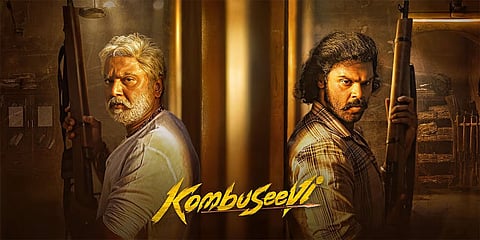

Kombuseevi Movie Review:
Asking us to think about the greater good or to look at the bigger picture is often an excuse to justify issues that affect a select few. But when you are shown the magnitude of these issues, can you actually feel righteous about doing the 'greater good' and looking at the 'bigger picture'? Ponram's Kombuseevi tells the story of the pawns who were sacrificed for the king and the kingdom. The story about the 12 villages that were left defenceless for the sake of building a dam that could benefit four districts needs to be told, but in Kombuseevi, it loses its gravitas because it ends up as a... typical Ponram film.
Kombuseevi begins in a village near Andipatti, where Rokkapuli (Sarathkumar) is introduced as a ruffian-cum-messiah, who turns to unscrupulous activities like violence and ganja smuggling. He chooses this life since he was forced out of his village and livelihood due to the construction of a dam in the Vaigai River. Scenes later, we see a young Pandi, who is orphaned as both his parents die due to unbearable debts in the face of challenges caused by the construction of the dam. Soon enough, a grown-up Pandi (Shanmuga Pandian Vijayakant) too takes to lawlessness, under the wing of Rokkapuli, who is now the only person the former can call his family. The duo challenges the law and tries to enrich themselves and their villagers. Their path is fraught with dangers and crimes.
The comparisons to Varuthapadatha Valibar Sangam are inevitable, both because of the subtle messaging and the dynamics between an elderly person and a youngster. What worked in favour of the 2013 film is that it never deviated from its tonality despite taking up honour killing as one of its pivotal plot points. More importantly, it doesn't even hint at taking the messaging route. On the other hand, Kombuseevi wants to have it both ways by taking on a heavy subject, and trying to inject funny scenes one after another. Unfortunately, neither works in complete favour of the film.
Cast: Sarathkumar, Shanmuga Pandian Vijayakant, Tharunika
Director: Ponram
Satire is Ponram's strongest suit. Like his lead characters, he too voyages into some uncharted territories imm this film. He does try to marry his sensibilities to the action-heavy detours in Kombuseevi, but the seams are starting to fray, and we see him fight a losing battle. We do see occasional flourishes in the writing that gives us a glimpse into what Ponram once did with ease. Take debutant Tharunika, who plays police inspector Laila in the movie, showing promise that her performance might just set the primary plot point in motion. The greyness and unpredictability in her characterisation were fresh and delightful to watch. Laila could have just been the missing piece in the puzzle. On the verge of solving the puzzle, Ponram decides to change the game. To give his action ambition wings, he introduces a North Indian SP. We never understood why Laila, who was on a roll for a good 15-20 minutes, was shafted out of the proceedings to accommodate a disdainful 'Hindi officer', who does nothing but scorn.
There is no explanation why the first half ends where it does, except for Ponram wanting to rebrand himself as an action director. This incident's impact doesn't last beyond one courtroom scene, a few chuckles, and a Vijayakant reference. What Ponram has remained faithful to is his inherent need to give a lighter finish to a serious scene. This mostly works due to Sarathkumar and Shanmuga Pandian doing a decent, if not impeccable, job. Another writing joy comes in the form of the veteran actor with a score of actioners under his belt and the newcomer who has the trappings to become an action star, making light of their destructive acts. Rokkapuli, for instance, in a scene, enters the charred police station he has set fire to, looks around, and appreciates himself, saying, "Paravala nalla erichirukkomla." If not for such moments, the film would have been hard to sit through. The second half wades into an elaborate comedy sequence, which was mildly enjoyable but served no purpose, since we are suddenly thrown into the climactic proceedings. Despite laughing at the jokes, one can't help but think if the lead characters, especially in the last half hour, could have done something beneficial to their villagers or even to themselves! After a point, we grow restless, waiting for the film to end.
Ponram, fancying grand ambitions, fails to repeat his previous successes that required just a simple story plotted with laughs. We forgive the film for what it does when the post-credit scene begins rolling. The evident discordance between his sensibilities and what he tries to accomplish surfaces in that scene. Ponram speaks to the villagers about the benefits of the dam, when the film claimed to speak for the affected. With the skewed messaging, Kombuseevi cuts a sorry figure and serves as a lesson for filmmakers not to sacrifice their strengths at the altar of experimentation.
