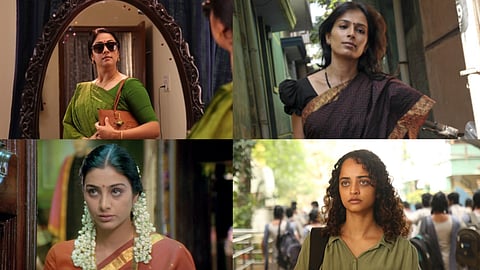

There was an era where we grew up seeing women as the emotional anchors of the household, often confined to their domiciles and the duties within them. But the new wave of cinema has transformed them, empowering them with greater agency. Consequently, we are now accustomed to seeing the ‘strong survivor’, the women who take desperate risks just to protect themselves and/or their families.
Kolamaavu Kokila (2018) serves as the ultimate blueprint for this new-age protector. We see Kokila (Nayanthara) as a quiet, innocent woman who gets trapped in a dangerous cocaine trade, but the audience takes sides with Kokila, as her unethical/illegal decisions are rooted in a sense of selfless desperation rather than greed. Her choice is driven by the urgent need for her mother’s medical treatment. It's a survival story built on sacrifice.
However, Aaranya Kaandam (2010) shatters this mold with Subbu (Yasmin Ponnappa), who plays a threatening game solely for her own benefit, with no intention of protecting others. She masterminds a chain of betrayals to escape the shadow of the gangster Singaperumal (Jackie Shroff). By the end, we realise she wasn’t a victim but rather the one leading the story all along. It’s an infrequent look at a female character who chooses a ‘selfish’ and ‘unethical’ path to win her own freedom.
While Subbu and Kokila are both entangled in high-stakes criminal games, these two characters redefine what it means to be a survivor in Tamil cinema. In Saani Kaayidham (2022), Ponni’s (Keerthy Suresh) life is smashed by a senseless act of violent assault. Escorted by her brother, Sangayya (Selvaraghavan), she embarks on an uncooked, bloody, and soaked murder spree as a police constable, taking a brave yet unethical path to hunt down and destroy the people who ruined her life. She really makes you think about how the world works, especially when it comes to injustice. The murders in the film are incredibly cruel, but they reflect the raw rage of a victim who has been left with no other choice. It's a dark, intense look at what happens when a person is pushed to the edge and decides to serve themselves the justice that the system failed to give.
The film Bad Girl (2025), on the other hand, follows a more unconventional, and relatable kind of survival—a battle for personal independence. Ramya (Anjali Sivaraman) is a modern teenager trying to break free from her stereotypical culture. She decides to go against her family’s ‘rules’ to explore life on her own terms.
For many who feel forced to follow strict family traditions, this film hits home. There is an influential moment where Ramya tells her mother, “I actually felt happy, but you had to take it away from me.’’ It’s an unpolished, honest dialogue that many of us have wanted to say to our parents sometimes. In today’s Gen Z world, where these preferences are finally being normalised, Ramya isn’t labelled as a “bad girl’’, she is spotted as someone living the life that many teenagers and young adults secretly long for.
Kaatrin Mozhi (2018) follows Viji (Jyotika), a woman who didn’t complete her schooling and being criticised and mocked by her sisters. She determines to carve out her own identity and succeed in life on her own. She truly loves what she does, bringing a sense of joy and passion to work. But she eventually hits the wall of failing to balance between her personal life and work life. After making a hard sacrifice to come out of her work as a Radio Jockey for her family and she refused to give up on herself, she started a business, and that shift allowed her to become financially independent on her own. The character Viji is a reminder that formal education isn’t the only path to a successful life. She shows that true success comes from finding what you love and having the courage to actually work for it. By staying passionate about her work, she proves that following your heart is just as significant as any degree. Her story inspires every woman to turn their personal interest and joy into a career. No matter where they start.
On the other hand, Kaatrin Mozhi shows Viji turning her passion into a business to bypass her lack of a degree. We see a more deceptive, early blueprint of the independence in Kandukonden Kandukonden, where Sowmya (Tabu) begins as a woman who believes her life is commanded by ‘bad luck’ and responsibility. However, when her family loses everything and moves to the new city, Sowmya enters into the corporate world, working hard for her way up from a receptionist to a software professional.
Like Viji, Sowmya faces the pressure of family expectations and the personal sacrifice. Yet she chooses to become the financial backbone of her family. She doesn’t need a loud violent fling or criminal plot to prove her strength; she simply refuses to let her fates define the future. She chose the ‘unconventional’ path of a career to prove that independence is the ultimate form of luck.
