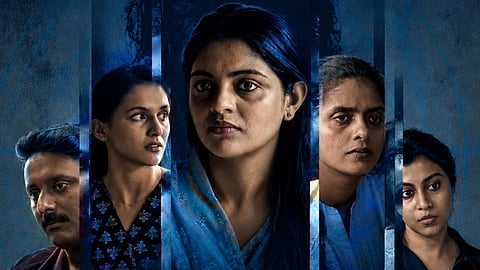

A man begs his ex-girlfriend, who is sitting across from him in a café, to give him one more try. She says no. What happens next is truly terrifying, and it offers insight into the world Uyare filmmaker Manu Ashokan's web series debut, Eyes, is about to delve into. Before the credits even begin, the Sony LIV original makes it clear it wants to explore that strange place where love turns into obsession and rejection becomes punishment.
Director: Manu Ashokan
Writer: Bobby-Sanjay
Cast: Kani Kusruti, Nikhila Vimal, Shruti Ramachandran, Riya Jithu, Prabhu Muralikrishnan, Dev Mohan, Saniya Iyappan, Jaffer Idukki, Anand Manmadhan
Streamer: Sony LIV
It is a topic that is uncomfortably familiar to all of us. Violence against women constantly reminds us of how easy it is for obsession to escalate into control and then finally violence. In Eyes, the senior officer from the police department mentions that it is the twelfth case of murder in four years, even though there have been complaints against the accused. As we see, the police have been limited to issuing warnings. It is an annoying truth, and the show revolves around this central theme. Can one identify the warning signs before the stalker turns violent?
That's where we are acquainted with the experiment attempted by the Kerala Police. The men who keep getting charged with stalking are made to undergo a psychological evaluation in an attempt to prevent them from becoming violent. Tina (Kani Kusruti) and Justin (Prabhu Muralikrishnan) represent the police force. On the psychology side, psychiatrist Aisha (Nikhila Vimal) takes charge, with help from the young psychologist Thanvi (Riya Jithu). Another criminal psychologist, Vidya (Shruti Ramachandran), helps with the monitoring software. A smartwatch keeps track of how close the man is to his victim and whether he is taking his medicine.
It is hard to buy the central idea of Eyes, and the makers seem to know it. The pitch is optimistic, almost naive. Yet director Manu Ashokan and the writer duo Bobby-Sanjay commit to it so wholeheartedly that you go along. The series isn't blind to the flaws in that idea. Vidya’s invention keeps misfiring; she is sinking into debt over it, and the real breakthroughs come from people talking to people. When a monitored man takes his own life, the team breaks apart, and the show circles back to explain how that happened.
The team takes on a series of cases, each revealing a different side of obsession. We meet a photographer and the actress he imagines is his partner, a supermarket worker and her boyfriend (plus his nasty father, a terrific turn from Jaffer Idukki), a woman trapped with an alcoholic sweetheart, and an IAS officer whose marriage to a powerful politician’s daughter is in trouble. Each story is more disturbing than the last, depicting the consequences of not accepting rejection. The most compelling case is of the IAS couple. Dev Mohan takes on the role of Sajin, Saniya Iyappan plays Shobitha, and over the course of two episodes the writing deliberately fails to reveal who is treating whom unfairly. In all the other cases, the moral boundaries are clear. With this one, the team hesitates, doubts itself and argues, just as we do.
The writers also refuse to offer simple reassurance; it is clear the team cannot rescue everyone. One of the most honest moments in the series is the way it shows the team coming to the realisation that offering help is of no use to someone who does not think she deserves it. The expectations of the family and the pressure from society keep women in harmful relationships for a lot longer than people outside the situation suppose, and the series recognises this.
Bobby-Sanjay have always handled relationships under strain well. Their work with Manu on Uyare and Kaanekkane proved it, and it carries over here despite the shift to police procedurals. The victim and the stalker in each case feel like specific people, and so do the team members, whose private lives (a strained marriage, a controlling fiancé, a business near collapse) keep intruding. Women anchor this story, and they are allowed to disagree with, correct and confront one another. That kind of sisterhood is rarely written this well, perhaps because the original story comes from a woman, Anjana Nayar, with Bobby-Sanjay shaping it into the screenplay.
As for the performances, Kani Kusruti as Tina is on familiar ground, carrying the role with her quintessential dry smirks and no-nonsense attitude. She does a fine job, making the character engaging without ever seeming to try too hard. Nikhila Vimal brings a steady, lived-in restraint to Aisha. Shruti Ramachandran is convincing as Vidya, whose faith in her own creation slowly curdles into desperation. Prabhu Muralikrishnan plays Justin with an easy, understated charm. He is the team’s bridge between policing and technology, and his awkwardness about his own heartbreak adds a human texture that the procedural setting needs.
What works best in Eyes is its constant refusal to dress up stalking as love gone wrong. The series understands the entitlement behind such behaviour, as well as the social pressures that make it harder for women to walk away. The trouble is, it takes its time getting there.
At around 50 minutes an episode, seven episodes feel a little excessive, especially when some storylines have already said all they need to. Still, the first episode's closing moments offer a curious detail involving a piece of gift wrapping, and the mystery it leaves behind is reason enough to keep watching. The series offers no easy answers, but it makes a sincere attempt to understand a disturbing reality.
