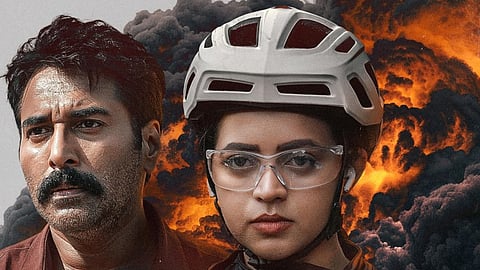

Anomie Movie Review
Anomie: The Equation of Death begins on a note that feels quietly unsettling in the right way. An urban apartment in Kochi. Morning light slipping in. A sister heading out on her bicycle while her brother sleeps, heavy with grief, medication and memories that refuse to loosen their grip. For a brief stretch, the film seems content observing these fragile routines, as if it wants to sit with loss rather than rush towards thrills. It is a mood that draws you in. Unfortunately, the film does not trust itself enough to stay there.
Director: Riyas Marath
Cast: Bhavana, Rahman, Vishnu Agasthya, Binu Pappu
The story kicks into motion when Ziaan, a young man struggling with trauma and suicidal tendencies, goes missing. His death soon follows, and the police are quick to close the case as suicide, citing his psychiatric history. His sister Zaara, however, refuses to accept this version of events. Certain details do not sit right with her, and grief slowly turns into resolve. What follows is her determined attempt to uncover the truth behind her brother’s death, even as the system around her grows impatient and defensive.
Directed by debutant Riyas Marath, the film wears the structure of a familiar crime thriller and makes little effort to disguise it. There is one suspicious death, then another, all conveniently tied together by similar circumstances. The police lean on easy conclusions, and the narrative sets up its central conflict between institutional apathy and personal conviction. The makers' attempt to elevate Anomie above the usual serial killer template is its medical and speculative science-driven idea, one that gestures towards questions of death, consciousness, and ethics. The ambition is clear and even admirable. The disappointment lies in how predictably the film chooses to arrive there, borrowing from well-worn serial killer tropes.
The first half, which runs close to an hour, moves along at a decent pace. It introduces Zaara Philip, a forensic expert played by Bhavana, her troubled brother Ziaan, and Inspector Ghibran, portrayed by Rahman. The writing here is straightforward and often unimaginative, but it remains focused. The emotional bond between the siblings is established with some sincerity, and for a while, that connection anchors the film. As the narrative shifts its focus towards Ghibran’s investigation and his need to redeem a faltering career, that emotional centre begins to fade, replaced by procedural beats we have seen many times before.
Bhavana remains the strongest reason to stay invested. As Zaara, she brings a quiet authority and emotional steadiness that the writing does not always support. The role is clearly designed to be author-backed, and while it does not push her abilities into challenging territory, her screen presence does a lot of invisible work. There are moments where her eyes communicate more grief and resolve than the dialogue allows, helping smooth over several narrative cracks.
Rahman, as Ghibran, is serviceable but rarely memorable. He fits comfortably into the familiar mould of the conflicted, angry cop haunted by past failures. Beyond the two leads, the supporting cast leaves little impact, despite capable actors like Vishnu Agasthya and Binu Pappu being on board.
On a technical level, Anomie is mostly impressive. Sujith Sarang’s cinematography stands out, with a recurring blue and yellow palette that gives the film a polished, almost clinical look. Even when the script loses its way, the film rarely looks careless. The sound design is effective in creating an atmosphere of unease, though Harshavardhan Rameshwar’s background score often overplays its hand. The music is almost constantly present, nudging and pushing emotions that might have landed better with a little restraint.
At 152 minutes, Anomie feels far longer than it needs to be. The ideas do not deepen in proportion to the runtime, and the narrative could have benefited immensely from tighter editing. By the time the story moves towards its final reveals, there is a sense of exhaustion rather than intrigue. The twists themselves are neither shocking nor particularly affecting.
The film looks good, sounds polished, and is anchored by a committed central performance from Bhavana. But its high-concept ambitions are weighed down by familiar writing, excessive length, and a reluctance to truly break away from formula. It holds your attention in patches, yet leaves surprisingly little behind once everything is laid bare.
