
Aashaan Movie Review
There is something quietly moving about Aashaan, a film that understands how stubborn, foolish and beautiful the longing to belong to cinema can be. Written and directed by Johnpaul George, who made an impressive debut with the endearing Guppy and followed it up with the middling Ambili, this meta dramedy unfolds as both an affectionate inside joke and a gentle emotional drama. While it occasionally buckles under the weight of its own ambition, Aashaan’s sincerity never wavers. The film knows exactly who it is speaking to: anyone who has waited outside a set, sent one unanswered message too many, or believed that a single opportunity could quietly change everything.
Director: Johnpaul George
Cast: Indrans, Joemon Jyothir, Shobi Thilakan, Bibin Perumbilly, Appunni Sasi, Madan Gowri, Abin Bino
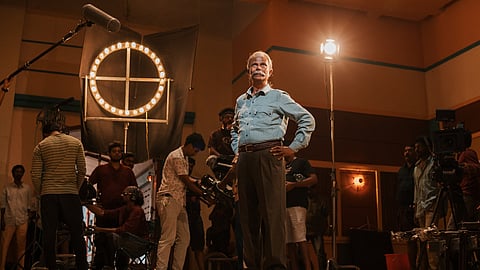
At the centre of the film is not cinema itself, but the titular Aashaan (Indrans), a man who loves it with an almost childlike stubbornness. Everything else, the chaos of filmmaking, the hierarchies of a set and the quiet desperation of newcomers, slowly begins to orbit around him. Aashaan is not merely a character. He is an emotion shaped by longing, patience and resilience.
Indrans turns him into the film’s beating heart with an unforgettably outstanding performance that is restrained, dignified and deeply affecting. There is no attempt to make the character pitiable or comic beyond what is necessary. Instead, Indrans allows silences, glances and small gestures to do the work, trusting the audience to recognise the weight of a dream that has lasted a lifetime.
Aashaan is an elderly man living in an apartment complex, respected by those around him, quietly negotiating illness, loneliness and a lifelong ambition that never quite went away. He wants to act. Not for fame or money, but for the simple joy of being seen on screen, atleast once. He makes reels with earnest enthusiasm, worships stars and still believes that cinema might notice him someday. There is something instantly endearing about this faith. In a culture that often mocks late-blooming dreams, Aashaan stands as a reminder that aspiration does not come with an expiry date.
Running parallel to this is the story of Ananthan (Joemon Jyothir), a visual effects artist from Wayanad who wants nothing more than to enter the film industry as an assistant director. He has talent, patience and genuine passion, but the system keeps pushing him back into the same deadlock. You need experience to work, and work to gain experience. Johnpaul captures this frustration with quiet precision, refusing melodrama in favour of lived experiences. There is humour here, there is irritation, and there is a persistent sadness that comes from watching time slip away while dreams remain permanently stalled at the threshold.
What makes Ananthan’s arc particularly effective is how ordinary it feels. His struggles are not framed as extraordinary obstacles but as everyday realities that thousands quietly endure. Meetings that go nowhere and promises that dissolve into silence. It effectively mirrors the grinding uncertainty of the industry without romanticising the suffering it produces. Joemon captures that exhaustion beautifully. There is a quiet dignity to his performance, and he holds his own as a near-equal protagonist alongside the titular Aashaan. Like Karthik in Jigarthanda or Udayabhanu in Udayananu Tharam, Ananthan becomes our guide into a system that both feeds on dreams and survives because of them.
The supporting cast adds texture throughout. Shobi Thilakan is excellent as the perpetually cussing director, channelling echoes of his legendary father without imitation. Bibin Perumpally plays the arrogant superstar as a sharp and amusing caricature, without tipping into excess. These characters, exaggerated though they may be, ground the film in an almost autobiographical authenticity.
The first half of Aashaan takes its own sweet time, perhaps a little too much of it. At close to ninety minutes, it could have benefited from a firmer edit. Yet even in its indulgence, the film remains watchable because the gaze behind it is affectionate rather than smug. Much of the humour works, especially if you are familiar with the film set culture. The arrogant hero insulated by entourages, the abusive director who mistakes cruelty for authority and the perpetually suffering assistant directors all feel uncomfortably familiar.
Aashaan is best understood when placed alongside films like Jigarthanda and Udayananu Tharam. Like them, it is not merely about cinema as an industry, but about people whose lives are quietly shaped and bruised by it. Johnpaul occupies the same emotional terrain, though in a gentler way. Where Jigarthanda allows cinema to crash violently into a gangster’s life, and Udayananu Tharam treats an aspiring filmmaker’s dream as a satire driven by ego and manipulation, Aashaan sits somewhere in between. It recognises cinema’s power to inspire and humiliate, but looks at it through softer and more compassionate eyes, as a quiet form of resistance against cynicism.
On a technical level, Aashaan is a quiet marvel. The film’s long post-production period shows on screen, particularly in the confidence with which its various elements come together. Vimal Jose Thachil, making his feature debut as cinematographer, lights the film vibrantly with warmth, finding texture in cramped apartments and an almost lyrical order within the controlled chaos of film sets. The visual effects work by EggWhite is particularly remarkable, especially in the way the film within the film is realised. It looks exactly as rich and convincing as the narrative demands, blurring the line between limitation and imagination in a way that feels thematically apt.
Johnpaul’s debut as music director also pays off, extending the emotional atmosphere. ‘Kunjikkavil Meghame’ lingers long after the credits roll, not because it demands attention but because it gently earns it. Ajeesh Anto’s background score and M R Rajakrishnan’s sound mixing further deepen the immersive theatrical experience.
The second half is where Aashaan truly finds its voice. The film sheds its early hesitancy and commits fully to its emotional core, becoming more reflective, more playful and ultimately more generous in how it views its characters. It begins to trust simplicity, allowing moments to unfold without explanation or embellishment. What remains is a film that may not be perfect, but feels deeply felt. In the end, Aashaan stands as a tender love letter to cinema and to those who continue to orbit it with hope intact. It understands that dreams do not always need fulfilment to be meaningful. Sometimes, simply being seen is enough...
