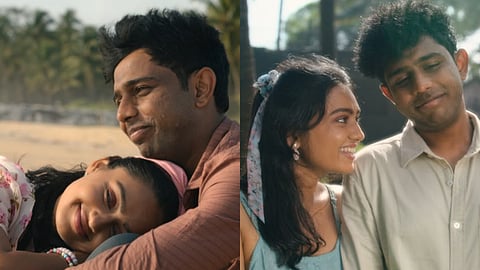

Karthik Sharma’s Bhavantara opens not with a statement of intent but with the kind of everyday intimacy that catches you off guard. You see Madhava (Karthik Sharma and Radha (Tanvi Rao) in the familiar, unassuming shorthand of two people who are both artistically ambitious and in the early stages of their domestic lives. There are dance rehearsals, some cheeky banter and plans for the future made in the most casual of ways. It looks like the very essence of an earnest indie romance, but beneath that easy camaraderie is something else going on. The film is not simply about the transition of a person from one state to another. It is about the emotional debris that is left behind in the wake of that transition. Madhava doesn’t just admire the feminine form from the perspective of a lover or an artist. He feels the feminine form clawing at him from within. And when that reality comes to the surface – not as a theoretical construct, but as Madhavi in a saree and with flowers in her hair – the film becomes an existential confrontation.
Director: Karthik Sharma
Cast: Karthik Sharma, Tanvi Rao, Pranav Sridhar, Shree Vaishnav, Veda Rao
What makes Bhavantara such a compelling piece of drama is the way it establishes a clear, almost brutal duality between its two central characters. Karthik Sharma, who is the director, writer, music composer and lead performer, divides his own performance into two very different physicalities. With Madhava, there is a palpable inwardness... the voice is lower, the shoulders are pulled in, the eyes are full of the kind of caution you would expect of someone hiding something in plain sight. But look at the way his posture settles when he becomes Madhavi. The hesitation is gone. In its place is a mixture of being bold, sorrow and an unshakeable pride of being one. It's a performance which resists the urge to play to the gallery. There are no theatrical gestures, no exaggerated voice modulations. It is the exhaustion of a man who has finally shed a disguise he's lived with for his entire life.
The film’s most intelligent dramatic decision is that it refuses to let Madhavi exist in a vacuum. On the other side of that revelation is Radha who becomes the emotional heart of the film. Most coming of age stories about queerness make the mistake of turning the cis partner into a flat, unfeeling obstacle; Bhavantara doesn't do that. Radha is allowed to be confused, hurt, and heartbroken. When she looks at Madhavi, she is experiencing the real confusion of someone who has just realised that the person she spent her life and planning to build a future around didn't exist in that form. Tanvi’s performance is all in the micro-expressions – the shock of disbelief, the frantic instinct to look for a solution, the utter emptiness of grief that follows. She gives the tragedy its balance, reminding us that finding who you really are on one side can feel like mourning a loss on the other.
The documentary crew traveling with Radha broadens the story. With them is Abhimanyu (Pranav Sridhar), an actor who works with her. He cares for Radha, but he cannot understand what she is going through. His presence reflects the outside world, nudging her to move on while her past breaks apart. Running alongside this is a brief track featuring Radha’s friend, Thriveni. Tucked into the background is a quiet lesbian subplot showing two women dealing with family pressure, marriage, and hidden feelings. Placing this beside Madhavi’s path creates an easy parallel. It shows that queer people everywhere share the same simple fight: to live as they are without having to say sorry. Shree Vaishnav brings offhand humour just when things get too heavy.
Cinematographer Sagar Athalekar captures this well, moving from quiet indoor spaces in Bengaluru to the crowds of Tamil Nadu. The music by Karthik Sharma, is central to the storytelling, and also one of the highlights. The key stretch is set at the Koovagam festival, where trans women marry Lord Aravan for a night and mourn him the next morning. The score blends folk drums, classical tunes, and chants into the scene. When the celebration turns to mourning, the songs mirror Madhavi’s own heartbreak. The crying, the beat of the drums, the broken glass bangles, it shows the grief of an entire group, mirrored in Madhavi’s own fall.
When one person takes on directing, writing, composing, and acting, an indie film can turn into a vanity project, but Bhavantara does not. The film has rough patches, but its intent is clear. It does not beg for tears. It asks you to sit with the pain of someone choosing to live as their real self. And the next time you see queer folk on the street, it makes you want to look past the surface and understand their lives.
