
Karavali Movie Review:
Karavali introduces itself as a film about Kambala. Stay with it a little longer, and it reveals something else. The race is merely the arena; the real competition occurs in the minds of the spectators.
For some, Kambala is worship, and for some others, it's a family tradition they can't let go. For a few, it's the last connection to a lost friend. Gurudatha Ganiga's film repeatedly returns to one idea: traditions survive not because they are old but because each generation fights for its own interpretation of them. This is why Karavali grows into a conversation about legacy, belonging and the price of inheritance.
Yet another tale from the coast, Karavali uses the slush on the race track as an integral part of storytelling. The buffaloes sprint across the track, but the people spend the entire film racing against their past. Every Kambala here carries baggage that has something to do with the sport, but a lot to do with ego, legacy and old wounds.
Director: Gurudatha Ganiga
Cast: Prajwal Devaraj, Raj B Shetty, Mithra, Sridhar, Ramesh Indira, Sampada, Sushmitha Bhat, Vidyamurthy, Govinde Gowda
Perhaps the film's cleverest sleight of hand is that it convinces you this is a story about humans and animals. The buffaloes, like every animal, are the most uncomplicated souls in this universe. They don't recognise status. They don't know whether they sleep under a tiled roof or inside a sprawling estate. They don't measure wealth or power. They recognise only one thing: the hands that raise them. Their loyalty never changes, whereas human loyalty does.
The film even slips in an observation about class. The wealthy wear Kambala like a badge of prestige. The less privileged carry it like a responsibility. One side competes to protect its standing; the other competes because the race is perhaps the only place where standing doesn't matter.
The director deserves credit for not polishing Karavali into a tourist brochure. This coast isn't interested in looking pretty. It smells of wet earth, buffalo hide, sweat and salt. Abhimanyu Sadanandan's camera doesn't stand at a distance admiring the spectacle; it wades into the mud alongside the racers. Sachin Basrur's score is one of the film's highlights, lifting the races while allowing the quieter moments to breathe.
Ironically, the film finds its finest moments away from the finish line.
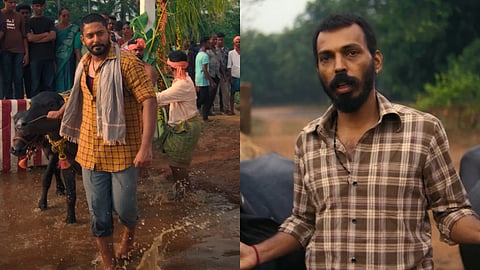
Mithra as Mahabala is bruised but never begging for sympathy. He loves his buffaloes with a devotion that asks for nothing in return, and for someone like Mithra, he enjoys playing such characters. Yet this is also where Karavali leaves you wanting a little more. For a film built around the bond between man and animal, it surprisingly rushes past the small moments that build their bond.. We are told how much Mahabala, or a few other characters love their buffaloes. We see it too. But we rarely get to live inside those moments. A few more scenes of shared silence between man and beast would have made the emotional peaks even more devastating.
Raj B Shetty as Mahaveera appears only briefly, yet refuses to leave the film. Even in his absence, conversations continue to orbit around him. The friendship between Mahaveera and Mahabala becomes the film's emotional thread, proving that some relationships continue breathing through the people left behind.
Prajwal Devaraj occupies an unusual space as Dhananjay, fondly called Dhana, a man returning to the home he once abandoned, forced to confront memory and belonging. Yet the film repeatedly hands its strongest emotional moments to others, making him another participant in the ensemble. His performance is measured and sincere, but the dubbing places an invisible wall between the actor and the audience. This was a talking point before the film released, and watching it only confirms why an actor's voice is often inseparable from the emotion they are trying to communicate.
Ramesh Indira does his best with the role of Adishesha. He doesn't rely on loud theatrics. Instead, he plays the character with confidence, making him more unsettling than someone who simply shouts. Actors like Govinde Gowda and KS Sridhar round off the supporting cast with assured performances.
Karavali carries a few bruises. Some story turns come a little too soon. Mahabala's dream of walking the Ratha Beedhi with Mahaveera is moving, but the film returns to it often enough for the emotion to lose some of its impact. Sampada does well in her role, while Sushmitha Bhat makes an impression before her character disappears too soon. One only wishes the women had more to do in a film so invested in legacy.
Yet Gurudatha Ganiga has made something rare. Not a film that argues whether traditions deserve to survive, but one that asks who pays the price when tradition becomes prestige.
The buffaloes never run for status. They never inherit feuds. They never care whether their owner is rich or poor. Humans do. By the final frame, the race has been won and lost. What remains are the people and the price they pay. The race ends in minutes.
