
Valavaara Movie Review:
Valavaara is not structured like a conventional coming-of-age drama. It does not build towards a defining incident or a moral realisation that neatly resolves its conflicts. Instead, Sutan Gowda’s film, written by him as well, including the story, screenplay, and dialogues, works by accumulation. Scene after scene, it constructs the emotional condition suggested by its title, partiality, not as a flaw in a character but as an atmosphere a child grows up breathing.
The film’s opening is instructive. A man is tied to a tree and beaten, rage etched across his face. The image abruptly collapses into a child waking from a dream, having wet himself in fear. This is not narrative foreshadowing but psychological orientation. Authority, in Valavaara, is introduced before comfort, and fear precedes explanation. By the time the film settles into everyday rural life, the emotional imbalance has already been internalised.
Kundeshi (Master Vedic Kaushal), the elder of two brothers, becomes the film’s point of alignment. He insists on being called by the name his mother uses, rather than his given one, a small but telling assertion of agency. He is watchful, quietly resentful, and deeply attached to his mother. His younger brother, Kosudi (Master Shayan), enjoys an ease of affection with the father that Kundeshi never receives. The film does not dramatise this through confrontations or dialogue-heavy scenes. Instead, it partiality reveals itself in repetition, in who is teased, who is defended, and who is heard.
Director: Sutan Gowda
Cast: Vedic Kaushal, Shayan, Malathesh HV, Harshitha R Gowda, and Abhay S
One of the screenplay’s strengths lies in how it embeds emotional hierarchies within routine activity. A casual game of cricket in a narrow lane. Shirts passed down because they no longer fit someone else. A father being asked to repair the television. A mother counting money from hidden dabbis. None of these moments advance the plot, but each reinforces the family’s internal geometry. The mother repeatedly positions herself between the father and the elder child, acting less as a mediator than as an emotional shock absorber.
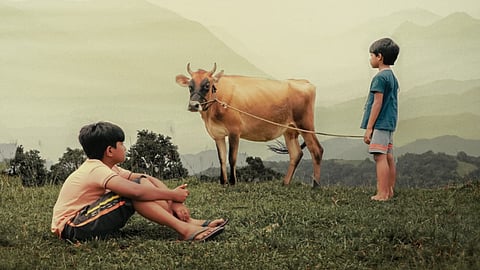
The heavily pregnant cow, Gowra, enters the film almost incidentally. Gradually, she becomes a stabilising presence for Kundeshi. His concern about when she will deliver, his mother explaining that she needs to be walked, and his insistence on caring for her mirror his unspoken need for patience and fairness. Gowra is not a symbol imposed from above. She becomes meaningful because the child invests meaning in her.
When the cow goes missing while grazing, the film commits to a decisive shift. What follows is not an adventure or a suspense-driven search but an extended portrayal of a child’s panic. The demand for money, the borrowed amount, its loss, and the succession of failed plans unfold with uncomfortable inevitability. The screenplay resists narrative mercy. Problems do not resolve because intentions are good, and help arrives too late or in insufficient measure.
What distinguishes this stretch is the film’s refusal to correct Kundeshi’s logic. His attempts, selling a hen from his own house, refusing to return home without the cow, and seeking help from the neighbour Yadukumar (Abhay S), barely older than himself, are flawed but not mocked or moralised. The film remains rigorously aligned with his emotional reasoning, allowing the audience to experience how crisis feels at that age—total, personal, and unforgiving.
There are moments where ethical awareness surfaces quietly. A conversation about why a local lake bears a derogatory name becomes an unexpected moral pause. Kundeshi’s discomfort signals the early formation of conscience, not through instruction but through observation. Even the father is not framed as a villain. His partiality wounds, but it also appears habitual and unexamined.
Valavaara’s emotional credibility is its ensemble, whose performances are inseparable from the film’s narrative flow. Master Vedik Kaushal anchors the film with remarkable restraint, expressing Kundeshi’s fear, anger, and resolve through internalised gestures rather than overt emotion. His silence often carries more weight than dialogue, especially as the crisis around the missing cow deepens. Master Shayan brings an unaffected ease to Kosudi, allowing the younger brother’s privilege and innocence to feel organic rather than constructed. Harshitha R Gowda lends the mother a quiet emotional intelligence, balancing warmth with fatigue, while Malathesh H V’s brief presence as the father is crucial in showing how partiality can exist without overt cruelty. Abhay S, as Yadukumar, adds a contrasting texture, offering a glimpse of street-smart pragmatism that operates outside the family’s moral order. These performances are complemented by atmospheric picturisation and a score that never intrudes, allowing emotion to surface naturally.
The film’s closing movement avoids catharsis. A birthday arrives without a cake, yet a cake-like sweet is cut. The cow finally delivers her calf. Lost money is recovered, but nothing materially improves. The emotional release comes instead through the mother’s words, which wound more deeply than physical punishment. It is here that Valavaara clarifies its central idea. Partiality shapes children not through cruelty alone, but through everyday imbalance.
By choosing observation over explanation, and emotional alignment over dramatic resolution, Valavaara stays with the child’s gaze, allowing sibling difference and uneven affection to speak for themselves.
