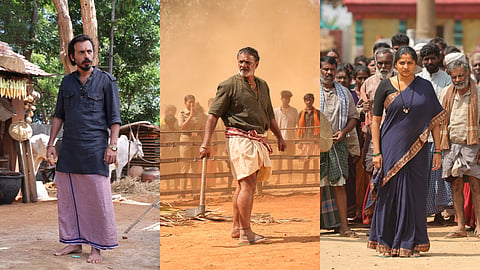

In Indian villages, land is more than soil. It holds memory, lineage, authority, and fear. It decides who can speak, who must obey, and who remains invisible. Why do laborers believe that ownership is a story they cannot tell? How does dignity become conditional, judged not by effort but by birth? Landlord, set in 1980s Kolar, immerses us in a village where laws exist on paper while customs dictate lives. Fields are inherited, disputes are settled in panchayats that prioritise prestige over people, and suppressed anger eventually erupts. Jadeshaa K Hampi’s rustic drama film does not glorify rebellion. It confronts the hard truth of power and questions why respect and rights are privileges of the few.
Kodali Rachayya (Duniya Vijay), once from Ramadurga and now a daily-wage worker in Hulidurga, holds a quietly dangerous dream: cultivating his own two acres. In a system built on inherited dominance, even having aspirations is defiance. Vijay balances raw physicality with weary resignation. His fists may fly, but the exhaustion marked on his face from decades of being told where he belongs lingers longer than any punches. His command of the Kolar dialect roots the character both geographically and socially, making his struggle feel immediate and real.
Director: Jadeshaa K Hampi
Cast: Vijay Kumar, Raj B Shetty, Rachita Ram, Rithnya Vijay, Umashree, Shishir, Rakesh Adiga, Abhi Das, Bhavana Rao, and Gopal Krishna Deshpande
Opposing him is the village’s absolute authority, the landlord (Raj B Shetty), deliberately unnamed. He represents a system rather than a man. His cruelty follows a procedure. Authority here doesn’t need to shout. By stripping him of individuality, the film turns him into a symbol of feudal permanence, dominance passed down like property. Raj B Shetty’s controlled expressions carry a heavy threat in every glance. His carefully draped costume reinforces that power is a tradition, inherited rather than earned.
The moral pivot comes with Rachayya’s daughter Bhagyamma (Rithanya Vijay), a police constable, who weighs duty against feudal command. In her debut, she brings the weight of inherited conscience. Her presence is both determined and gentle, embodying the film’s argument that land is not wealth but continuity. Alongside Rachayya is Ningavva (Rachita Ram), the emotional core of the film. Her rebellion is quiet but persistent; she negotiates survival while protecting her child. Ram conveys this through subtle gestures and controlled expressions. Small, steady acts of defiance speak louder than speeches.
Around these central figures, the village operates like a machine of inequality. Bhavana Rao’s Padma is trapped by ritual. Achyuth Kumar’s policeman knows the truth but cannot act. Sampath Maitreya’s politician offers selective justice. Shishir fights for equality. Gopalakrishna Deshpande’s laborer is too tired to hope. Avinash, Sharath Lohitashwa, and Rakesh Adiga illustrate everyday dominance with understated menace. Together, they show that oppression doesn’t require conspiracy; it only needs to continue. Umashree makes a strong impact in her brief appearance.
Visually, the film convincingly recreates a village from three decades ago, with scenes filled with dust, sweat, and routine. Swamy Gowda’s cinematography immerses viewers, bringing the village to life, while Ajaneesh B Loknath’s score and songs weave into the emotional fabric, heightening tension without distraction. However, narratively, Landlord sometimes relies on familiar rhythms, which we have seen in films like Kaatera and other village-based subjects. The conflict between the powerful and powerless escalates predictably, and commercial elements like fists, fire, and spectacle occasionally overshadow systemic critique. This raises an uncomfortable question: does mass cinema simplify politics because it fears silence, or because it underestimates the audience’s ability to handle moral discomfort?
Yet, Landlord sharpens its focus on labour as politics, examining how systems quietly turn exploitation into a tradition, and tradition into inevitability. It does not dilute its argument. Landlords cannot exist without labourers, yet labourers are denied wages, dignity, and a voice. Change is framed not as charity, but as a delayed, resisted entitlement. History and constitution meet here. Customs older than memory confront a law that is barely decades old, yet morally expansive.
Rachayya might lead the uprising, but the struggle belongs to a community slowly envisioning ownership not just of land, but of destiny. Ultimately, the film asks not who owns the soil, but who is allowed to dream, who is conditioned to obey, and who gets written into history. Sometimes, all it takes to disrupt centuries of silence is the courage to claim a handful of earth and say, “This too is mine.”
Yet the question persists: in villages shaped by centuries of inequality, can cinema capture both the nuance of oppression and the breadth of rebellion without reducing struggle to spectacle? With committed performances from every actor, guided by the director's vision, Landlord portrays lives under landlords with credibility and intensity, revealing how dignity, courage, and resistance manifest in everyday acts of survival. The film prompts us to consider not just who wields power, but who learns to claim it, and whether that claim can ever be denied.
