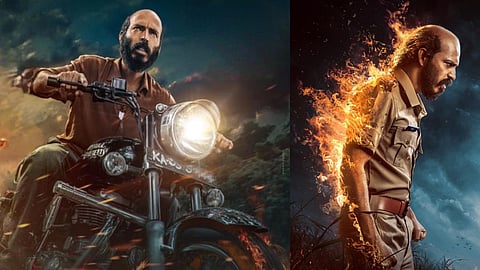

Rakkasapuradhol Movie Review:
Rakkasapuradhol unfolds inside a village where superstition is neither questioned nor casually practised; it is embedded in daily existence. Ritual markings on streets, lemons hanging as protective barriers, and folklore guiding behaviour form a social structure that operates more on inherited belief than rational explanation, and of course, the fear of Kolideva (Torch Ghost). Director Ravi Saranga uses this cultural framework not merely as background but as the narrative’s central driving force.
Into this tightly bound world arrives Shiva (Raj B Shetty), a suspended police officer, who is transferred to what appears to be a low-crime region. Shiva carries visible emotional fractures, he drinks and maintains a detached emotional presence, and functions with a professional instinct dulled by personal unrest. His arrival does not immediately disrupt the village, but his presence gradually exposes its fragile stability.
The village functions under the spiritual authority of priest Siddhaya Swami (B Suresha), whose influence strengthens a belief system that treats omens as warnings and predictions as inevitabilities. The story pays meticulous attention to these symbolic markers. A crow’s call or a crab’s crawl is never staged as a coincidence; each moment becomes a narrative device illustrating how communities validate fear when events begin to align with prophecy.
The illusion of calm fractures when a sequence of disappearances and deaths unsettles the village. What emerges is not a straightforward investigation but a layered conflict where paranoia, rituals, beliefs, and human motivations blur into one another.
The village police station’s relaxed, conversation-driven functioning, combined with the need to climb trees to access a mobile signal, reflects Rakkasapuradhol’s deliberately slow rhythm, where even communication feels uncertain and distant. The question that gradually builds is whether Shiva will be able to find his way through the mystery of the killings. Director Ravi Saranga avoids reducing the narrative into a simplistic clash between faith and logic. Instead, uncertainty dominates, creating a mystery that constantly shifts emotional and psychological ground.
Cast: Raj B Shetty, Anirudh Bhat, Swathishta Krishnan, Archana Kottige, Gopal Deshpande B Suresha, and MS Jahangir
Director: Ravi Saranga
The storyline may initially appear familiar: a rural community governed by superstition confronting unexplained violence, but the screenplay finds strength in its structural discipline. The first half invests time in establishing behavioural patterns and social hierarchies, allowing the audience to absorb the village’s moral ecosystem. The second half alters the film’s pace, particularly during the final stretch, where the narrative compresses into a series of sharply executed twists that sustain tension until the closing moments.
One of the film’s major strengths lies in its management of suspicion. The screenplay repeatedly redistributes doubt, preventing viewers from settling comfortably on one interpretation or suspect. This shifting perspective keeps the mystery psychologically engaging. When the antagonist is finally revealed, the moment does not rely solely on shock value but maintains thematic continuity.
The director also introduces a reflective layer through psychological mirroring between the protagonist and antagonist. Both characters appear shaped by similar emotional wounds, yet their responses to trauma diverge. The film quietly explores how unresolved pain can evolve either into protective instinct or destructive impulse, giving the narrative emotional resonance beyond procedural investigation.
The suspense structure is balanced with intimate personal storytelling. Shiva’s domestic life reflects quiet disintegration. Roopa (Swathisha Krishna) embodies emotional exhaustion, managing household struggles while confronting her husband’s instability. Their relationship is portrayed without overt confrontation, relying instead on emotional distance and unspoken resentment.
Archana Kottige, as Parvathi, Belli’s single mother, adds emotional vulnerability while positioning her family under constant social scrutiny. The developing bond between Shiva and Belli becomes one of the film’s emotional anchors, particularly as Belli’s repeated ghost story, passed down through oral storytelling, reflects how fear and folklore are transmitted across generations.
Supporting characters further enrich the film’s rural moral compass. Performances from Gopal Krishna Deshpande, B Suresha and Jahangir also contribute meaningfully to the narrative’s emotional and thematic layering. A special shoutout must be given to Aniruddh Bhat, who leaves a noticeable impression and delivers a performance that deserves recognition.
Technically, Rakkasapuradhol relies heavily on atmospheric storytelling. Cinematographer William David constructs shadow-dense frames and uneasy spatial compositions that build visual tension without resorting to stylistic excess. The visual tone consistently suggests that danger is lurking just beyond the visible frame. Arjun Janya delivers one of his most controlled background score works, functioning as an emotional undercurrent that heightens suspense.
Producer Ravi Varma’s involvement is evident in the action choreography, which integrates seamlessly into the storytelling rather than existing as a standalone spectacle. The dialogues by Kraanthi Kumar, especially through the humour woven into the police constables (Gowrav Shetty and others), offer carefully timed tonal relief. Mohan B Kere’s production design brings naturalness to the film’s visual environment.
Raj B Shetty approaches Shiva with admirable restraint, choosing internal conflict over expressive dramatics. His performance relies on stillness, silence, physical hesitation, and controlled dialogue delivery, presenting a character who observes more than he reacts. Swathisha Krishna delivers a grounded portrayal despite limited screen time, bringing authenticity to her character’s emotional fatigue. Archana Kottige effectively justifies her role within the emotional framework provided, and the little girl brings her innocent charm.
Rakkasapuradhol attempts to occupy a distinctive space within suspense crime storytelling by blending investigative drama with village folklore-driven psychological tension. The film occasionally reveals minor narrative roughness but sustains intrigue through strong world-building and performance-driven storytelling.
More than its mystery, Rakkasapuradhol remains effective because of its human core. The film suggests that fear rarely emerges from the unknown alone; it often grows from the stories societies choose to believe and protect. The presence of Kolideva, the village’s torch ghost, becomes a subtle metaphor for the emotional shadows haunting its characters. As the story unfolds, the actors carry this weight, becoming the torchbearers of the film’s fear, vulnerability, and tension. And this draws viewers into a world where silence, belief, and suspicion burn slowly, illuminating the delicate line between myth and human truth.
