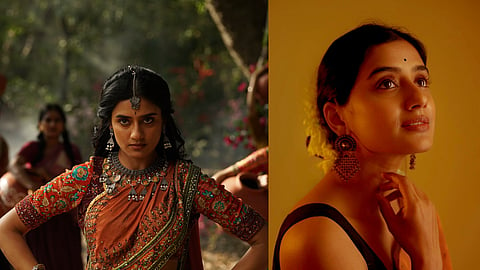

Sushmitha Bhat may already be familiar to audiences, especially after the success of the song, 'Tulasi', composed by Sumedh K. But the Chow Chow Bath actor is steadily carving a path across industries. Having made her presence felt in Kannada, followed by Tamil with Love Marriage opposite Vikram Prabhu, and Malayalam with films like Dominic and the Ladies Purse and Dies Irae, her film journey began in Telugu cinema with Natyam. Now, she is all set to mark her Hindi cinema debut.
Sushmitha will be seen in director Hardik Gajja’s Krishnavataram Part 1, a mythological drama releasing on May 7. She plays Radha and is paired opposite Siddharth Gupta. The film also features JK as King Satrjith and Sanskruti as Sathyabhama, through whose perspective the narrative unfolds.
“Though the story is largely told through Sathyabhama’s eyes, it also explores Krishna and Radha’s relationship. It’s a role with good screen time,” she says.
For an actor who has been testing her mettle across South industries, stepping into Hindi cinema wasn’t something she had planned. “Hindi always felt like a distant space for me. It just happened. I’ve always been drawn to devotional themes, and coming from a slightly orthodox background, the role intrigued me. It all happened suddenly, and the opportunity was completely unexpected.”
Interestingly, Sushmitha was initially considered for a different role. “But after meeting me, the director felt I could pull off Radha,” she adds. Today, having worked across multiple languages, she sees her journey as part of a larger shift in Indian cinema. “The borders are slowly blurring, especially for female actors. Audiences are more aware of talent across industries. We’re no longer confined to one region; it’s becoming one space: Indian cinema.”
For Sushmitha, the journey is as much about growth as it is about discovery. “I enjoy exploring different cultures and languages. I consider myself lucky to know a few languages. I see every project as a learning experience, and I’d love to continue working across as many Indian languages as possible,” she says.
