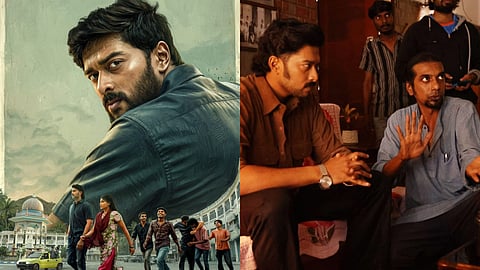

Debut director Viveka does not call himself a scholar of cinema, but a student of cinema. With his debut film, Mango Pachcha, it was about patiently finding a voice and, more importantly, finding the right world to place that voice in. That world, as it turns out, waited with him for six years. Long before Mango Pachcha reached theatres, and long before producers aligned, and casting fell into place, the story existed in fragments during the uncertainty of Covid. Viveka, who studied journalism and worked across radio, advertising, television and cinema, had always carried the urge to write.
"Like everybody else, we were all at home during Covid. My friend Nagabhushan Deshpandey, who wrote the story of Mango Pachcha, and I began developing the screenplay during that period. Somewhere in mid-2020, we pitched it to Karthik Gowda and Yogi G Raj of KRG Studios. The film was completely different then. The ending was different. Character arcs changed. Many things evolved over the years. But the core plot remained untouched," says Viveka. And that core eventually reached Priya Sudeep, who decided to mark her first production venture under the Supriyanvi Productions banner. Between finding the right collaborators and deciding who would inhabit this world, the film took its time.
However, Viveka does not sound bitter about the wait. "Six years is not unusual for a debut filmmaker. I know directors who have waited fifteen years. Compared to that, mine is reasonable. Especially because this story was born during Covid, when cinema itself felt broken. We were skeptical, but we still wanted to create the world of Mango Pachcha. In 2020, there was very little hope, but today to have the film mounted and ready for theatres on June 5 feels fulfilling."
Viveka shares that, even before he chose cinema as a career, the visuals of the world first fascinated him. "I was always attracted to images, drawings, and paintings. Then theatre introduced me to other fine arts. That's when I realised there is no better medium than cinema, because it is the union of all art forms. I don't consider filmmaking a talent. I consider it an ability. It is an opportunity to tell stories visually, using every fine art to manufacture emotion." Sharing the influences he had in his cinema journey, Viveka says, "Martin Scorsese's Taxi Driver and Guru Dutt's Pyaasa were among my earliest inspirations. They made me want to tell stories."
Before direction came years of apprenticeship. Viveka worked across departments, assisting directors, writing, helping with dubbing and observing the ecosystem closely. Talking about his debut film, Viveka insists that the 'Green Mafia' referenced in the film is not merely about narcotics or organised trade. "The heart of the film is family, loyalty, deceit and brotherhood. The story is set against Mysuru and revolves around two brothers. Marijuana is not just used as a business device in the film. It is a major aspect of the story. But I was always sure that the emotional core had to stay with family. Along with that, we are also touching upon crime, lifestyle and the Mysuru of the early 2000s."
The film carries an 'A' certificate, and Viveka asserts that it is still for everyone and that there will be a lot to take away from it. He adds that one of the strongest pillars of Mango Pachcha is the backing. With Priya Sudeep, Karthik Gowda, and Yogi G Raj coming together, the film brought together three producers invested in both Viveka's debut and actor Sanchith's launch. "Karthik and Yogi have been with the story since 2020. Priya ma'am came in 2024 and immediately connected with it. The biggest strength was that we were aligned in what we wanted to say. We were all curious to see how the film would finally shape up. It became a joint effort, and for a first-time director, that support means everything."
This support grew multifold with Sudeep's presence. "Half the industry approaches Sudeep with trailers, ideas, and scripts. Only a few get the opportunity to discuss their film with him and receive feedback. For me, it felt like a blessing. He was there throughout as a guiding force. We discussed everything before shooting started, so everybody had clarity. In terms of freedom, I have shot the film exactly the way it was written. There were no compromises," says Viveka, who shares that he is also happy about launching the superstar's nephew, Sanchith. "Everybody knows Sanchith wanted to become a director. That academic understanding of cinema shows in his behaviour. Once he arrived on set, he surrendered completely to the script. There was no baggage of launching an actor from a film family. He was delightful to work with."
Yet perhaps Viveka's deepest emotional investment lies in how Mysuru has been showcased in Mango Pachcha. Cinema has often framed the city through familiar postcards: the Palace, Chamundi Hills and Brindavan Gardens. "As a Mysorean, I always felt our city is more than the tourist version people see on screen. You will see the galis, the smaller streets and the mass side of Mysuru. These stories often get camouflaged behind bigger structures. Sooji, played by Kajal Kunder, runs a roadside tea shop. I have known people like her growing up. I have seen boys like Pachcha. These are not invented lives for me."
Recreating the early 2000s demanded precision, and he was helped by the presence of cinematographer Shekar Chandra, and working alongside Charan Raj and Vishwas Kashyap. "The visual distance between 2002 and 2025 is larger than people imagine. Things like sodium vapour lighting and production detailing needed experience."
Billed as a commercial entertainer, Viveka also points out that he is not claiming a larger moral ambition. "I am not trying to underline a message. My intention is to tell the story of Mango Pachcha and immerse audiences in its world. The more personal something is, the more universal it becomes. People connect to honesty, irrespective of language."
With the release date upon him, for someone who spent years quietly learning, waiting, and building, Viveka still feels it is all unreal. "I can't say I dreamt of this exact backing or support. I only feel lucky and privileged that so many people worked together to bring this film to theatres."
