
The Voice of Hind Rajab Movie Review
There are only casualties in war. No victory or loss. When the casualty is a little girl, what military or geopolitical objective could justify it? It is a war crime, and there are no two ways about it. This is the central theme of director Kaouther Ben Hania’s gut-wrenching docudrama The Voice of Hind Rajab. Based on real events, the film is essentially a 100-minute dialogue: between emergency respondents and a little girl stuck in a war zone in Gaza, between the frustrated response team members, and between the characters and the audience.
The film looks at the geopolitical conflict between Israel and Palestine from a humanitarian perspective rather than a political one. The response team at Palestine Red Crescent Society tries to coordinate a rescue mission for a girl named Hind Rajab, who is hiding in a car under fire in Gaza. The Israeli military closes in on her, but the dispatchers are paralysed by the agonising requirement to secure military clearance through rigid, bureaucratic protocols.
Director Ben Hania uses the actual voice calls of the victim to heighten the impact. It is heartbreaking to listen to the girl pleading to the dispatchers to send a rescue team over to her. It only takes a matter of minutes for the team to reach the place and potentially save her, but unfortunately, they have to go through hours of bureaucratic formalities to get to that point.
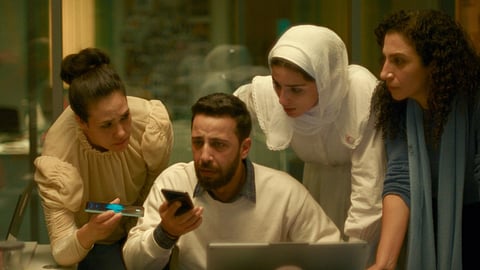
On top of the sufferings of the victims, the film explores the psychological toll on the dispatchers themselves. While they try to remain a steady, calming presence for the callers, the horrific nature of the events eventually get to them and wear them down. The Voice of Hind Rajab masterfully shows how this vicarious trauma creates a snowball effect, transferring the emotional weight from one response team member to the other. At one point, one of the dispatchers, who specialises in counselling, motivates her teammate, reminding him of his dedicated training for the job. However, when she is forced to take his place, it affects her too. After all, what can you do when you hear shots of gunfire in a voice call and have little agency to do anything about it?
Director: Kaouther Ben Hania
Cast: Motaz Malhees, Saja Kilani, Amer Hlehel, and Clara Khoury
The truly shocking realisation for the audience is how normal this horror feels; our daily exposure to atrocities on social media has systematically desensitised us. Social media feeds and algorithms are so saturated with violence that the world has largely grown numb to it. The Voice of Hind Rajab recognises the implications of the digital world in which it is set. The film feels as urgent as it speaks to the times we live in.
The aforesaid realisation hits hard when one of the respondents tells another to make the child's audio recording live online to fuel global outrage and thus maybe force a rescue, only to be reminded that the internet now treats such tragedies as a daily norm rather than an anomaly. After all, it is all 'background noise' in a world driven by algorithms.
This helps explain why every effort and cry from the respondents to break through the red tape falls on deaf ears. By the time they get a green signal for the rescue mission, it is too little too late. It does not end well for the girl, which will not be a surprise for an audience who has been following the horrific events in Gaza.
What is also fascinating about the film is how it tells the story from different points of view among the respondents. While the front-line dispatchers suffer from compassion fatigue and vent out their frustration at the coordinator who seeks military clearance, the latter quietly points out the potential futility of the mission to them. He points to a wall with pictures of the rescue team members who have laid down their lives in a bid to save innocent lives in Gaza. The film forces us to see the events from each of their perspectives.
It is hard to judge The Voice of Hind Rajab in mere binary terms, classifying a film as bad, good, average, or great. It is a devastating account of a real-time tragedy told with the finesse and suspense of a wartime procedural. Then again, its hyper realistic staging often makes it feel more like an urgent documentary than a traditional feature film. The raw performances make the trauma deeply vicarious, which helps drive home a message that is more about urgent, basic human accountability than peace in its abstract form. Perhaps the only area where The Voice of Hind Rajab slips up is when it juxtaposes the faces of the real respondents with their fictional counterparts in the film as they come on video. Other than this minor blip, it offers a shattering look at the horrific aftermath of war, forcing us to listen up and act.
