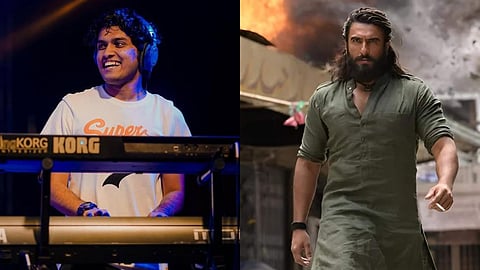


The latest blockbuster, Dhurandhar, is all about celebrating the unsung, and one such talent is Steve Kottoor, who served as an additional composer on the movie and co-produced its background music alongside its main composer, Shashwat Sachdev. Following the success of the masala-filled spy saga, Steve is now busy juggling interviews and live concerts. In an exclusive conversation with CE, the music producer begins by admitting he never expected this level of attention. “When our work on Dhurandhar started, Shashwat told me that people would talk about the film even after 15-20 years. Even then, the response has been astonishing,” says Steve.
Notably, Dhurandhar is not Steve’s first major project in Hindi. It reunited him with Shashwat Sachdev after their collaboration on the series The Ba***ds of Bollywood, which marked the directorial debut of Shah Rukh Khan’s son Aryan Khan. Recalling his previous collaboration, he reveals, “We were in sync with each other soon after starting work on The Ba***ds of Bollywood. I know exactly what he wants, and he also understands the kind of work that I do. This allows us to work faster. Our chemistry is so good now that we can understand each other and the project requirements through eye contact alone.”
While songs and background music play a big part in making the Dhurandhar films the entertainers they are, Steve is aware that any excess in the technical aspect could mean exhaustion for the audience. Speaking about how professionals like him decide where to dial down the music and let the performances speak for themselves, he says, “If the score just keeps going, the movie would become a ‘brick wall,’ as it would cause a sense of inertia among the audience. You do not want that to happen. Therefore, there must be silence to ensure some breathing space for the characters and the audience. Music would become more impactful then. We do get inputs from the director, editor, and composer, but this understanding ultimately comes from experience.”
Speaking of which, Steve Kottoor is also a frequent traveller. Interestingly, the music producer says that he takes his experiences from the travels and applies the learnings from these trips to his work. “Travelling has influenced my music considerably. I have been to around 30 countries. Wherever I go, I try to explore the live music scene there. This has introduced me to various styles of music with different types of singers and instruments,” he explains. The music producer goes on to add, “Travelling also inspires ideas quite often, especially when you immerse yourself in nature.”
This helps explain why Steve embraces the challenge of collaborating with multiple singers and composers. He serves as a keyboardist and a music director of Atif Aslam’s live shows and has also worked with the likes of Sonu Nigam and KS Chithra. “Each composer has a different style, which I like a lot because I do not want to stick to one particular style alone. I want to become a versatile musician who can pull off any music genre.” Explaining how he went away from his comfort zone, Steve cites his work with AR Rahman’s Firdaus Orchestra for an Atif Aslam show with much Arabic music. “Arabic music was not my zone, so I did some research to understand how violin, viola, trombone and trumpet are used in it. Ultimately, it was challenging for me but at the same time, it was exciting too because I do not usually deal with it. Therefore, we were delighted with how the show turned out.”
Steve uses elements of music in live concerts and films interchangeably. “I look at how people respond to certain beats in concerts and use these accordingly in films and vice versa. Working on concerts helps me understand the audience pulse to a great extent.”
Coming back to Dhurandhar, even as the audience has been raving over the songs and score in the franchise, there are many trending reels and shorts that use the music from films such as The Dark Knight and Batman in place of the original. Many of these reels come with captions saying, “We fixed the music for you.” However, Steve is not disappointed by this practice and is rather delighted about it. “This shows how much the audience likes Dhurandhar. We are really happy to see how much they are engaging with the film. After all, everyone has their own interpretations,” he says.
Come to think of it, while Dhurandhar has become this gigantic blockbuster franchise, it is not without its detractors. Allegations of propaganda have been following director Aditya Dhar ever since the first film came out and reached a fever pitch with the release of its sequel, Dhurandhar: The Revenge. Many also question the political awareness and ethics of actors based on their involvement in the franchise. However, Steve Kottoor remains rather detached from all of this and views cinema as just a form of entertainment. “As an artist, my role begins and ends with ensuring that the music I work on falls in line with the director’s vision. I do not have a big say in how the audience is viewing the film and its politics. For me, they have to be entertained, especially when they come to the theatre for a film clocking in around four hours.”
That said, Steve does acknowledge the fact that Dhurandhar has a political perspective that is opposite to his other big project, L2: Empuraan. “I find that a big coincidence,” he says while underscoring that his commitment to these films remains strictly as a creative person.
Recently, there has been much discourse around how Dhurandhar has set a standard that might be unattainable for future films. For example, Ram Gopal Varma opined that the film could prove too big a benchmark for other filmmakers, putting much pressure on them to keep up with the standards. However, Steve feels that such high expectations can be mutually beneficial for other filmmakers and the audience. Weighing in on this, Steve explains, “There is no point in making some hastily assembled film because the audience is intelligent and we cannot fool them. It delights us when people say that they enjoyed Dhurandhar considerably, having sat through the film for four hours straight without finding even a second of it boring. Ultimately, they are spending money, so it is important to give them the best output whether it be from a storytelling or a technical perspective.”
Interestingly, Steve has also made his acting debut of sorts, as the makers of Bhramam, the Andhadhun Malayalam remake, used his hands for the close-up shots of Prithviraj Sukumaran’s character. “I taught Prithviraj how a pianist operates. You cannot teach the whole piece at one-go, but I talked to him about the hand movements and posture of a pianist. I was also there on set to help Prithviraj do those piano scenes authentically. He is a quick learner,” he shares.
Steve is determined to cash in on the Dhurandhar success and realise his biggest ambition of becoming a composer. “I started learning piano when I was five. I always wanted to become a musician because my father is also one. Whatever I am doing now is to help realise my life-long dream of becoming a music director. While nothing is quite official yet, talks are underway for a Malayalam film and a Telugu film. Hopefully, I can make the announcement about my debut film as a composer this year itself.”