
Being Heumann Movie Review:
In a solemn moment in Sian Heder's Being Heumann, Judy Heumann (Ruth Madeley) looks at the United States Capitol building, a marble-white institution that has the power to change the way Judy can lead her life. Within the halls of the building lies not only the power to change how people with disabilities access public spaces, but also the power to change how they are perceived. But in that moment, the biggest hurdle for Judy, who has spent her life fighting for access rights, is the huge marble staircase leading into the building. True to its title, Being Heumann succeeds in its aim to empathise with the lives of people with disabilities, and it does so in a tale that is moving, grounded, and, more importantly, human.
Director: Sian Heder
Cast: Ruth Madeley, Mark Ruffalo, Dylan O'Brien, Madeline Delp
Streamer: Apple TV
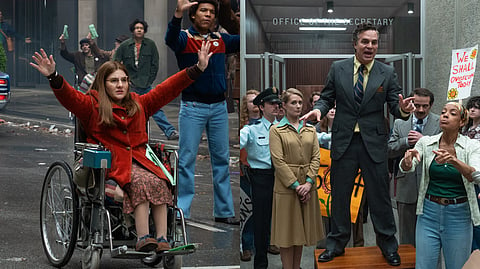
In a key moment from the film, when reporter Evan White (Dylan O'Brien) shares his intention to cover the sit-in protest by Judy and her compatriots to urge the lawmakers to speed up signing of Section 504 of the Rehabilitation Act, 1973, Judy in turn asks him if he is doing this to inspire people to do something about this or to just be inspired. Being Heumann separates itself from other films that include characters with disabilities by treating its subjects as humans rather than mascots. The protestors are not only people who use wheelchairs, but they also include people with blindness, people who are hard of hearing, and more. The lack of public access to include them not only deprives them of the right to access, but also deprives them of the ability to protest, which leads to multiple infighting, and more hilariously, the inability of the police to arrest them, because even police vans and jails are not inclusive. While showcasing all of this in the film, Heder does not pity them or elevate them; instead, she wants you to see them as human, which she achieves.
With Being Heumann, Heder also takes on the momentous task of telling not only the story of one woman's fight, but the story of an umbrella movement stretched across several years. In this tightly knit two-hour film, Heder deftly weaves every single story, which doesn't waver from its core ideal. The sit-in protest with Judy at the centre, not only has to talk about discrimination against people with disabilities, but also racial prejudice, homophobia, and a lot more. But no cause is diminutive, and Heder maintains this objective by giving importance to every single moment. When Judy addresses a gathering about wheelchair access, a child of a deaf adult has to interpret for hard-of-hearing people, which also forces her to learn signs for more complex words on the spot to pass on the message immediately. This also leads to multiple chaotic crosstalks, which Heder handles with finesse, so no parts of the conversation are missed by the viewers. Heder, with cinematographer Jamie D Ramsay and editor Geraud Brisson, takes on this mammoth task and achieves it with ease.
But beyond everything, Being Heumann is also a biopic. It uses every single trope of a biopic: the underdog origins, the unforgiving climb, the offering of false hope, and finally the achievement of the goal. But it isn't confined to these tropes. The underdogs here aren't clearly defined, the climb never ends, hope is never offered, and goals aren't achieved. The finish lines are just pushed further. In this showcase of a frustrating journey, Ruth Madeley shines as the headstrong, obsessive Judy Heumann. She is vulnerable, imposing, but also gentle and strategic in her portrayal of Judy. Mark Ruffalo as Joseph A Califano Jr portrays a real-life figure who represents the larger populace that is without disabilities, with conviction. Califano wants the world to believe he is a crusader for rights, but he is also a people-pleaser who, in the end, cares about his position in the US government. While it is easy to portray Califano as a villain, Ruffalo's portrayal brings his human nature front and center, prompting us to ponder and reflect on our own biases.
The story of Being Heumann doesn't end with Judy's tale. In fact, it doesn't end at all, as people are still fighting for the right to access. But while it may inspire people to do something or just inspire people, Being Heumann exemplifies the importance of access and, more significantly, the importance of self-respect.
