
The Furious Movie Review:
Martial arts action movies made in Southeast Asia have always fascinated the Indian, especially Tamil viewers. The beauty of this fascination is that you may not be a cinephile, but you are still familiar with the names: Bruce Lee, Jackie Chan, Tony Jaa, and Jet Li. More than the racy fights, the love for these films can also be attributed to the philosophical lesson it imparts, that the mighty aren't infallible and the meek do not remain underdogs. Skills may win you the day and put you above lethal weapons and even intimidating body frames, which alone are praised in this part of the world as Pailwaan/Pehelwaan. Although storytelling is a hit-and-miss, The Furious sticks to the pleasures of martial arts films and also scores big on the emotional front.
The film is set in a nondescript Southeast Asian 'Gotham City' where lawlessness is the law. The police department doesn't care if you are bleeding from head to toe, but unless you follow the procedure, your complaints won't get entertained. Here, a person gets killed either by the crime bosses or by procedures. Wang Wei (Xie Miao), a deaf and mute Kung Fu trainer and single father, has a hard time training his daughter, Rainy (Yang Enyou), who gets fed up and quits training after making a wrong move. A perfect cue for the imminent tragedy. Scenes later, Rainy gets abducted by the bad guys. Yeah, you guessed it right. The father becomes furious.
While there are delights in struggling to pick a side in movies where everyone is grey, The Furious-like films don't offer any less excitement with their lack of nuance and one-dimensional characterisation, where every scene serves as a build-up to an explosive action sequence. This is not to say the film doesn't have an emotional core. In fact, the struggle throughout the runtime revolves around a father, a father-to-be, and a son. Wei conveys his anxieties to the audience, without attempting to do so, as 'You don't love me Dad' are the last words he hears before Rainy is kidnapped. Though you don't get slow-motion montage flashback shots (thankfully) of Wei and Rainy, you understand he doesn't want to lose his daughter with this negative impression about him, and he somehow wants to make up to her for this. The spaces where the boy, who helps his father, a henchman in this child trafficking nexus, turns against them, is an impressive arc. The film required this flair in its antagonist. Will come to that later.
Director: Kenji Tanigaki
Cast: Xie Miao, Yang Enyou
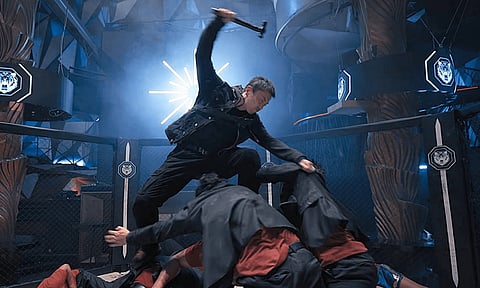
Man oh man, the stunts. Be it the street, the pub, the ice factory, or the police station sequences, every little, medium, huge, and everything that is in between is used as a weapon. The beauty, however, is that when all fails, the characters turn to the most lethal weapon: Their fists. Every action set piece makes one forget the rough edges around some of the spaces that needed more work. For instance, it is understood that the law is in shambles in this city, but how does this nexus operate, and how deep-rooted is it? The film is silent about this. The writers seem to have taken only the ideas, left them without flesh, and used them as mere props to structure stunts around them. In addition to this, the narrative, structured like a game where the last level is the 'Boss Fight,' by the time Wei disrupts the crime network and sends a statement to the trafficking boss, it prepares the audience for the one big fist fight. The film fails to convince why this big boss, who remotely controls the whole city, law enforcement, and leaders, has to resort to a physical fight. The black-and-white treatment in the film sticks out in these spaces, where you would want this crime boss to have more sophistication than just donning a coat and suit. The final fight was breath-takingly staged nonetheless.
The Furious, on the whole, is busy chasing revenge and has no time for nuance. You tend to love the film for it and feel underwhelmed by it at times, too. Packaging familiar beats with inventive stunts and earnest emotional core, The Furious leaves you wanting more storytelling finesse, but never more punches.
