
Backrooms Movie Review:
Horror in today's cinema is entering newer dimensions, especially since there are only so many ways you can show an exorcism. Backrooms is a welcome and intelligent addition to this welcome list of films. The journey, carved from a cool internet theory, into the maze of memories and trauma, is chilling. What can be scarier than living in your head, and being left alone?
The film begins with a furniture store proprietor, Clark (Chiwetel Ejiofor), speaking to his therapist, Mary Kline (Renate Reinsve), about how bad and ungrateful it was to be driven away from his own house by his ex-wife. His finding a dwelling place in his store is reflective of his lack of belonging and his shrinking of his world inside the store. The problem is, his dwelling too gets very attached to him.
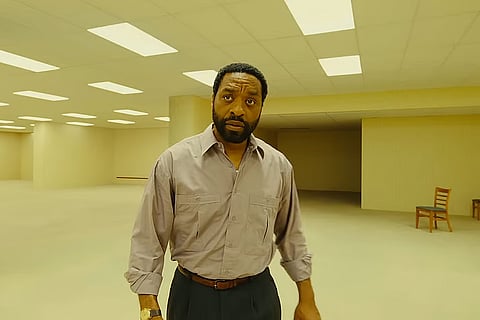
Full marks to the production design team for the seamless integration of physical construction and digital fabrication. The pale yellow used in the backrooms heightens the anxiety about the lack of inhabitation. This colour palette and the vastness of space were effective in making Clark and Kline look like tiny, vulnerable creatures in need of protection. While horrors centred around an apparition or entity thrive on making far-fetched supernatural elements believable, Backrooms makes you fidget further with a close-to-reality proposition of walking into the maze of memories. And, finding your way out of the maze is not the fix here, but if you actually want to do that?
With a horde of issues taking you apart and preventing you from living in the present, what if you quit and retreat into literally living in your head without getting judged for it?
Director: Kane Parsons
Cast: Chiwetel Ejiofor, Renate Reinsve, Lukita Maxwell, Finn Bennett
What Backrooms also gets right is the well-fleshed-out character stories for both Clark and Kline. While Clark still couldn't fathom how unceremoniously he was thrown out of his house and the self-image of faultlessness, Kline is still unable to outrun the memories of her abusive mother. Perhaps story devices like this are what make the film stand out, say, in comparison to another ambient horror film like Vivarium, where you don't really get to know the people but just the scares they are subjected to. Kane Parsons is beautifully consistent with evoking horror both visually and viscerally, armed with liminal intoxication and an arresting human story. The spaces (portions of the film in this context) where the visuals shift from a polished, static-shot cinematography to hand-held camerawork peculiar to the 90s deliver a giddy thrill of childhood, where you sit in a circle with your friends and share scary stories.
Performances, especially Ejiofor's after entering the backrooms, were disturbing and impressive. The dialogues where delusion camouflages as clarity like, 'This is every place there has ever been' and 'I got right where I am supposed to be' sounds enticing enough for people going through their bout of loneliness to fancy getting lost in the labyrinth of yellow hallways, with no pressure of moving on. Why bother burdening each other with communication? As Reinsve's Mary helplessly runs around the warren in this non-place, you feel so disoriented, wondering about the veritability of existence itself. The strobe effects in these spaces grow visceral enough to stop you second-guessing the screenplay's choices as the plot thickens, rendering you numb and in an almost trance-like state.
Kane Parsons' brilliant attempt to breathe life into the internet myth of the backrooms through human drama functions much like the human mind and the internet itself: a liminal space where every corridor leads to another question, another memory, another rabbit hole.
From going to absurd lengths to be with a person instead of doing the basic thing, 'to talk' (Obsession), to retreating from the world itself rather than confronting another human being in Backrooms, youngsters Curry Barker and Kane Parsons seem fascinated by a similar idea: the horrors the mind creates when communication breaks down. Whether this marks a new wave remains to be seen, but they have certainly reimagined psychological horror for a generation raised on internet anxieties and isolation. This has the potential to lead to a Jacob's Ladder or A Beautiful Mind for this generation. But horror is in safe hands, nonetheless.
