
In 28 Years Later: The Bone Temple, Ralph Fiennes’ maverick doctor Ian Kelson keeps repeating the Latin phrase "Memento Mori" (Remember death). The film itself keeps reminding us how death is a necessary rite of passage for rebirth, evolution, a new beginning. Almost every death, symbolic or literal, ushers in a character evolution, a new relationship or new turn of events. The young boy, Spike (Alfie Williams), is forced to kill a human (not the undead) for the first time. Ian Kelson almost sacrifices himself before figuring out he might be able to cure the virus; the cultists known as the Fingers have to face the death of their faith; the Alpha AKA Samson, treads along the edge of death multiple times before his awakening. There is enough gore and zombie-jump scares, but this time around, what we remember most are not the deaths but the desperation for community, the quiet yearning for peace, and most of all, the cautious undercurrent of hope.
Director: Nia DaCosta
Cast: Ralph Fiennes, Jack O'Connell, Alfie Williams, Erin Kellyman
Films of this genre often show how quick civility and morality crumbles when humans are pushed to survival mode. The Bone Temple is unique in how a sense of desolation and despair also binds humans together, sometimes even if it is through drugs or brutal acts of violence. The Bone Temple picks up right after the last film, and as predicted, the Fingers force Spike to do horrible acts of violence so that he can join them. Why couldn’t Spike just run away? (And he almost does at one point). Why did Doctor Ian Kelson risk a horrible death to make first contact with the Alpha zombie? Characters take such extreme and confounding decisions, and through that, we understand an oft-unspoken aspect of an apocalyptic world: loneliness. People need a sense of community, and they would risk everything they have, even sedate an Alpha zombie or allow themselves to watch stomach-churning violence, just so they have someone to talk to.
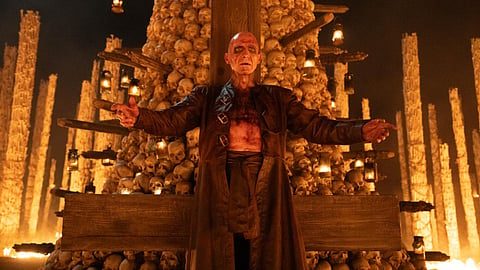
If you go in expecting thrilling escapes and gory zombie violence, The Bone Temple might not be sufficient. But the franchise officially enters its “humans might be more terrifying than the zombies” phase that all media of this genre eventually enters at some point. And we get a glimpse of it through the cultists, Fingers, and their leader, Sir Lord Jimmy Crystal, played by a wonderful Jack O'Connell. However, the most standout performance of the film is undoubtedly the magnificent Ralph Fiennes. The man walks into the frame with a red skin amidst a giant monument he made out of human skulls, and yet, is the most human character in the story. He has a childlike awe for life and existence itself. One of the most poignant scenes in the film is when he sits down with a heavily sedated Alpha AKA Samson, and talks about yearning for “peace and respite”. While the film avoids the visual innovations applied in the previous entry in the franchise (like the scenes shot with a rig made of multiple phones), it still manages to be a visual spectacle. The story itself births enough memorable visuals, and the film was smart enough to punctuate these instances with stunning frames, especially the ones at the end with the Bone Temple bathed in light from a ring of fire.
The Bone Temple leaves a lot of questions unanswered, like the fate of Spike’s father and his village. And the film also reduces Spike to a scared little boy, while we saw him go through his coming-of-age phase in just the previous film. On the other hand, the film also builds excitement by leaving a lot of questions unanswered. Does the cure mean zombies can turn into humans or something else entirely? Is that a new step in evolution? Can Spike and his new friend go back to being their old selves even after witnessing brutal violence? Extending a franchise as far as it can go might be the new norm, but The Bone Temple at least goes the extra mile to sweeten the deal by presenting the exciting themes it might explore in the future. Of course, a beloved character returns, but what excites us more is how the character brings a fresh dose of hope into a bleak world. When his daughter spots the survivors and asks him, “Do we help them?” and after a pause, he replies, “Of course we do,” it makes us look forward to seeing how the conviction in the “of course” survived even after years of brutal post-apocalypse decadence. And for that, “Of course,” we are excited to see where the story goes, even if it (hopefully not) takes another 28 years.
