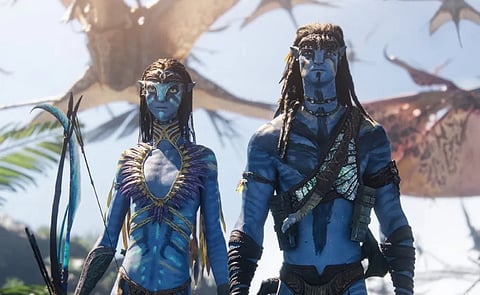

Avatar: Fire and Ash Movie Review:
SPOILER WARNING
Avatar: Fire and Ash is the fading echo of a breathtaking song. We return to Pandora; feel the caress of the wind, flow of the water, softness of its bioluminescence, and breath of every being. Decades later, you still feel the exhilarating rush when the Sullys soar the skies on top of their winged reptiles. There is immense joy in the little moments where the characters interact with the seemingly conscious ecosystem all around them. When James Cameron takes the time to show us the children exploring the ocean, playing with their aquatic friends, it reminds us why the alien planet struck a chord with us, leaving us yearning for a place that never was, and a curious case of unlived nostalgia sets in. As for the story itself, we keep finding echoes of earlier storytelling beats threaded through fresh moral quandaries, of which most of them are interesting, some of them stale, and all of them woefully underexplored.
We begin right after the events of The Way of Water. Jake (Sam Worthington) and Neytiri (Zoe Saldana), now living among the water tribe, are still reeling from the death of their eldest son. Their second-born, Lo'ak, blames himself for the death of his brother. Quaritch (Stephen Lang) is out to catch the traitor-rebel Jake and reconnect with his estranged son Spider, who is now living with the Sullys. Somewhere in the mix is Varang, the eccentric head of the Ash people, who wants to “spread her fire everywhere.” Amidst the ingenuity of the rich design of Pandora and the complex weave of character dynamics is the unignorable echo of moments from the previous films. Humans destroy everything in their wake to obtain the resources of Pandora. A scientist (a Marine biologist this time) pleads with the soldiers and the suits to stop destroying the delicate Pandora ecosystem again. Quatrich tries and fails to bond with Spider again. Neytiri’s love for Jake and her family is tested again. Jake tames the legendary aerial predator, becomes the Toruk Makto, and unifies the tribes to fight the humans again. And the goddess/planet-wide consciousness swoops in at the last minute, sending fauna (marine life this time) at her bidding, to help the Na’vi in the fight...again.
Director: James Cameron
Cast: Sam Worthington, Zoe Saldana, Sigourney Weaver, Stephen Lang
A frustrating number of times, Fire and Ash swells on the shores of greatness but quickly recedes before any meaningful imprint occurs. Take, for example, the shocking moral conundrum Jake Sully is thrown into. He has to choose between killing a loved one and letting the biggest scientific breakthrough into the hands of humans, which would help them effortlessly colonise Pandora. A profound character moment, it could have been the central overarching conflict of the entire film, but we are overwhelmed by a million different things. Neytri faces a torrent of similar emotions, trying not to let her seething hatred for the Sky People spill over to her husband and half-breed children. Quaritch gets some of the wittiest lines in the film. As he delves deeper into his newfound identity as a Na’vi, we can see his internal conflict, struggling to handle his nascent connection with the oneness of Eywa and the call of duty.
Kiri’s (Sigourney Weaver) mystical connection with Eywa serves more as a Deus Ex Machina. With what seems like an immaculate conception and her ability to transform human morphology, Kiri seems to be set up as Pandora’s messianic figure. It is an interesting choice, but again, gets lost in the cacophony of the Human-Na’vi feud. The film begins with Lo'ak visiting the remnants of his brother’s consciousness stored in the central hub of the planet's interconnected mycelium network, and it ends with all the deceased characters welcoming Spider into their fold, as his consciousness gets uploaded into this biological data centre.
A smile spreads across the crowd as the giant planet-wide family of Na’vi is reconnected in this central consciousness, and Spider is told that he will “live on forever.” This is one of the rare moments when a film looks favourably upon the concept of immortality. The central antagonists in some of the biggest franchises in history, from The Lord of the Rings to Star Wars and Harry Potter, are all corrupted by their quest for immortality, while the heroic figures are those who welcome the sweet embrace of impermanence and sacrifice themselves. James Cameron takes a refreshing detour and subverts this trope. He dares to kindle our fantasy of eternal paradise, an ancient desire to peel beyond the veil of death, only to see lush, bright plains with all your loved ones cheering on your arrival.
It is this audacity of the filmmaker that becomes the relentless pulse that still beats life into this ever-expanding story. The biggest strength of Avatar is that it stirs the ancient instinct in the back of our minds to find the perfect world, where rocks float, plants light up in the dark, animals talk to you, and connecting with others is as simple as tethering the neural fibres growing out from the back of your head. Perhaps, it does not matter whether the story of Fire and Ash moves you or not, for the yearning to return to Pandora still remains.
