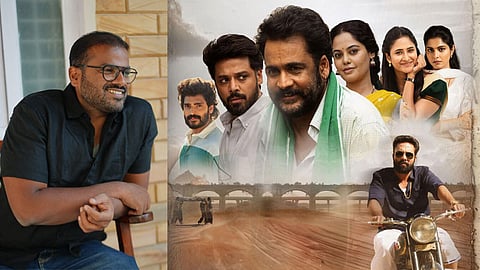

Debutant director Muralikanth D is all set to make his mark with Dhandoraa. The film features Sivaji, Navdeep, Nandu, Ravi Krishna, Bindu Madhavi, Adhiti Bhavaraju, and several others in key roles. What makes Muralikanth’s journey exceptional is that he never worked as an assistant director nor apprenticed under anyone. Instead, he learned the craft of filmmaking on his own — scriptwriting, shooting, editing, and sound — using just his phone and by making small videos with friends and cousins.
“I applied to many directors for assistant roles, but never received a response. Eventually, I realised that even if I worked under someone, one day I would have to say ‘camera on’ and ‘cut’ myself. So I taught myself by making short videos. That’s how I learned filmmaking,” says Muralikanth.
Having grown up in Medak, Muralikanth says the usual dream for most in his village was to secure a government job. “Teachers, bus conductors, electricity department employees — these were the people we saw around us every day, so they were our role models. But I wanted to break that cycle. Why not join an IT company and go to America? That thought pushed me forward,” he recalls.
After completing B Tech in Electronics, Muralikanth shifted to the US on work between 2014 and 2019. “My passion for cinema grew even stronger there. For someone like me, going to America itself was a big deal. So I asked myself, why can’t I make a film too?” he says. His friends also encouraged him, believing he was a good storyteller. While in the US, he attended filmmaking workshops during his free time. “My job was routine — go in the morning, return in the evening. It didn’t excite me. But cinema did. I attended workshops, learned how to write stories and prepare scripts,” he says.
After six years abroad, he returned to India when his company allowed him to work from home, which would give him more time to focus on writing scripts. But soon after, the pandemic hit and his two-year plan went off track. He returned to work but continued developing stories alongside his job.
One story in particular stayed with him — a dark comedy revolving around a death. “It’s quirky, satirical, and rooted. In some villages, even cemeteries are caste-based — that inspired the core idea. The story is fictional but influenced by several real incidents like Chunduru, Karamchedu and similar events in Telangana,” he explains.
Before this script, Murali pitched another story to a few producers, but it was rejected. “I felt bad initially, but then I understood — not every story I like will be liked by others. So I decided to check a producer’s background before narrating anything.” That’s when he thought of Colour Photo producer Ravindra Banerjee. Muralikanth then narrated the full story on his laptop, and Ravindra immediately agreed to make the film. “Within three months, I resigned from TCS after receiving an advance. I had to give my 100%,” he says.
The film took nearly two and a half years to complete. Initially, Murali wanted to make it under ₹1 crore, not wanting the producer to risk too much. “But Ravindra insisted it should be a bigger film. He asked me to narrate it to actors like Sivaji, Navdeep, Nandu, Bindu Madhavi and other — and they all liked it,” he says. The shoot finally began in January this year.
Before the actual shoot, the producer asked Murali to do a test shoot with a little money. “I shot a few scenes and showed them. That gave him confidence that I could handle the film,” he shares.
Many Telangana-backdrop films like Balagam or Raju Weds Rambai have struggled in Andhra regions. When asked whether Dhandoraa would face the same challenge, Murali remains confident. “It’s not fully a Telangana film. These issues exist everywhere, even in Andhra Pradesh. There is no Telangana film or Andhra film — only Telugu cinema,” he asserts, further adding, “When Pushpa released, the characters spoke in Chittoor slang, but no one called it a Rayalaseema film — they called it Telugu cinema. But when a Telangana-backdrop film releases, people label it as Telangana cinema. I don’t like that distinction.”
While the film includes Telangana linguistic flavour, Muralikanth avoided making the slang too raw, ensuring wider understanding. He also notes that actors today are eager to adapt to rooted stories. “For Dhandoraa, everyone learned the Telangana dialect,” he says. He also acknowledges the growing talent from Telangana in the industry. “Earlier, most producers came from Andhra or Rayalaseema, but now, because of social media and growing awareness, more talent from Telangana is emerging.”
Muralikanth admits he initially underestimated the filmmaking process. “I thought I could finish everything in a year — narration, pre-production, shoot, post-production. But now I realise it takes much longer, and I’ve learned to adjust. When you chase your dreams, you must adapt.”
Now that the film is ready for release, Muralikanth feels both excited and nervous. “The entire process was fun, and I enjoyed every bit of it. I’m scared, but also hopeful. It’s a good film, and I believe everyone will appreciate it,” he concludes.
