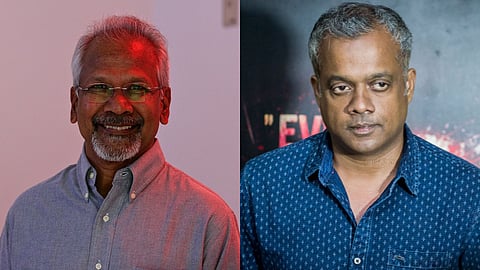


Mani Ratnam and Gautham Vasudev Menon had a long conversation about filmmaking at IFFI, Goa, the other day. Among their many talking points was about the making of Ponniyin Selvan, the first part of which earned the best Tamil feature at 70th National Awards. Gautham Menon asked Mani Ratnam about whether he felt any fear about adapting a widely-beloved novel for the big screen. In response, Mani said, "No, I trusted Kalki, you know, and he's the author. It's been a classic and the best-selling book from 1950, and something that I read when I was finishing school. It has everything that is common to be made into a film. It has the scale, the intrigue, and the theater. It has horses, adventure, and characters that are brilliant."
When Gautham prodded further, Mani stated, "I was afraid of how I would be able to do it. You know with a film like that, a story like that, every person who's read it and there's millions of people who have read it in Tamil. And they all are absolute experts in it, you know, each one have their own vision of how each character should be. And so I was battling with not just a five-volume book but also the perception of so many readers who are passionate about it. But the only guiding factor that I had was that I was also one of the passionate readers and I will go with what I felt that every book was great."
Speaking further about the story, Gautham asked, "So when you read Ponniyin Selvan for the first time and then the many versions later, the abridged versions, the translated versions, when you heard something, editing the story, did the visual imagery sort of come alive? Did the shots speak to you? I'm also asking this because I've read that Charles Dickens, who died, you know, 25 years before motion pictures were invented, is credited with inventing the apparel montage, the intercutting between two stories in his writing and is also said to be the inspiration behind the tracking and zooming technique of filming through his writing. So did the writing sort of speak to you? Did the material sort of inspire you? Did the visual imagery come up then itself or was it a process that evolved?
In reply, Mani stated, "No, I think the visual imagery, he must have come across to everyone who's read the book. I mean, he's such a visual writer and he's got a fantastic way of telling a story. It's almost intimate, it's a huge thing, but it looks like as though he's talking only to you and his description of that period is quite elaborate, quite amazing and when I started doing research for the film, I realised that there's so much of accuracy in what he's done at that point of time where the research was not as much as it is now in the research material. So I think he's very graphic in his imagination and his description.
There's some pieces which are still, which I could not capture at all. I mean, they're still vivid in my mind from what I've read and always wanted to see but it couldn't be fitted in. So he was the master."