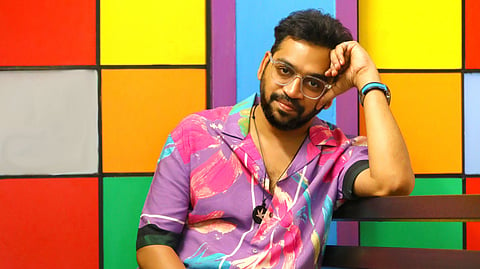

When American actor-filmmaker Orson Welles said, “The whole eloquence of cinema is achieved in the editing room,” he was echoing a sentiment that continues to resonate across generations of cinema and technological advancements. Walking into editor Ruben’s office was like walking into the sanctum sanctorum where many a film was shaped, reshaped, distorted, and made to look like a complete film again. “I have worked with people who completely surrender to my vision for the film, and then, you have people who know what they want and stick by it. So, an editor has to be like a school teacher. You have to work differently with each of them to ensure all of them pass with flying colours,” says Ruben, who doesn’t shy away from delivering such analogies throughout this interaction where we discuss editing star films, understanding what every language’s audience needs, and how humans need to handhold AI, and not the other way.
Excerpts:
As an editor, what you leave out is as important as what you use in a film… How do you decide that?
For me, it is not about what I don’t want, but what I want. Honestly, every editor plays multiple roles. They are a writer, a director, an editor, and of course, the audience, as well. We don’t make films for ourselves, right? Ultimately, we want to make a film that the audience would appreciate.
But how do you find the time to stay up to date with the audience?
In any education system, the syllabus will keep changing. History gets updated. Newer lessons get added. It is the same in cinema, as well. Now, our audience's attention span has dropped to 20-30 seconds. It is important to realise that our competition isn’t exactly another film but the phone in their hands. Once you are aware of it, right from the teaser cut to the trailer, and even the songs and scenes, you know what has to be done.
You work in multiple languages, and each language has its own audience, ethos, and culture. How do you find the nuance in editing for films in different languages?
Editing is very much like a culinary adventure. The spice levels in your food will oscillate depending on your clientele, right? In Telugu, they like liberal doses of masala, and in Tamil Nadu, probably not as much. You have to understand the difference. That comes from observation, and I like to think I’m a keen observer. Even while watching a film in a theatre, I see how the audience reacts and where they're emoting. If I see a video on YouTube, I'll go through the comments. I need to know how they are responding and what they are responding to.
Is this a very pressurising aspect of your job? You already have the pressure of time, and even the star value of your films…
There is pressure from all sides, actually. When you are working on a star film, you are under pressure from the audience, the makers, and the lead actor’s stature, as well. Let me get back to a cooking analogy. It's like cooking biriyani for a wedding; you are not making it for a small crowd. The audience ranges from kids to adults, and everyone should be able to relish the food. Everyone should get pieces of meat; everything should be properly cooked, and the catch? You only get one chance.
When there are reviews that talk about a ‘lag’ in editing, and criticisms against your work, do you take it personally?
If there are genuine comments or feedback, I always welcome it. I learn from it. Again, there are times when I know a particular edit choice isn’t the right one for the film. But then either the producers, the director, or the actors want it that way. So, I indicate to all involved that I am keeping that edit against my personal judgement. When you identify there is a pothole in the road, you have to take a detour around it, not on it. But then, I have also seen how certain other factors, including sheer star value, can make the ride smooth even if it goes over the said pothole.
Do you get into fights with your directors?
It isn’t a fight to have a personal ego boost. We fight for the film. Ego should never take the front seat, and if I realise that it is the case, I detach myself from the system. You shouldn’t put all your energy into a vehicle with square wheels.
Is that why you are the go-to editor for a bunch of successful filmmakers?
Take, for instance, Atlee, Mithran, Siva, or Sam Anton… they don’t come with any ego. They are primarily my friends, and we know our input is always for the film, not to satisfy our egos. That’s why I am choosy with the projects I accept. If I feel something is wrong, I will stand by it, and if they want me to step down, they have to convince me. That’s how our conversations go. Of course, I would let them know about the risk involved in taking a particular route, and it can end up as a learning experience for either them or me. That’s the thing about cinema… You can never be sure about what will work.
We are now seeing AI being used for editing. How do you see this evolution?
See, AI is built on what the human mind has already thought. It doesn’t understand where the audience might get bored. Without our intelligence, AI is quite ignorant. But we shouldn’t be ignorant of it. Remember how we thought digital filmmaking was just a passing cloud? We cannot avoid science. But the AI doesn’t have a brain or a heart, and it is important we treat the machine as a machine.
