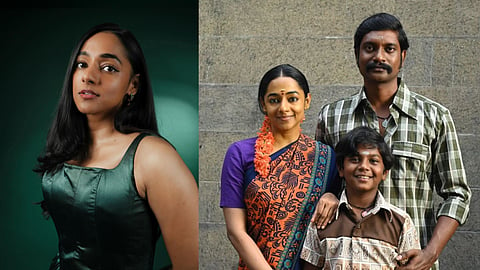

Actor Vijay Sethupathi-led Baththa, which is gearing up for its digital premiere, has struck a chord with audiences for its distinct retelling of the David-versus-Goliath myth. The film has Vijay Sethupathi playing the titular role, a dreaded don who finally meets his match in a kid. Beneath its humour and emotional storytelling lies a sensitive exploration of bullying, toxic masculinity and patriarchy, examining how cruelty can be learned and how emotional trauma can shape a person. Among the film’s compelling characters is Selvi, played by writer-actor Santhy Balachandran, a woman whose conventional understanding of masculinity puts her at odds with her sensitive husband. In this conversation with CE, Santhy reflects on becoming Selvi, the film’s nuanced portrayal of women navigating patriarchal norms, and how bullying and rigid gender expectations can have far-reaching consequences
Excerpts:
How did Baththa happen?
Director Balaji Tharaneetharan had seen my work in Sweet Kaaram Coffee, and his team reached out to me last July for an audition. I happened to be in Pondicherry and travelled to Chennai for a day. He explained the background of the character and the time period, and gave me a couple of scenes to perform before offering me the part.
As a writer, what were your observations on Selvi, who mocks her husband Thirunavukkarasu for not being brave enough, and Kannima, who suffers due to her husband's behaviour?
Kannima absorbs the daily violence of living with an aggressive, hyper-masculine man. She does not consider leaving him even at his worst. Selvi, on the other hand, deals with the frustrations of a woman who has absorbed a conventional understanding of masculinity and can't bear to see her husband being punished for being sensitive. The women represent the time and the world in which the story is set.
Did you take any help to understand the 80s Tamil sensibilities for Baththa?
I relied completely on the director and his direction team to bring Selvi to life. He had a very clear idea of how Selvi presented herself visually. She is a woman of modest means but takes pride in herself. She wears manjal, mookkuthi, metti and flowers, and is always dressed neatly. He was also clear that Selvi has a mind of her own. She is compassionate yet assertive, and anchors her son Sabari’s emotional world.

Baththa also felt almost like a horror film because of its dark idea of how school bullying can create antisocial elements...
I believe it reflects an essential truth — that most bullies are made, not born. The film provides the audience the space for understanding the far-reaching consequences of emotional trauma and the toxicity of gender norms that constrain empathy.
How important is it for a writer to stay in touch with novels and literature rooted in local culture and folklore?
Personally, I believe that reading is an essential activity for screenwriters. It activates the imagination in a distinctive way, and expands our capacity to create fresh images instead of simply consuming and drawing on pre-existing imagery and visual language. In the context of Lokah, since the core idea was to reimagine our legends and set them in a contemporary context, there is also plenty of room for being creative. Our myths and legends have never been static entities, so it is an interesting exercise to strike a balance between tapping into popular memory while also crafting a fresh narrative for the audience.
Can masculinity be done right? Can you find a middle ground between Baththa and Thirunavukkarasu?
As with any other form of gender expression, masculinity exists on a spectrum. Healthy masculinity is secure, and secure men are not threatened by gender expression that falls outside the traditional boxes society uses to define personhood.