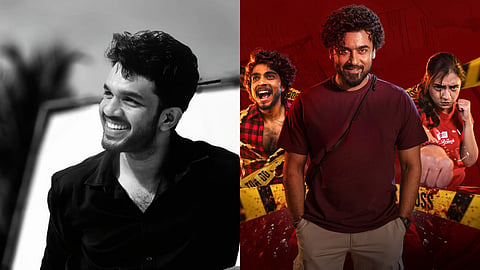

It's rare for two films one has been closely involved with to find extraordinary success across two industries within a couple of months. For Ajmal Sabu, however, that is precisely what has made this phase of his career special. He worked as the cinematographer on Malayalam cinema’s highest-grossing film, Bethlehem Kudumba Unit, and as an editor on Jithu Madhavan-Suriya’s Scene back-to-back. Ajmal's interest in editing goes back much further, as he once ran a popular YouTube channel where he shared his edits.
The Suriya-starrer, however, marked his mainstream debut in the department. Unlike Girish AD's romantic comedy starring Nivin Pauly and Mamitha Baiju, which saw him working in a familiar role, the Suriya-starrer offered a new creative challenge, demanding a different approach to pace, rhythm and storytelling.
In this conversation, Ajmal talks about the crime comedy's editing language, his collaboration with Jithu, working with Suriya's star image, his experience moving between two crafts, and more.
Excerpts:
When Jithu approached you for Scene, what was the initial discussion about how the film should be treated in the edit?
One day, he called me out of the blue and asked if I’d be interested in editing a film. At that point, I didn’t know it was a Suriya sir film. It was a whole new world for me. Jithu wanted the entire film to have a trailer-like energy throughout, with the editing being quite evident, almost like a gimmick. We discussed how the pace, music, sound, and visuals could all work in sync to achieve that.
You’ve worked on trailers and edited videos for your YouTube channel, but a feature film is a different ball game...
It was a tough experience for me. I’ve worked on a few offbeat films and non-commercial projects, but this was my first. On some of my earlier films, I joined only towards the end, whereas with Scene, I was involved from pre-production. You develop your own judgement at every stage, particularly when it comes to shaping the narrative graph and finding the right rhythm. I wouldn’t say editing itself was the biggest challenge. What was completely new to me was coordinating with all the other departments: music, sound, dubbing, VFX, titles, and so on.
Having worked with Nivin Pauly as a cinematographer and Suriya as an editor, how different was the approach to working with these two stars?
I personally like giving a hero a stylish build-up, particularly through action sequences, but until now, I'd only had the opportunity to do that in trailers, not feature films. Girish’s approach is quite different. He usually introduces a star in a very natural, realistic manner, without elaborate build-ups. With Scene, we had the chance to present Suriya sir a little differently, with stylish shots and a certain build-up.
Having worked with Naslen as a cinematographer in Premalu and now as an editor in Scene, how different was your experience of observing and shaping his performance?
He’s a terrific actor who knows exactly how to convey something through his performance. As a cinematographer, I’m more focused on the narrative and shot division, but as an editor, I have to look closely at the performances and pick the right expressions and moments. In Scene, he’s not the Naslen audiences are familiar with; he’s completely immersed himself in this character.
You have previously mentioned that you think like an editor even when you're behind the camera. Has editing a feature changed that understanding?
Definitely. When I was a cinematographer, I would sometimes ask editors to place certain shots in a particular way because I had an idea of how I wanted my footage to be used. But now, I understand that an editor sometimes has to remove entire scenes if they don’t serve the story. Having experienced that myself, I don’t think I’ll complain about my favourite shots being removed anymore.
Was there a particular sequence in Scene that you especially enjoyed working on?
One sequence I particularly like is the one leading up to Mami's death. It begins with Irudhayaraj figuring out that Eeswaran's team has three members, followed by Maya spotting Mami and the events that unfold. It has everything coming together: comedy, Suriya sir's mass element, a chase, and a thriller angle. It wasn't a particularly difficult sequence to edit, but I had a lot of fun with it.
The interval block brings together events happening at three different points in time. How did you go about piecing them together, and was that structure part of the original script?
It wasn't in the script initially like we see now. Jithu came up with the idea midway through the shoot, and we discussed how to make it work. The four of them walking during the day was already in the script, while the car blast was originally part of the second half, and we had shot it accordingly. After that, Jithu suggested intercutting the walk with the blast. To achieve this, we had to shoot an additional portion of the four of them walking at night. Since the idea came later, I had to spend some time figuring out the right order for the intercuts.
One of the interesting aspects of Scene is how it brings dark moments and comedy together without making the tonal shifts feel jarring...
That treatment was decided right from the beginning. We didn’t want serious music during the murders or the usual thriller treatment, where the music and visuals constantly underline how disturbing a moment is. There’s a sequence where Naslen is seen swinging a dead body’s leg around, while Maya and Inbaraj’s love song plays. We wanted it to feel pleasant, yet a little haunting, rather than overly dramatic. The second murder, for instance, happens while Suriya sir is dancing. It was a conscious choice to retain the film’s peculiar sense of humour even while dealing with disturbing events.
How did you put together Maya's action sequence, particularly with Inbaraj's comic antics playing out in the background and Sushin Shyam's music tying it all together?
The idea was to use the music to enhance the humour and give the sequence a surprise element. I initially worked with a reference track to establish the rhythm. Sushin later composed a different song using that track and its tempo, but the emotional aspect of it changed, so I re-edited the sequence around the new music. We never wanted it to feel like an emotional fight. The fun, the gimmicks, Inbaraj's comedy, and Maya's transformation were the main elements. Stunt director Chetan (Dsouza) and cinematographer Vineeth (Augustian) had choreographed it very well.
The major reveal about Suriya’s character was originally meant to come at a different point in the film, but the leak forced you to rethink the edit...
Jithu could have announced the film by revealing that aspect of the story upfront, but he wanted to keep it under wraps and let the audience discover it in the theatre. I thought it was a great marketing idea, and we were careful not to reveal anything. But during dubbing, as we moved between studios, the information somehow got out. Still, a large section of the audience wouldn’t know about it, and we didn’t want to spoil their experience.
So, rather than making drastic changes, we tightened the first 30 minutes, shortened Suriya sir’s introduction, and trimmed parts of the graveyard and garage sequences to bring the reveal forward. People misunderstood what Jithu said, and some thought the reveal came at the interval. It didn’t. We simply moved it from around the 50th minute to the 35th minute.
In hindsight, how do you feel about the changes?
I think both versions worked well. The original cut had the advantage of a much bigger surprise for audiences. We did lose a few shots and portions in the revised version, though. Having said that, I feel the current theatrical cut is the best version.
