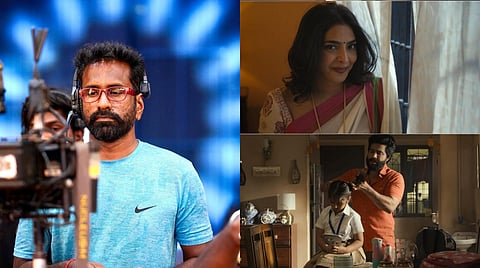

Cinema often asks its audience to suspend disbelief. A wrestling match on screen must feel visceral without causing real harm, a basketball game must carry the thrill of the sport without resembling a televised broadcast, and every emotion must seem effortless despite the countless technical decisions that shape it. "I need to make very specific visual choices to ensure the wrestling match in Gatta Kusthi 2 doesn't feel like any live match we watch on TV. I needed those creative aspects to make the film cinematic," says cinematographer KM Bhaskaran.
For Bhaskaran, films in his career have mostly demanded observation, research and planning—from studying basketball for his debut, Vallinam, to attending women's wrestling bouts for his latest, Gatta Kusthi 2. Having stepped into the sequel of a film with an already established visual language, Bhaskaran was tasked with retaining the familiarity of Gatta Kusthi while giving its follow-up a distinct identity. In conversation with Cinema Express, he reflects on filming sports for the big screen, the invisible craft of cinematography, and why he believes technicians should not be boxed into films of a certain scale. Edited excerpts:
How does the role of a cinematographer differ when it comes to sports films?
Most cinematographers are adapted to a certain kind of cinema, predominantly family-orientated or commercial films that focus on the actors. Sports films are different because not every sport is familiar to the audience.
When I did Vallinam, basketball was completely new to Tamil cinema audiences. I attended several live matches in Chennai to understand the sport before deciding how to frame it. Only after I understood how the ball moved was I able to design the visuals. Since the ball can't remain stationary for more than three seconds, my camera also had to stay in motion. We didn't choreograph the matches; the players played naturally, and we captured the game as it unfolded.
With Gatta Kusthi 2, the approach was different because wrestling had to be choreographed. The director wanted to show the protagonist's growth stage by stage, so every move had to reflect that progression.
Did you attend wrestling matches, especially women's matches, to understand the sport for Gatta Kusthi 2?
Absolutely. I attended several women's wrestling matches before the shoot. Since our central wrestler is a woman, I had to ensure she never felt uncomfortable or conscious while filming. I was extra careful about camera angles and also worked closely with the sports choreographers to understand how certain wrestling moves were executed so I could hide those tricks through the camera.
Some of my references were Sulthan, Dangal and Godha. Those films, along with watching live matches, helped me understand how to elevate a woman wrestler onscreen. It couldn't just feel like a raw fight—it needed drama.
Gatta Kusthi was shot by a different cinematographer. When you take over a sequel, what do you have to ensure for the sake of continuity?
The biggest challenge was that the first film already had a visual identity and a winning formula. I took up the sequel because I wanted to face that challenge. I had to justify it as a continuation while also establishing my own signature style.
The story is set five to six years after the original, so the characters' looks, costumes, lifestyle and surroundings have evolved. Much of the film unfolds inside a house filled with family emotions, and every emotion needed its own visual mood. I'm happy that both the director and Vishnuu Vishal felt the visuals were distinct from the first film.
Even during the wrestling sequences, I deliberately chose darker backgrounds so that the focus remained on the sportswomen. Otherwise, the matches would have looked like something you'd watch on television rather than in a film.
You worked with Desingh Periyasamy on Kannum Kannum Kollaiyadithal, but he has gone with Manoj Paramahamsa for STR50. How do you see that?
I was Desingh Periyasamy's first choice for STR50, and initially the production team was also happy with that decision. Eventually, the lead actor wanted to mount the film on a larger scale, and they went with Manoj Paramahamsa.
I don't understand why large-scale films are expected to go only with certain technicians. I am capable of doing every kind of film. If I'm given the opportunity, I can prove that too. As cinematographers, we adapt to every kind of cinema when we're given the chance.
