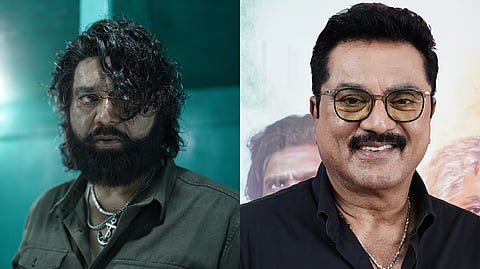

There were three interruptions during my interview with actor-filmmaker-politician Sarath Kumar. The first time, he had to make a call to talk to a family member. The second time, it was a call regarding his political endeavours. The third time, an actor had come to invite him to his daughter’s marriage. And each time, the veteran actor was kind enough to ask whether I wanted to continue the conversation or if he could take those calls. Sensing my incredulity about his rather grounded demeanour, Sarath Kumar says, “Not many perceive that I am quite a grounded person. Some people think I don’t speak well with them, or that I am too much of a tough guy. But to know me, people have to move with me, speak with me, and then they’ll know the real Sarath Kumar.”
For someone who is just a couple of years shy of completing 40 years as an actor, he has braved tough tidings and navigated through the vagaries of the industry with his head held high. “I don’t brood over defeats and be defeated by it,” says a pensive Sarath Kumar, adding, “I will look into the reasons, but I won’t be bowed down by it. I like my space and keeping things in balance. Why rejoice too much in victory, and sulk uncontrollably in defeat?” While he has definitely seen dizzying heights of success and the loneliness that accompanies failures, Sarath Kumar has never allowed his narrative to be set by anyone but him.
Be it his political battles or the various wars of words he has indulged in over time in the realm of cinema, he has never shied away from speaking his mind. And over the years, he has seen some friendships endure, and others fall through the cracks. Some dreams are realised, and some remain just that. “There cannot be permanent enemies, as such, especially in cinema. There can be competitiveness, and there should be an attempt to be better than the rest. What are the weapons in your armoury to equip yourself in this endeavour? That should be the focus, and not personal enmity. I never hit below the belt, and I will be disciplined in my approach. It is important that discipline and decorum are part of the conversation.”
But be it on social media or in the political arena, discipline and decorum seem to be relics of the past. One look at the kind of conversations that plague our timelines and our televisions, and one can’t even remember the time when things were… let’s say better. “If we weren’t this close to an election, I don’t think this level of mudslinging would have happened. Now, everybody will take a dig at the other person, and even your family can be dragged in. That’s how Tamil Nadu politics has been. But whoever it is, you have to face it and know how to handle it all. Of course, social media has taken it to a different level,” points out Sarath Kumar, who reiterates the need for discipline, especially with the future generations in consideration. “What are the future leaders that we want to create? Shouldn’t we leave behind intelligent leaders of substance, who are also empathetic and sympathetic towards society?”
With elections fast approaching and the alliances and allegiances shifting every other day, Sarath Kumar asserts that it is important to understand the real meaning of politics. “It is not just a game to gain more popularity and sit in a seat of power. Are you capable of handling that power? Do you know how to implement new policies? Can you do something for the people that the previous government hasn’t done? This is what people have to understand. A leader should be charismatic, dynamic, powerful, and a good samaritan taking care of the people of the State, and ensuring the economic growth of every individual. That is politics, and I’m sorry to say that many still do not understand what qualities a leader should have. It is the policy that counts, and not popularity.”
It is a rather refreshing change of pace when someone of Sarath Kumar’s stature is candid and unguarded in an interview. In these times where everything is ‘content’ and anything has the propensity to be viral, how can someone be, let’s say… real? “I like to call a spade a spade, and I expect the interviewer to be true to the profession. I have been a journalist, and I dislike how everything is now being twisted to create controversy. Why should news have ‘masala’? But yeah, I am not too worried about how it will be construed, since I don’t read the comments. I have to be truthful and say what comes from my heart. And if you don’t like it, then I can’t help it,” says a pragmatic Sarath Kumar, who is gearing up for the release of director Madhav Ramadas’ Aazhi, which features extensive scenes in choppy waters on a rickety boat. “I never felt seasick even when I was going into deep waters in a catamaran with my friends from Nochikuppam. Of course, it was a scary experience, but I trusted my friends from the fishing community. The sea has always been good and kind to me,” says the actor, pointing out that Aazhi isn’t your regular masala fare that is often dished out in Tamil cinema. “Aazhi is about how anything in extreme, even love… can create hatred. And I wanted to do something that is truly different, and not be part of another ‘regular’ film.”
Interestingly, Aazhi is going to clash with another not-so-regular film, Thaai Kizhavi, which stars Radikaa, another veteran of Tamil cinema, and his wife. While Sarath Kumar has clashed with his own films at the box office, this must have been a completely different ball game. “Is it the first time in Tamil cinema history where a real-life couple has their individual films, where they are playing the lead, releasing on the same day? In fact, when her film was announced for a February 20 release, I told team Aazhi that we could go ahead and release our film on February 27. But when Thaai Kizhavi was also pushed to the same date, we decided to let things flow as is. Both films are of different genres, and I’d like to say that Thaai Kizhavi is a very progressive film that celebrates women's empowerment and deals with it in a very funny yet emotional way.”
Interestingly, Sarath Kumar has been part of films that set records, and he was ahead of the curve on many trends. Everyone is now talking about pan-Indian films, but he was already playing pivotal roles in films of other industries, even while playing a hero in Tamil cinema. He has been part of bilinguals since the 1990s and has delivered superhits across multiple decades. But has he got his due in Tamil cinema? “Honestly, my efforts have not always been acknowledged, and I think that is the sadness of this industry,” says a pensive Sarath Kumar, who opens up about the lack of appreciation that stems from within the industry. “See, I rate Kamal Haasan as a great actor. But when people say he is the only actor, and don’t even share a word of appreciation about the others who are giving it their all, then that becomes the problem.”
Batting for the acknowledgment of others in the industry, the veteran actor points out that the achievements of many other actors are hardly highlighted and are brushed away as footnotes. “I am an underrated actor. But regardless of whether people write about me or not, I know that almost all my producers and distributors have made money on my films. This also means that people have liked my films, enjoyed my acting, and I’ve entertained them thoroughly. In fact, I was a minimum guarantee hero, and delivered more hits than even Rajinikanth or Kamal Haasan,” says a confident Sarath Kumar, who also points out that his statement isn’t coming from a place of regret at all. “People have to realise, right? That is why I wish films like Pachaikili Muthucharam, Aai, Arasu, Naatamai, and Suryavamsam are re-released. But I’m happy that I’m still very relevant. When I do a Kanchana or a Varisu or a Dude, I’m putting myself out there for a newer audience and a newer set of filmmakers who can give me the opportunity to play different characters. They can get fascinated by an actor called Sarath Kumar, and go back to see the kind of films I have done in the past,” says Sarath Kumar, who signs off by epitomising the idea of why being content doesn’t mean the thirst for excellence in art should be quenched. “When you see the name Sarath Kumar in a film, you are still intrigued now, right? My presence is still a USP… even after all these years.”
