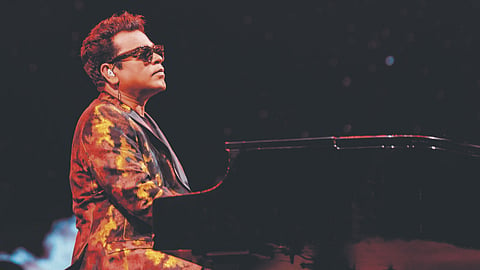

For a composer as prolific as AR Rahman, a premiere is always around the corner. The world concert premiere of the soundtrack of his directorial debut, Le Musk, took place in Canada recently. The “immersive film” premiered at Cannes XR, the Extended Reality section of the Cannes Film Festival, in 2022, and the soundtrack was released a few weeks ago. On October 5, the Vancouver Symphony Orchestra performed a selection from the soundtrack and some of his other works as part of the Vancouver International Film Festival. In an interview, Rahman said, “We've done big shows in Vancouver, but not to the mainstream community, so I thought it would be interesting.”
Le Musk is a 37-minute long multi-sensory film that provides viewers with the experience of virtual reality, motion, haptics and scent, which is central to the film. “It’s a huge undertaking and I was like a lone ranger working on it for the past 6-7 years,” says Rahman. Showcasing such a film is as challenging as producing it, with the need to distribute scent capsules and specialized chairs at screening venues. After realizing the chairs were expensive to source in the United States, they are now made in Coimbatore at a fraction of the cost, says Rahman, who wants the film to be financially viable for exhibitors and viewers: “It's all about how much you spend, and how much you get back. I wanted it to work well, rather than people blaming me for having invested so much, and I don't want to raise the tickets too much.” The scents are released from capsules that can be used thousands of times. “Each perfume can be sprayed so many times because it doesn't linger, it just lingers for four to five seconds and vanishes so that you move on with the story,” Rahman explains.
Over the next 3-4 months, Rahman is gearing up to release Le Musk in “Singapore, Malaysia, Thailand and maybe London and Dubai”. He says the film has been “upgraded, upmixed and upscaled” with the number of scents doubled to 12, the music going from stereo to Atmos, and the quality of the film bumped up from 4K to 6K using AI. Releasing it in India is also in the pipeline. “We’re speaking to a couple of people. My main intention was to do something for the rest of the world,” Rahman says and jokes, “Most Indians produce for Indians, and I felt like, let me stay away from competition and maybe do something that’s unique and doesn’t conflict with anyone.”
Rahman is confident enough in the appeal of this novel format that he is currently working on some more immersive films. Unlike Le Musk, which had a global cast and minimal Indian participation, Confessions “will tell unique stories from India, but in English." Rahman is also working on Rasa, which is based on classical Indian dance. “With Indian dance, you always sit 50 feet away and watch the dancer. Sometimes they show it on an LED screen but there’s so much happening at the face level, the expressions, and I felt like in VR it could be a completely different ball game.” Another project Rahman has teased is Secret Mountain, which could take viewers into the metaverse.
On a more conventional front, Rahman is working with Dave Stewart, co-founder of the British pop band Eurythmics, on the soundtrack of Ebony McQueen, a feature film inspired by Stewart’s own adolescent years, directed by Shekhar Kapur. “(Dave) is such a great visionary and I love his passion for innovation, music, and how he puts great things together,” says Rahman. Back home, he has his hands full with a clutch of Indian films, including the silent film, Gandhi Talks, Uff, the Hindi film Chhava, as well as Tamil films Kadhalikka Neramillai, Mani Ratnam’s Kamal Haasan-starrer Thug Life, and Prabhu Deva’s Moon Walk.
Thirty-two years after exploding on the national film music landscape with the fresh and evergreen score for Roja, Rahman now has bigger ambitions on the global stage. But, even as he reaches for new frontiers of art and technology, he feels that Indian film music is not making full use of the country’s collective classical music heritage. “Definitely, there’s a void, a depth of learning, in using South Indian or North Indian classical music, bringing them in a way that younger people can appreciate,” he says, lamenting the absence today of films like the 1980 Telugu classic Sankarabharanam and the 1985 Tamil hit Sindhu Bhairavi, both of which were steeped in Carnatic music. “It requires a lot of mastery in creating a tune in any classical raga,” Rahman says, and adds, “Some movies from Kerala, Maharashtra still have a lot of classical music, there’s a little bit that Mr (Sanjay Leela) Bhansali does, in his own way.” However, the script must have space for it, as he says: “You can’t have people singing in Switzerland and just put classical music there.” Here’s hoping Indian filmmakers take note – or a few, from this musician’s vast repertoire.
