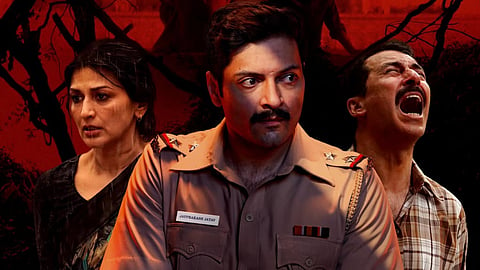

It doesn’t take too long before the instigating crime occurs in Raakh. Before we know it, the otherwise-languid Delhi police is at the scene of crime, still struggling to make sense of the macabre evidence on display. And just as we are getting immersed in the cold landscape, we are jolted into a moment of personal grief as someone pierces through the screen, rushing to see something for themselves that could break them apart. It’s a devastating moment that also captures the essence of the show — it’s this merging of the cold and distant and the humane that works as the central force of Raakh.
Directed by Prosit Roy, Raakh is not plot driven. The premise is fairly simple and straightforward — Saahil (Vivaan Sharma) and Suman (Divya Sharma), two teenage kids hailing from a reputed family, go missing. An up-and-coming cop Jayprakash aka JP (Ali Fazal), is assigned to the case. After his initial struggles to make headway, JP slowly digs deeper as he paves the path to nab the two killers, Babu (Akash Makhija) and Rajjo (Ramandeep Yadav).
Directed by: Prosit Roy
Written by: Sandeep Saket and Anusha Nandakumar
Cast: Ali Fazal, Sonali Bendre, Akash Makhija, Ramandeep Yadav, Dibyendu Bhattacharya, Aamir Bashir, Rakesh Bedi, Anshul Chauhan
Streaming on: Prime Video
It’s the structure where the show triumphs. Created by Sandeep Saket and Anusha Nandakumar, the show inverts the lens, going into the anatomy of a crime rather than the aftermath or the conventional chase-driven routine. We follow the recent journey of Babu and Rajjo as they become the monsters that an entire city has come to fear. The writers are interested in all their characters, particularly the antagonists, which makes Raakh such an unsettling yet gripping watch. We see the bricks that have built these men, little nuggets that inform us about who they truly are. With such a simple manoeuvring, the structure suddenly becomes unique, almost a miracle given a done-to-death nature of the genre.
It’s not like the tropes or plot devices are original, but Raakh draws your attention to the minutest of things that we otherwise take for granted, giving them a palpable form — for instance, the realisation that we, at any time, could be sharing the same space as the most ruthless person alive. It only helps that a huge chunk of the series unfolds at night. You are never let off the hook; a sense of mystery always prevails on the screen. There is something out there, out of your reach, yet might leap at you any moment. (Some of the episodes too are curiously named after stars, something invisible in daytime but inescapable at night). The ‘70s Delhi feels like a ghost town at times. (Incredible work by cinematographer Saumyananda Sahi). After a point, the use of silence becomes a style in itself. The minimalistic sound design, and every quiet moment embedded in it, works in the show’s favour, creating an eerie atmosphere.
A lot of the tension also comes from the unpredictability of its two antagonists, and from the sheer nature of violence itself. There is a constant sense of terror even during the most mundane of moments. You are never at ease when Babu or Rajjo are interacting with anyone else, including their family members. (A scene with Rajjo and his niece assumes the most unsettling shape, before choosing to pull the brakes). There is an ugliness even to their love-making — When Babu corners his partner Meena (Namita Krishnamurthy), you can’t help but feel creeped out by the aggression.
The dynamics between Babu and Rajjo is another thing of brilliance. Rajjo is consistently emasculated at the hands of Babu, which becomes his trigger towards dehumanisation. It’s an interesting observation on how masculinity and violence often breed themselves. At many points towards the end, we see Babu and Rajjo in a scuffle — one could even argue it’s like watching two fraying ends of patriarchy devouring each other. The show arguably belongs to Akash Makhija and Ramandeep Yadav who play Babu and Rajjo, respectively, with a chilling effect.
Equally deserving of the acting accolades is Ali Fazal as JP. Playing an earnest underdog who is struggling to be heard, Ali proves to be a great fit for the role, hitting all the right notes, capturing JP’s slowly-pent up angst and determination. The ensemble cast is consistently brilliant, be it Anshul Chauhan as Nisar, a pragmatic yet empathetic journalist or Aamir Bashir as the mourning father figure who struggles to pick up the pieces. Special mention to Divya Sharma, who delivers one of the most emotionally devastating performances of recent times despite a very limited screen-time.
As the show goes deeper into its second act, the narrative too continues to go inwards, while never losing track of the chase at hand. This interest is not perverse in any manner. The curiosity to explore these people and their struggles to exorcise their inner demons is piercing, something which reflects in how a minor character like Pyaare Mohan (A brilliant Mukund Pal) comes out as a fully fleshed, wounded human being, completely worth empathising for.
Raakh is also an introspection of a city that’s growing more violent with each day. While making minimal use of Delhi as a visual backdrop (makers avoid touristy visuals of the city), director Prosit Roy captures the indifference of a city that is drifting away from decency and civilisation. Mona’s (Sonali Bendre, channeling a rare vulnerability) denial rings true, because the series paints the pictures of a once-upon calmer city, where any stroke of brutality would seem implausible. This altering between an idyllic city and a ghost town is where the series derives its sense of horror and other-worldliness.
In one of the few missteps, Raakh attempts to make a half-hearted commentary on current times, as JP links the individual apathy to the society’s collective ability to think straight. The makers also tread along the themes centred on caste-dynamics with excessive caution. JP’s identity as a Dalit is significantly alluded to, but never openly addressed. There is also a lot of poignance in the way JP’s father (Rakesh Bedi in a refreshingly subdued appearance after Dhurandhar) feels the constant need to please others, which probably comes from years of relegated to sidelines, and yet the character needed a little more exploration. However, these are only minor hassles in what is otherwise exceptional piece of long-form artistry.
The season finale is another tricky masterstroke of its own kind. After many episodes that explore the before and after, we finally get to see what happened that evening where it all began — and it’s exactly what we needed to see after a series of relentlessly unsettling episodes. When surrounded by such violence and darkness, we often forget to remember the light — that’s precisely what Raakh reminds us of in its last leg, lending heart-wrenching dignity to both Suman and Saahil.
The final episode is also a remarkable evidence of the writers’ control on their narrative, and their understanding of crafting a gruesome narrative that never goes overboard. While there is ample depiction of graphic violence throughout, the makers also show resistance at many moments, depriving us from visuals which only adds to the impact. At one point, we see a battered kid’s dangling feet, which sometimes shakes you more than the image of a bloodied head could have done, perhaps. In one of the most haunting moments in Raakh, a character simply smiles and asks for matchsticks, and we cut away from the scene — just the anticipation of horror on the other face is enough. Looking at fire could be an intensely scary experience, but perhaps not a necessity to conjure terror — sometimes, it’s enough to look at the ashes, to imagine what the fire would have been like.
Raakh is a brilliant series that respects its audience and their imagination, the one that captures the terror of both fire and the ashes that remain behind.
