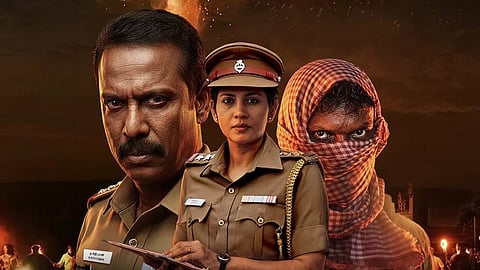

Thadayam Review:
The Zee5 web series Thadayam, marking Samuthirakani's debut in the format, ends in a spectacularly dissonant manner. It forces an examination of the ideals presented. Some ideals invite doubt on whether they qualify as one, and others, whether the makers believed in them. Thadayam, in its condemnation of prison torture and exploration of the roots of brutal crimes, has failed to convey its sincerity.
The series begins with a horrific murder taking place in Tiruvallur's Podaturpet, bordering Andhra Pradesh. A few scenes later, SI Athiyaman (Samuthirakani) is being introduced as an indolent cop who spends most of his duty time at a nearby tea shop. He views policing as a thankless and cut-throat profession, and applies for voluntary retirement with one month of service remaining. Thadayam bears Athiyaman's story and how this killing spurs him to action once again.
Right through the visuals, the makers are confused whether to scare people or evoke sympathy for the killers. The series takes the liberty of capturing the gory murder scenes with disturbing details like the density of blood and savage lacerations. There are at least five to six such murders in the series. There aren't many scenes, except for a lacklustre one in the flashback, that suggest that the killers were once victims of the system, and they command our compassion. The lack of proper placement and the jarring tonal shift did not help with that. The killers to crusaders for justice narrative shift would have had more poise if not for the magnitude of gore involved in the first couple of episodes.
The trouble with the characterisation, especially of the antagonists, seems to be a spillover effect of the writers' confusion between crafting a work that hits out against the skewed justice system and forging a gripping serial killer thriller. While remorse in a killer would drain the tension, the focus should have at least occasionally shifted towards their attachment to their families and the monsters they became due to wounds inflicted on them. Similarly, the newly-appointed inspector, Lakshmi (an underutilised Sshivada), merely acts as an expositional prop that gives a full picture of Athiyaman and why he has become what he is. However, Athiyaman comes across as an interesting character, evoking a curiosity about him. His nonchalance as a disillusioned cop wanting to discard his khaki is one of the good things to happen to Thadayam.
Cast: Samuthirakani, Sshivada, Munnar Ramesh
Director: Navinkumar Palanivel
Streaming platform: Zee5
Tiruvallur has this haunting aura to it, the way it was captured in the series. The narrow lanes and a porous border between Tamil Nadu and Andhra Pradesh, enabling lawbreakers to commit a crime and escape, give an eerie feeling. It was more so as the series is set in the 90s, a period before the information and communication boom. Unfortunately, none of these good things stay or make this messy narrative any better.
The resolution the series arrives at is far removed from lived experience. It stands on the shaky ground of too many cinematic liberties. There is a line where Athiyaman says, with pity for the killers, that they began murdering people for revenge, and it has slowly turned into an addiction that couldn't be stopped, followed by a martyr-like encounter scene. The expectation to instantaneously understand them and shed a tear when they fall to the ground was a criminally contrived creative choice that even makes us overlook the extrajudicial killing. As an extension, Athiyaman, who has lost all hope of a fair system, suddenly is infused with hope that he can fight back the rotten apples in the department after solving a case and not even being credited for it, was laughable to say the least.
Thadayam operates as a whydunnit and doesn't waste much time in revealing its killer. The issue primarily lies in the idea of fusing a serial killer story with a vigilante story, rendering both ineffective. Though the motive behind these killings is justified, empathy wears thin when the act veers away from vengeance and morphs into a mad killing spree. The series suffers from humanising the serial killers to the point of dehumanising their victims. It is not just that, it also throws the sensitive issue of prison violence into the mix and unintentionally makes it look innocuous and a necessary evil to eliminate those who disturb society. If at all, the makers of the series have passed on to us something they felt, it was the thematic and ethical dilemma whether to call out or condone extrajudicial killings and empathise with or dread about the serial killers.
