
For nearly nine years, a Malayalam female actor has lived with the same question: will those who brutalised her ever be held to account? On Monday, December 8, as the Principal District and Sessions Court in Ernakulam prepares to pronounce its verdict, she stands at the end of a long, exhausting and relentlessly public legal journey.
This is how the case unfolded, step by step, and how a single crime exposed deep fault lines within the entire Malayalam film industry.
February 17, 2017: A crime in a moving car
On the night of February 17, 2017, while travelling to Kochi for work, a leading woman actor was allegedly abducted and sexually assaulted inside a moving car for nearly two hours. The assault was filmed in several clips by the main accused, Sunil Kumar, widely known as Pulsar Suni.
Unlike countless survivors who are quietly advised to withdraw complaints or “move on”, she went to the police the very next day and filed a First Information Report. Within 48 hours, three of the accused were arrested. Suni and the remaining men were taken into custody soon after. At that moment, it appeared to be a horrific but contained crime. No one yet fully grasped how far it would travel.
April 2017: The first chargesheet, and the first unease
In April, the police filed their first chargesheet, naming Pulsar Suni and six others. There was no formal reference to a larger conspiracy or a powerful hand behind the crime. The case was presented as the act of a criminal gang. Outside the courtroom, however, something had begun to shift. A woman actor had been attacked in public, and an industry that had long relied on silence suddenly found itself under scrutiny.
May to June 2017: Women speak, and an unexpected letter
In May, a group of women from the Malayalam film industry decided that silence was no longer an option. They formed the Women in Cinema Collective (WCC) to stand by the survivor and to speak openly about gender, power and safety at work. They met Chief Minister Pinarayi Vijayan, seeking not only justice in this case, but broader reform in an industry that had offered women little protection.
Then, in June, came the first major twist. A letter allegedly written by Pulsar Suni surfaced, addressed to actor Dileep. In it, Suni suggested that he had not “betrayed” Dileep and demanded money. Overnight, the idea that the crime may have been planned by someone influential began to feel less like speculation.
Dileep went on television to deny the allegations. In the process, he attempted to cast doubt on the survivor herself, claiming she had been friendly with Suni. The police remained unconvinced. A Special Investigation Team questioned Dileep and his close associate, director Nadirshah, for several hours. The case was no longer only about what had happened inside a car. It had begun to expose the informal power networks of Malayalam cinema.
July 2017: A superstar in custody and formation of Hema Committee
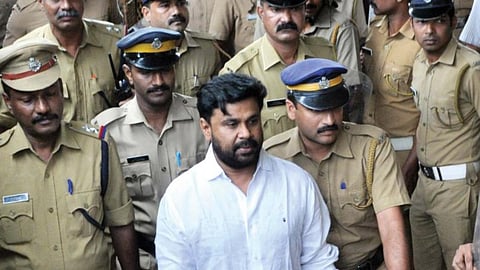
On July 10, 2017, the Special Investigation Team arrested Dileep. For an industry that had long celebrated him as the Janapriya Nayakan, the beloved hero of the masses, the moment was profoundly unsettling. He was not only a bankable star but also a figure of institutional power, serving as a senior office-bearer of the Association of Malayalam Movie Artistes (AMMA), someone used to influence, loyalty and protection.
Public pressure mounted rapidly. AMMA expelled him, and other major industry bodies followed, quickly distancing themselves from the accused. Outside the courts, fan battles played out noisily across television debates and social media. Inside, the case began to assume a gravity that went far beyond individual culpability.
Around the same time, the State government took its first formal step towards examining the wider rot the crime had exposed. In July 2017, following representations from the newly formed Women in Cinema Collective, the Kerala government announced an advisory committee to study sexual violence, discrimination and inequality faced by women in the Malayalam film industry. Headed by former High Court judge Justice K. Hema, with actor Sarada and former IAS officer K B Vatsalakumari as members, the committee signalled an official acknowledgement that the assault was not an isolated incident but part of a larger structural problem.
September to November 2017: Polarisation, bail and a widening case
By September, public opinion had hardened into opposing camps. The release of Dileep’s film Ramaleela became a flashpoint. One side called for a boycott, arguing that watching the film amounted to turning away from the survivor. The other maintained that cinema and alleged crimes should be viewed separately and flocked to theatres.
In response to the visible support extended to Dileep by sections of the industry, the Women in Cinema Collective launched the Avalkkoppam (#WithHer) campaign, a public assertion of solidarity with the survivor and a refusal to let the narrative drift back to business as usual.
After around 85 days in judicial custody, Dileep was granted bail on October 3. The legal net, however, continued to widen. In November, the police filed a second and much more detailed chargesheet, naming twelve accused in all and listing Dileep as the eighth.
More than fifty witnesses from the film industry were cited. Among them was his former wife, actor Manju Warrier, who told investigators that the survivor had informed her about Dileep’s relationship with actor Kavya Madhavan. The prosecution later described this disclosure as the emotional trigger for Dileep’s alleged anger towards the woman who would eventually become the target of the crime.
2018: Battling over evidence and control
By 2018, the case had turned into a prolonged legal tug of war. The key battles were over who would investigate the matter further and who would have access to the most sensitive evidence of all: the assault footage. Dileep filed multiple petitions seeking a copy of the video, arguing that he needed it to prepare his defence. The lower courts and the High Court rejected his requests. He then moved to the Supreme Court. The State opposed him strongly, warning that once the footage left judicial custody, the risk of it being leaked was real, and that any such leak would cause irreparable harm to the survivor.
At the same time, AMMA, now headed by Mohanlal, briefly moved to readmit Dileep. The decision triggered widespread outrage. The survivor and three members of the Women in Cinema Collective resigned from the organisation in protest. Amid mounting criticism, Dileep declined to rejoin. He also sought to remove the case from the Kerala Police by demanding a CBI probe. The High Court rejected that plea in December.
2019: A woman judge and the Hema Committee Report
At the survivor’s request, a woman judge was appointed to hear the case in 2019. Sessions Judge Honey M Varghese took charge, and the proceedings were ordered to be held in camera to protect the survivor’s privacy.
That year also saw the legal battle over the assault footage reach a decisive point. In November, the Supreme Court ruled that Dileep had already been granted sufficient access to the visuals under court supervision and that there was no legal basis to hand him a copy. Dileep then sought to have the charges dropped altogether, questioning the authenticity of the footage, but the trial court rejected the plea.
While the criminal trial crept forward, another process was quietly concluding in the background. In December 2019, the Justice K Hema Committee submitted its findings to Chief Minister Pinarayi Vijayan. Running close to 300 pages, the report was accompanied by documents, audio and video material detailing sexual harassment, discrimination and systemic exploitation faced by women in the Malayalam film industry.
Although the report remained sealed from public view, its submission marked an important shift: the assault case was no longer seen merely as an isolated crime but as part of a larger, officially documented pattern of abuse.
2020: The trial starts, and support fades
Charges were framed against all the accused in January 2020, and the trial began at the end of the month, almost three years after the assault. What followed was disquieting. One by one, several witnesses from the film industry turned hostile. Actors who had earlier spoken about Dileep’s anger towards the survivor now stepped back from their statements. What had once looked like firm testimony began to dissolve under oath.
The survivor approached the High Court seeking the transfer of the trial, alleging a hostile atmosphere. The court declined. Shortly after, Special Public Prosecutor A Suresan resigned, publicly criticising the conduct of the proceedings. The sense that the survivor was being left to fend for herself grew stronger.
2021: New voices, painful losses
In December 2021, the case took yet another dramatic turn. Film director Balachandra Kumar came forward with explosive allegations. He claimed he had seen Pulsar Suni at Dileep’s residence and that the assault footage had been watched there by Dileep and others. His statements reopened the investigation and led to a separate case accusing Dileep of conspiring to harm police officers who had investigated the assault.
Around the same time, former Thrikkakara MLA P T Thomas, one of the first people to support the survivor in the immediate aftermath of the assault, died. His widow, Uma Thomas [current MLA of Thrikkakara], later said he had been under severe pressure not to testify but had resolved to say nothing beyond the truth. Another pillar of quiet support was gone.
2022 to 2023: Leaks, recordings and institutional failure
In early 2022, audio clips believed to involve Dileep and members of his inner circle surfaced. In them, a male voice spoke about “dealing with” investigating officers. The Crime Branch registered a case alleging a conspiracy to intimidate or harm the police team and searched Dileep’s residence. A hacker, Sai Shankar, later turned approver and stated that he had assisted in concealing or deleting data from devices linked to Dileep’s camp.
More disturbing revelations followed. Forensic reports showed that the memory card containing the assault footage had been accessed multiple times while in court custody. A magistrate and court staff had viewed it. The digital fingerprint of the evidence had changed. The survivor wrote to the Supreme Court and the Chief Minister, saying her most intimate trauma no longer appeared to be under anyone’s control.
In response, the Kerala High Court ordered an inquiry and later issued strong guidelines on handling sexually explicit digital evidence. The court bluntly acknowledged that the system had failed the survivor and that the psychological damage caused was beyond measure.
2024: The Hema Committee forces a reckoning
In August 2024, years after it was first submitted, the Kerala government released a redacted version of the Justice K Hema Committee report. Formed in the wake of the assault case, the report laid bare years of exploitation, coercion and abuse of power in Malayalam cinema.
The findings triggered a wave of fresh allegations. Dozens of women came forward. Over 30 FIRs were registered. Prominent figures, including Mukesh, Siddique and Baburaj, faced accusations. AMMA’s entire executive committee, including Mohanlal, resigned, citing moral responsibility.
Back in the assault case, a Sessions Court inquiry confirmed that the assault footage had indeed been accessed illegally by three individuals. The survivor approached the High Court seeking a Special Investigation Team probe, arguing that her right to privacy had been violated repeatedly. In December, Balachandra Kumar died following a kidney-related illness. Yet another crucial witness was lost before judgment day.
2025: Waiting for closure
The trial concluded in February 2025, though hearings continued for months to address clarifications and arguments. In all, 261 witnesses were examined, and hundreds of documents were placed before the court. On November 25, the trial court announced that its verdict would be delivered on December 8.
For the survivor, this date carries the weight of nine years of endurance. She has lived through the assault, relentless public scrutiny, the erosion of professional support and the unsettling realisation that even the justice system failed to safeguard her dignity at times.
Whatever the judgment holds, the case has already reshaped Malayalam cinema and how Kerala talks about sexual violence and power. Nearly nine years after that night on a moving road, a woman who refused to be silent waits to see whether the law will finally stand with her, or whether the fight must continue yet again.
