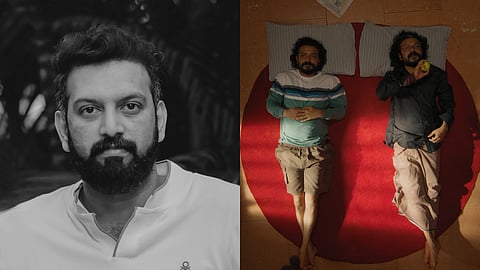

Ramees spent years chasing the chance to tell a story as a screenwriter. Projects never took off, plans fell apart, and even his recently released directorial debut Orijinal had to be paused for a while before it could resume filming. It’s ironic, then, that the film revolves around an aspiring filmmaker who bypasses the struggle by borrowing stories from the future. Starring Sreenath Bhasi in a dual role, the story follows Rijin Yusuf, whose life changes when his older self arrives through a time-travelling watch. The two use their knowledge of films yet to be made to build their careers. Beneath the playful premise lies a harder question: what is success worth when the work that earns you recognition is not your own?
Orijinal did not begin as a time-travel story. A friend's friend brought Ramees an idea for a dark thriller, and an element stayed with him. “I was reminded of the story of Aladdin that I loved as a child, where he falls asleep in one place and wakes up in a palace. There was something magical about that idea, and I wanted to bring in a similar sense of wonder,” Ramees recalls.
He began writing the screenplay in 2023, drawing on his admiration for Fight Club to explore the relationship between two versions of the same person. “I didn't want it to be about an alter ego. These are the same person at different stages of life. I was interested in how that relationship would develop and what they would have to say to each other,” he explains.
Ramees was more interested in that encounter than in the mechanics of time travel, so the watch comes with no elaborate explanation. “We aren't telling the story of the person who invented the watch. We're telling the story of the person who gets hold of it,” he notes.
Placing the story in the film industry allowed Ramees to examine the uneasy relationship between ambition and integrity. “Rijin initially wants to make films for the applause. He is more excited about the recognition than the actual process of making cinema. That's how he begins, but eventually, he has to realise that the satisfaction he is looking for has to come from within rather than from outside,” Ramees reflects.
The filmmaker sees plagiarism as more than a question of who owns a story. “When you achieve something by stealing someone else's work, you might have the money, recognition and everything that comes with success, but you won't necessarily have peace or happiness. There will always be the fear that you might get caught,” he says.
The first half of Orijinal finds its energy in the two Rijins working around the complications of their scheme. The film grows morally complex as the consequences emerge, although some later developments lack the ease of the earlier passages. Ramees acknowledges that the second half was harder to develop. “I had already worked out much of the first half, but the second half took a long time to develop,” he admits.

Initially, Ramees had hoped for a bigger star for Orijinal. Several projects he had been associated with, including one involving Vikram and Anwar Rasheed, failed to materialise. “At that point, I wanted to make a film as soon as possible. I didn't want to keep waiting for a long time for the right dates or the opportunity to work with a particular star,” he remembers.
As Orijinal's protagonist, Sreenath Bhasi had to convey the distance between a hopeful younger Rijin and an older one burdened by the possibility of losing everything he has gained. “With Bhasi, there were moments when the performance went beyond what we had imagined. He brought a lot of confidence to the role,” he says. Getting both Rijins into one frame brought its own difficulties as well. “We didn't have a motion-control device that could precisely reproduce the camera movement, so we had to do a lot of it manually, using an old-school method,” Ramees explains.
Directing was not part of his original plan either. Another director was initially attached to Orijinal, but when that fell through, Ramees stepped in. “I'm someone who gets tense quite easily, and I didn't think I would enjoy dealing with the pressure that comes with directing a film,” he admits. Years of working around cinema had nevertheless prepared him, including a long association with Anwar Rasheed and work as an associate scriptwriter with Amal Neerad.
Apart from the Vikram-Anwar Rasheed project, another unrealised venture is Variyamkunnan, announced in 2020 with Aashiq Abu and Prithviraj Sukumaran. The period film courted multiple controversies following its announcement, and both the director and actor later withdrew from the project, leaving its future uncertain. Ramees, who was initially associated with it as one of the screenwriters, is unsure it can be revived. “I've been thinking about it, but I honestly don't know if it will happen,” he says.
For all the setbacks and years of stalled projects, nothing had prepared Ramees for the unexpected call that came two days after Orijinal opened. Mammootty, with a reputation for making room for first-time filmmakers, wanted to watch the film. An invitation followed to the sets of the veteran actor’s upcoming action entertainer Mela, where Ramees spent nearly an hour chatting and laughing with him, leaving with a bag full of memories.
Mammootty promised he would watch the film on a day free of shooting commitments. “Honestly, I still haven’t completely processed what happened. For someone who has grown up watching him on screen, hearing that Mammookka wanted to watch my film was surreal,” says Ramees, adding that it was the first time he had met Mammootty. “I had only seen him from a distance at a few film sets before, so I was really excited and nervous about meeting him in person. As a debutant director, you dream of your work being noticed, but when someone like Mammookka takes an interest in your work, it means everything. After all the difficulties it took to bring Orijinal to theatres, this was the most satisfying moment that made the journey feel worthwhile,” he signs off, still sounding stunned.