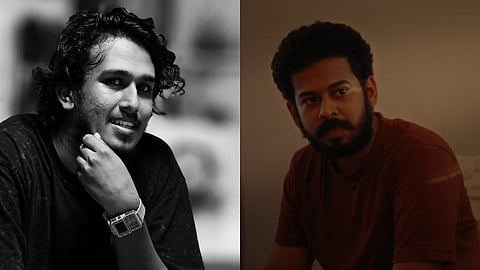

An aspiring filmmaker's inability to leave a mystery alone drives Sreehari Haridas's feature debut, Ajayante Maranam: Oru Case Study (A Case Study on Ajayan’s Demise). Aryan sets out to understand why Ajayan, a young, introverted and married corporate professional, died by suicide, speaking to the people from his life in the hope of piecing together what led him there. What begins as an investigation becomes an uncomfortable exercise in looking at the world around us, and perhaps at our own complicity in it.
Premiering on November 26 at the 57th International Film Festival of India (IFFI) as one of two Malayalam entries in the Indian Panorama - New Horizons section, the film draws on an incident at a Palakkad school. “It originated from an incident that happened at a school where I had studied, where a student died by suicide last year over alleged harassment from the school management, which affected me deeply on a personal level,” Sreehari says. Rather than approach the subject through the incident alone, he found himself thinking about what happens to someone who cannot articulate their distress. “That incident made me think about making a film centred on a person's mental health,” he adds.

For Sreehari, the film's concerns go beyond institutional accountability and toxic parenting to something more fundamental: our willingness to listen. “I want to talk about an individual's mental health. The film includes a statement about how people need to listen to one another. We are living in a time when that simple act of listening is becoming increasingly rare,” he stresses. “People should be willing to listen to others, especially when someone is trying to communicate their distress.”
Mental health and therapy are motifs in the narrative rather than subjects introduced for effect. The premiere's timing adds significance, as November is Men's Mental Health Awareness Month. “It feels particularly meaningful that our film is being screened at IFFI during this month. I hope the film contributes to these conversations in some way,” he reflects.
Though the story unfolds largely through Aryan's eyes, Ajayan remains its most important presence. “Aryan and Ajayan are two parallel characters. One is an extrovert, and the other is an introvert,” he observes. “Aryan is rarely seen without an object in hand, while Ajayan is withdrawn, though the two react similarly when panicked. That is how I connected these two characters.”
The investigative structure also recalls VK Pavithran-MT Vasudevan Nair's 1989 classic mystery Utharam, in which Mammootty's Balu investigates a woman's death. “That particular character and the investigative journey were inspirations for Aryan and Ajayan in our film. Utharam is one of my favourite films, and I see Ajayante Maranam... as our tribute to it,” he says.
The mockumentary format was as much practical as stylistic, along with inspirations from TV Chandran’s Kadhavasheshan. With the production largely financed by its members' savings, Sreehari had to consider what was achievable, and Krishand's Aavasavyuham and Jithin Issac Thomas's Patth also influenced his screenplay. “I believe a story can be narrated minimally, provided the content is good. When I started writing the screenplay, I felt that presenting the story as a mockumentary would be particularly useful,” he notes.
Getting those interview bites to feel like actual conversations, however, was another matter. Sreehari experimented with scripted and relatively spontaneous performances, depending on the people involved. Devaraj and Nandagopan, who play Aryan and Ajayan, bring considerable intensity to their respective roles. Sreehari had watched their work through their content creation collective Eureka Stories, but was initially apprehensive about approaching them, particularly because Ajayan has relatively little screen time despite being central to the film. “I was actually quite nervous about narrating the story to Nandhagopan and Devaraj,” he admits. Both came on board after a nearly 90-minute narration. The film also features compelling performances from theatre artist Arya Mini Kishan, social media influencer Joe Joseph and Devaa Vinod, among others.
For Sreehari and his core team, Ajayante Maranam… is the result of years spent figuring out filmmaking on their own, often in between their regular jobs. “I have only had experience making short films. I learnt how to approach a feature film by watching films and interviews with filmmakers. I have formally studied screenplay writing, but the actual process of directing a feature film is something I had to learn along the way,” he notes.
The IFFI selection pleasantly surprised a team that had submitted the film before colour grading was complete. “I am very happy that the film has found a place there, particularly in the New Horizons section,” he says, adding, “We pooled our resources and savings to make this film because we genuinely wanted to tell this story, and we hope Ajayante Maranam… works with the audience.”