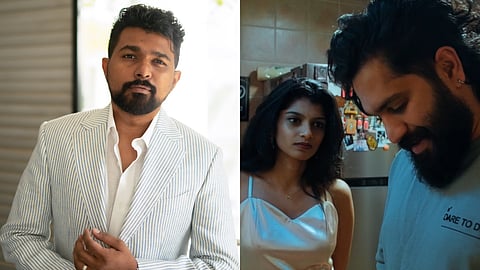

The recently released Malayalam short film Blue Lily, now streaming on YouTube, begins like a tender romance. Arjun meets Lakshmi on a seemingly ordinary night, their relationship unfolding through fleeting moments of warmth, playful affection, and the excitement of married life. But beneath the tenderness lies a growing sense of discomfort. Through fragments from the couple’s life together, the film gradually explores the psychological trauma of domestic violence and the subtle ways obsessive behaviour can disguise itself as love before spiralling into something far more disturbing.
For debutant filmmaker Gautam Raveendran, the response to the 30-minute short film has far exceeded his expectations. “When we shot the short film, I had planned only a theatre premiere. But after the first screening, people started asking us to send it to festivals,” he says. Blue Lily has now been selected to screen at around 10 short film festivals. Although the entire shoot was in Dubai, Gautam says the team consciously avoided making the location visually identifiable. “We wanted to show that this story could happen anywhere,” he explains.

Interestingly, Blue Lily began not with a story, but with a title that emerged during casual conversations with friends. Gautam's wife, Mini Nair, who also produced the film, became one of the earliest supporters of the project. Around the same time, Gautam met actor Shruthi Rajanikanth, who plays Lakshmi, through a mutual friend in Dubai, and immediately felt she was right for the role. “I personally felt she would be the right face for the character,” he says.
The male lead, Anrudh Balu, who plays Arjun, joined the project through another friend. Gautam recalls being impressed by the actor’s theatre background. “When I met Anrudh, he was this very excited person who genuinely loved acting,” he says. “He had that shade in him, someone who could easily pull off a negative shade.”
Anrudh also introduced the team to his wife and screenwriter, Charvi Ram Mohan, whose contributions were central to shaping the film's emotional perspective. According to Gautam, Charvi’s worldview and understanding of relationships helped the film gain a stronger female perspective. “The biggest positive about Charvi is that she's a very open-minded person. So, it became very easy for her to translate my ideas into a female perspective in the writing,” he reflects.
One of the biggest creative discussions during production centered on how to portray the violence onscreen. While Blue Lily primarily builds psychological tension, its climax turns physically disturbing. Gautam admits the team spent considerable time debating how explicit it should be. “Should we show blood? Should we tone it down? Or should we show it as it is?” he recalls. “For me, I like showing violence as it is, but not for the sake of violence. Only if it is right for the story and if it conveys something meaningful.”
Even then, the team was worried about audience reactions. “The biggest concern was how people would take it,” he says. “But in my head, I kept feeling that the scene was correct. So, I went ahead with that gut feeling.” The story was inspired by incidents Gautam had witnessed. “In my personal experience, in the lives of two or three friends, there have been incidents similar to this, though not to this extent,” he says. “They delayed taking action and went through these situations for a long period of time.”
Though Gautam had previously experimented with smaller short films, he considers Blue Lily his first proper filmmaking experience. “This was the first time I followed a proper cinema process, proper pre-production, scripting, planning shots, call sheets, everything,” he says. Gautam works as a cabin crew member and part-time customer service trainer at an airline company in Dubai. But filmmaking remains the larger ambition. “The idea is for all of us to enter the cinema together,” he says.